
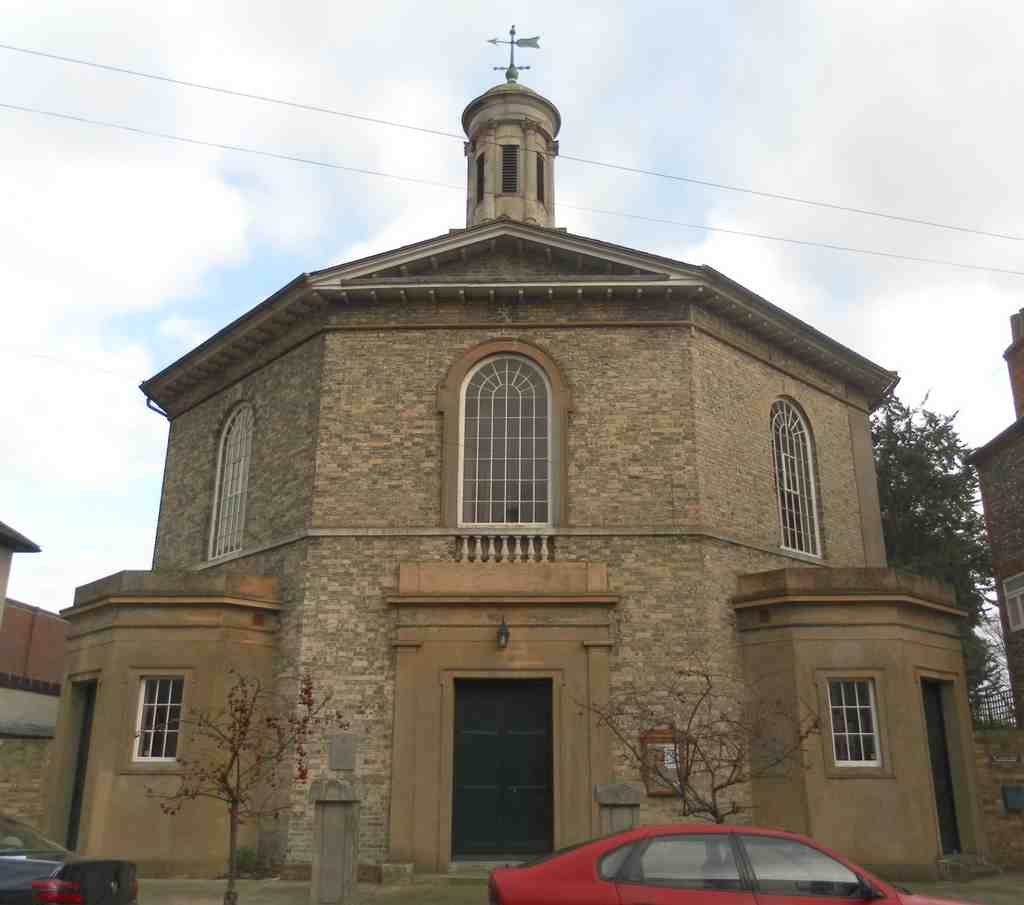
To spot St John the Evangelist's Church, look for an unusual octagonal building made of pale, yellowish-white brick, with tall arched windows and a curious small dome on top, right ahead of you.
Welcome, wanderer, to one of Chichester’s most fascinating landmarks, where stories echo off these yellow-white brick walls like a good joke in a quiet library! Imagine it’s the year 1812, and this part of the city, called New Town, is bustling with change-yet oddly, there’s not an Anglican church in sight. The people here decide they want a new place to worship, but rather than waiting for the lottery (or divine intervention), they put their coins together and start a unique fundraising scheme. Instead of buying a ticket to paradise, you could buy your very own seat in church! That’s right, invest in a pew, and you’re guaranteed the best view for every Sunday sermon.
Behind that plain, yet elegant stone doorway, you’d find a design unlike anything in Chichester. The man in charge? A young architect named James Elmes, though he was so unwell he handed most of the work off to his apprentice, John Haviland, who would later become a famous prison designer-let’s hope he didn’t get too inspired by his time here! The building that rose here was a bold response to the times: an elongated octagon in the Classical style, sprinkled with Greek Revival touches, and built to showcase the ideals of the Evangelical wing of the Church of England. Forget ornate altars and gilded screens-this church was all about the sermon. They installed an enormous three-decker pulpit front and centre, so high and proud it nearly blocked out the altar, which was said to resemble a kitchen table more than a holy relic.
Step inside (use your imagination!) and picture the sunlight streaming through tall, round-arched windows. The galleries, made from American birch, sweep around the room in a rectangle, held aloft on columns shaped like ancient Egyptian obelisks. Climb those side staircases, and you’ll have a bird’s-eye view of everything-if you held the right ticket, of course. In those days, the rich could buy or even rent out pews, some visitors had to pay an entrance fee, but there was a handful of free seats kept aside for the poor. Men and women even had separate entrances and seating-talk about a strict guest list!
And let’s not forget the odd sight at the very top: a mini ancient Greek monument, dangling like a cherry atop the building, with its own little bell forged in London the year the church opened-1813. Whenever it rang out, all of Chichester would know it was time to gather.
Life here was never dull. The pulpit-considered the finest three-decker in Sussex-became the beating heart of the church. On the lowest level, the church clerk would respond to prayers; above him, the vicar would lead the service; and high atop, almost as if reaching for heaven, the preacher would boom out the sermon to all, watched over by a sea of attentive faces. The arrangement wasn’t to everyone’s taste, especially those who favored the fancier High church style that swept through the country later. Somehow, St John’s survived the fashion battles and the enthusiastic renovators of later generations-some say it’s a mystery it’s still here in its original form at all.
But what of now? Well, the sermons stopped in 1973 when the church was declared redundant, but don’t let the name fool you-the building sprang back to life as a concert and festival hall. Every summer, the space fills with music and laughter, especially during the vibrant Chichester Festivities, keeping the spirit of this place very much alive. In 1950, the church earned a Grade I listing, cementing its place in history.
So next time you pass by, picture not just a church, but a stage set for two centuries of drama, debate, song, and change. And if you ever long to hear echoes of the past, listen closely-perhaps you’ll catch the gentle clang of the old bell, or the memory of a preacher’s voice rising above the city’s ancient stones. On to our next stop!




