
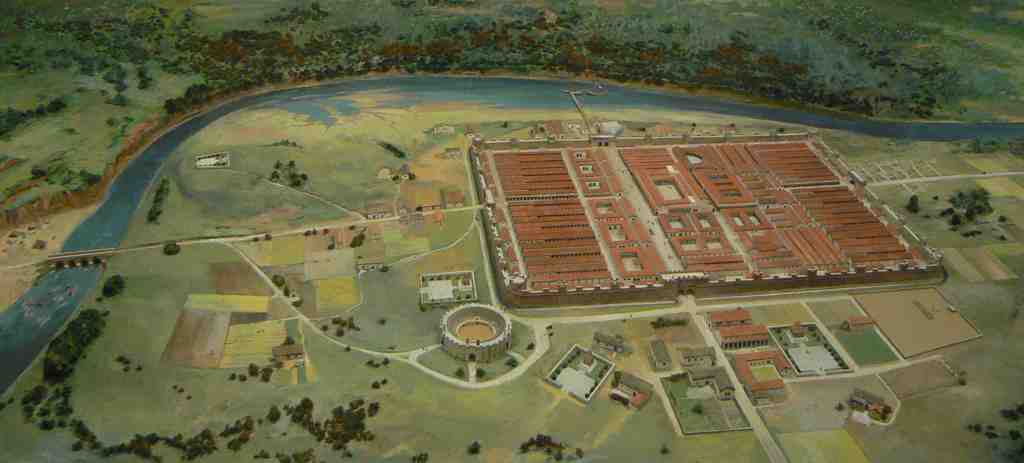
To spot Deva Victrix, look ahead for a large, rectangular shape outlined by stone ramparts, set near a bend in the river, with red-roofed buildings packed tightly within-imagine a stone-walled town with roads meeting at gates in the cardinal directions.
Welcome to ancient Deva Victrix! You’re standing on ground so rich with Roman history that if these stones could talk, they’d probably greet you in Latin. Picture yourself almost two thousand years ago: you hear marching footsteps, Roman shields glinting in the sun, and the walls rising high before you, protecting thousands of legionaries from the wild unknown.
Deva Victrix wasn’t just any old fort. Built in the 70s AD when the Roman army pressed north against the wild Brigantes, Chester became Rome’s powerhouse in the west. It was all thanks to the mighty Legio II Adiutrix and later, the determined Legio XX Valeria Victrix. They rebuilt Deva not once, but twice, each time stronger and grander. Imagine giant stone walls, nearly a meter and a half thick at the base, rising up with 22 sturdy towers spaced along the ramparts. These were built not with mortar, but by carefully stacking massive sandstone blocks-a bit like the Romans playing a very serious game of Jenga.
The fortress was shaped like a giant playing card, with four grand gates directing soldiers and supplies in and out. Its position was no accident: sat on a sandstone bluff by a bend in the River Dee, with fresh water piped from springs a mile away in Boughton, Deva was a blend of strategic brilliance and a touch of Roman over-engineering. The river swirled nearby, providing a harbor for ships bringing exotic goods from across the Empire.
The smell of fresh bread from barracks kitchens, the clang of blacksmiths, the buzz of traders outside the walls-life here was always humming. The canaba, or civilian settlement, was a bustling hub where soldiers, merchants, and families mingled. Retired legionaries popped by to reminisce about campaigns, while children ran between the timber shops lining the roads. South of the fortress was the amphitheatre: the largest in Roman Britain, seating up to 10,000 cheering fans (and that’s a crowd bigger than many a modern football match in Chester!). It wasn’t just for entertainment-soldiers trained here, their swords ringing and shields banging, while in peacetime, people gasped at the spectacle of gladiators or acrobats defying gravity on the sand.
But the comfort-loving Romans also knew how to relax! Near the fortress gates stood enormous bathhouses, with hot steam, cold plunges, and massive columns rising like a Roman jungle gym. Mosaics decorated the floors, and underfoot, cleverly-designed hypocausts made sure everyone stayed toasty even in the drizzle of a British autumn.
If you’d arrived here during its prime, you’d find some mysterious sights too. Deep in the heart of Deva was an unusual elliptical building like no other in Roman Britain-possibly a grand headquarters for the governor or maybe, just maybe, a temple dedicated to the twelve gods. Their central fountain sparkled, alcoves ringed the walls, and the place buzzed with imperial secrets. There’s even a theory that Deva, bigger and more splendid than York or Caerleon, was meant to be the capital of Roman Britain. Maybe the Emperor himself dreamed of ruling Britannia from right where you’re standing! Chester also grew a bustling port, making Ireland just a short ship’s hop and linking the fortress to the rest of the Empire.
After centuries of glory, the mighty legions finally marched away in the twilight of Rome, coins jangling in their pouches and memories echoing in the stones. The city carried on-Anglo-Saxons called it “Legacaestir,” and parts of Roman walls were recycled into new fortresses and churches. Roman tombstones found a second career propping up medieval defenses, and locals kept using the old baths and buildings for generations, some speaking a Latin that lingered here even as the world around Chester changed.
So take a moment to pause and listen. Do you hear the echoes of marching centurions, merchants hawking their wares, or maybe the splash of soldiers in steamy Roman baths? History here isn’t silent-it whispers through every stone, every echoing step as you walk through what once was the stronghold at the edge of the Empire. And don’t worry, no legionnaire will check your passport today. Welcome to Deva-the fortress, the city, the living past of Chester!
If you're keen on discovering more about the civilian settlement, legionary quarry or the legionary baths, head down to the chat section and engage with me.




