
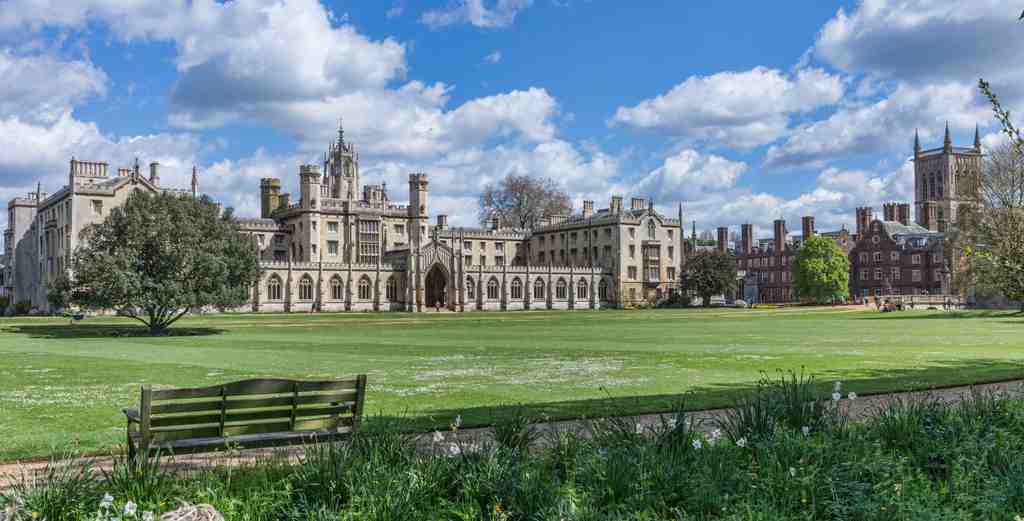
Look across the wide green lawn to the sprawling pale stone complex, distinguished by its intricate central gateway arch and the towering, pinnacled chapel tower that points sharply toward the sky. That majestic structure is St John's College.
Now, looking at its imposing, scholarly facade, you might imagine a sanctuary where every student sits hunched over dusty tomes in perfect, absolute silence. But beneath this veneer of high discipline beats a rather defiant heart. Let me introduce you to a young man named William Wordsworth. Before he became a legendary poet, Wordsworth was a wonderfully distracted, defiant student right here. Instead of attending to his studies, he later confessed to being an absolute rebel against academic discipline. He preferred to spend his days sauntering through the streets and rioting with his companions. From his room in First Court, he had a direct view of Trinity College, which we explored earlier, and he spent far more time listening to the double strike of Trinity's clock than he did listening to his tutors.
Oh, to be a fly on the wall during his tutorials! But that sort of academic rebellion is just one thread in the grand tapestry of St John's. Despite young William's time wasting, this college is an absolute powerhouse of intellect. Its courts have nurtured twelve Nobel Prize winners, seven prime ministers, and brilliant minds like William Wilberforce and Thomas Clarkson, who fiercely led the movement that brought slavery to an end in the British Empire.
In fact, the very foundation of this college was an act of brutal political defiance. It was established in fifteen eleven, following the death of the Tudor matriarch Lady Margaret Beaufort. She had wanted to build a college on this site, but she died before putting it in her will. It fell to her devoted chaplain, John Fisher, to make her dream a reality. And he had to fight tooth and nail against her notoriously ruthless grandson, King Henry VIII, who desperately wanted to keep her vast wealth for himself. Fisher refused to back down. He battled the King, fought off greedy household servants trying to seize the estate, and eventually secured a papal bull, a formal legal decree from the Pope, to officially establish St John's.
Talk about a high stakes gamble! Fisher ultimately paid for his resistance with his life, executed by the very same king years later, but his legacy stands before you in these magnificent stone walls.
St John's remains a place where monumental achievement and the wild human spirit have always danced hand in hand. If you want to wander those historic courts yourself, the college is open to visitors Monday through Friday from nine thirty in the morning to four thirty in the afternoon, though it is closed on weekends. Now, let us proceed to our final architectural marvel over the river, moving onward to the Bridge of Sighs, which is just a two minute walk away.




