
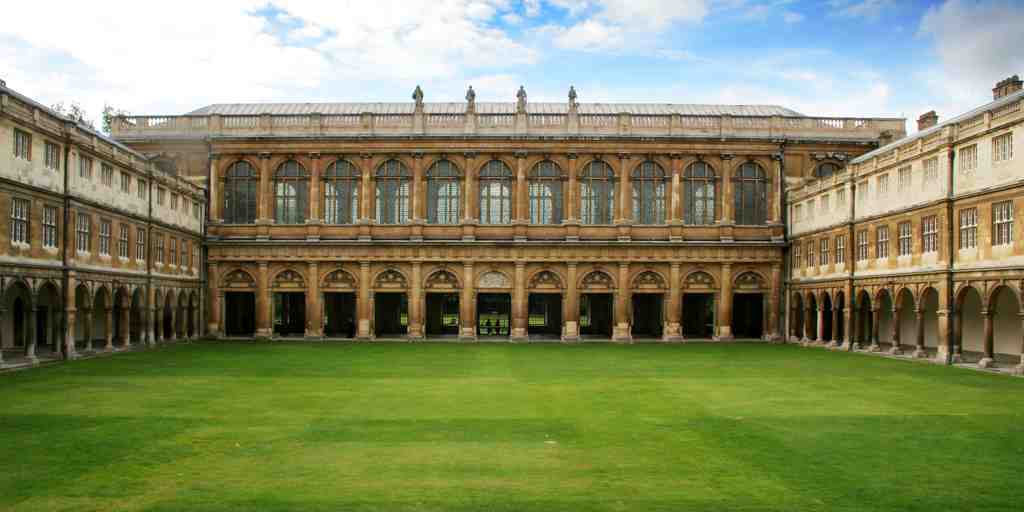
On your right stands a magnificent pale stone building stretching across the manicured lawn, defined by its open, arched ground-floor colonnade and a grand row of towering upper windows crowned by statues on the roofline.
Throughout history, grand architectural projects were rarely just about providing space... they were elaborate flexes of institutional power and control. A university did not merely want to house its scholars, it wanted to mould them, directing their gaze and dictating their habits through stone and mortar. Enter the legendary architect Christopher Wren, a master of clever spatial manipulation who was persuaded by his friend, the College Master, to design this very library in 1676.
Look closely at those towering windows on the upper floor. From the outside, the proportions look flawlessly balanced. But step inside, and you would discover that the floor of the reading room actually drops several feet beneath those grand external ledges. This was a brilliantly deceitful disciplinary measure. By sinking the floor so the window sills sat unnaturally high, Wren ensured that students sitting at their desks could see absolutely nothing but the empty sky. There was no watching the activity on the river or the college grounds... just a ruthless, uninterrupted focus on their studies.
You can see how perfectly this facade has survived the test of time if you take a peek at the before and after image on your screen.
But architectural discipline could never fully tame the brilliant, unruly minds within these walls. Take Isaac Newton, for example. Rather than quietly reading upstairs, he turned the open colonnade on the ground floor into an ad-hoc laboratory. Legend has it he used that echoing space to time the speed of sound, stamping his foot and measuring the seconds it took for the noise to return from the far wall.
Then there is the poet Lord Byron, a man whose defiance caused a posthumous scandal. Today, a full-size marble statue of him rests inside, but it arrived only after a decade of bureaucratic exile. The statue was originally offered to Westminster Abbey, but the church bluntly refused it due to Byron's notorious reputation for immorality. The masterpiece remained trapped in a damp shipping crate in a London customs house for ten long years until Trinity finally agreed to give the scandalous poet a home.
Even the building's plain backside hides a secret. The facade facing the River Cam was intentionally left unadorned because the masters viewed the river as nothing more than the city's main sewer. They assumed no person of social importance would ever look at the building from such an unsanitary angle. When Queen Victoria visited and asked the Master what the various scraps of paper floating down the river were, he had to think fast. Spared the grim truth about the sewage, she was told they were simply notices warning the students against the dangers of swimming.
The library is entirely free and open to the public on weekdays between noon and two in the afternoon. Now, let us leave the deceptive beauty of the library behind and walk toward the vast scale of Trinity's main quadrangle, as we make our way to Great Court.




