
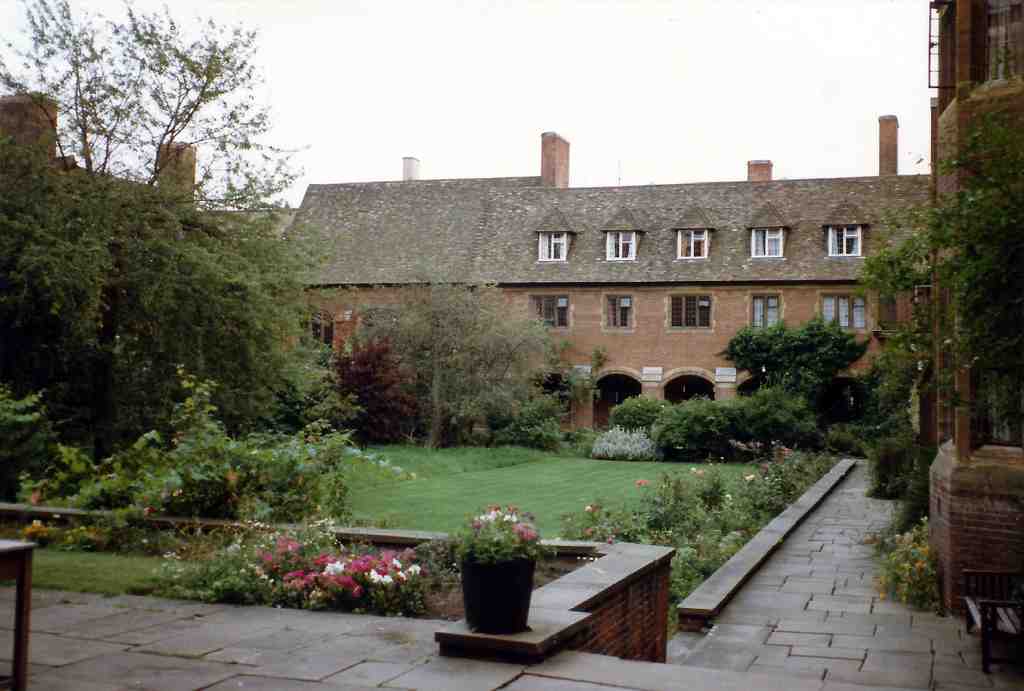
To spot Westcott House, simply look ahead for a long, red-brick building with dormer windows and a beautiful, leafy courtyard framed by stone paths and vibrant flower beds.
You’re now standing in front of Westcott House, the place where future ministers prep for a life that’s one part inspiration, one part dedication, and-let’s be honest-at least one part sleepless essays! Just imagine, it’s 1881, and the air is crisp with possibilities. This peaceful courtyard wasn’t always filled with the laughter of students or the quiet hum of theological debate. Back then, Brooke Foss Westcott, Regius Professor of Divinity and a true heavyweight in Bible scholarship, had an idea: train clergy not just to preach, but to truly understand, think, and care for their communities. The walls around you, brick and sturdy, grew out of his dream to raise the standard for everyone called to serve, no matter which corner of the Church of England they loved most.
Now listen carefully: can you hear them? Those could be the echo of Westcott himself, or perhaps one of the many figures who shaped this college’s spirit. Unlike many stuffy Victorian institutions, Westcott House has never liked labels or getting stuck in one style. Some call it Liberal Catholic, others say it welcomes all shades of Anglican belief. In fact, Westcott was famous for refusing to pick sides. He just wanted his students to be thoughtful, compassionate, and a bit rebellious-because, let’s face it, if you can’t question things in Cambridge, where can you?
When the Faith in the City report shook up the Church in 1985, Westcott House decided to double down. They became pioneers in “urban ministry,” sending students into real city neighborhoods, not just to preach, but to learn from people’s lives and struggles. You could say they were “street smart”-but with a little more Hebrew.
Not only did they keep that flame burning, but they shared their new techniques across England. Many other theological colleges have copied their context-based learning, hoping to keep up with the Westcott spark-sort of like playing chess against the teacher and hoping for a gentle hint, instead of getting checkmated!
As you stand near the stone paths and flower pots, picture the many heads of the college, or “principals.” Frederic Chase wore that honor first, but names like Rupert Hoare and Helen Dawes followed, leading a parade of staff who’ve become bishops, monks, canons, and even global social reformers. The walls here have heard a lot of Latin, laughter, and possibly divine arguments over who gets the last biscuit. Hey, even a future Archbishop of Canterbury, Rowan Williams, taught and prayed here!
Throughout its life, Westcott House has opened its arms to people from all backgrounds. If you could peek into the rooms behind those dormer windows, you’d find students not just from the UK, but from across the world. Their voices rise in debate, hope, and the occasional off-key hymn. The college calls itself a home for an “inclusive and international community.” Sounds like the best dinner party ever-intellectual, eclectic, and just a little bit holy.
Maybe you hear church bells in the distance, or the buzz of students planning the next big outreach program. The spirit that Westcott began with-fighting ignorance, complacency, and empty faith-still breathes here every day. So next time you pass a group of students in smart black gowns, ask them a tricky question about city ministry or the legacy of Saint Westcott. Just make sure you have enough time for the answer-you might be here all day!
Alright, onward! Our next stop is packed with discovery and, I hope, less Latin. Ready to stroll?




