
Cambridge Audio Tour: Tales of Scholars, Spires & Secret Passages
A single stained-glass window in King's College Chapel once survived the blast of an air raid, just as Cambridge itself has withstood centuries of intrigue and ambition. Wander the hushed courts and echoing corridors on this self-guided audio tour to unlock the city’s most dramatic chapters and secret corners—the stories most visitors walk right past. What spark of rivalry drove a midnight raid between colleges that changed academic history? What lost treasure is rumored to be hidden beneath the chapel’s foundations? Which student scandal, whispered about since Victorian times, stunned even the dons at Trinity? Follow twisting alleyways and grand facades as each moment sharpens into vivid clarity. Feel the city shift under your feet as you discover rebellions, betrayals, and oddball brilliance that shaped the world. Ready to trace the light and shadows that linger behind Cambridge’s windows? Your journey into the unknown begins now.
Tour preview
About this tour
- scheduleDuration 50–70 minsGo at your own pace
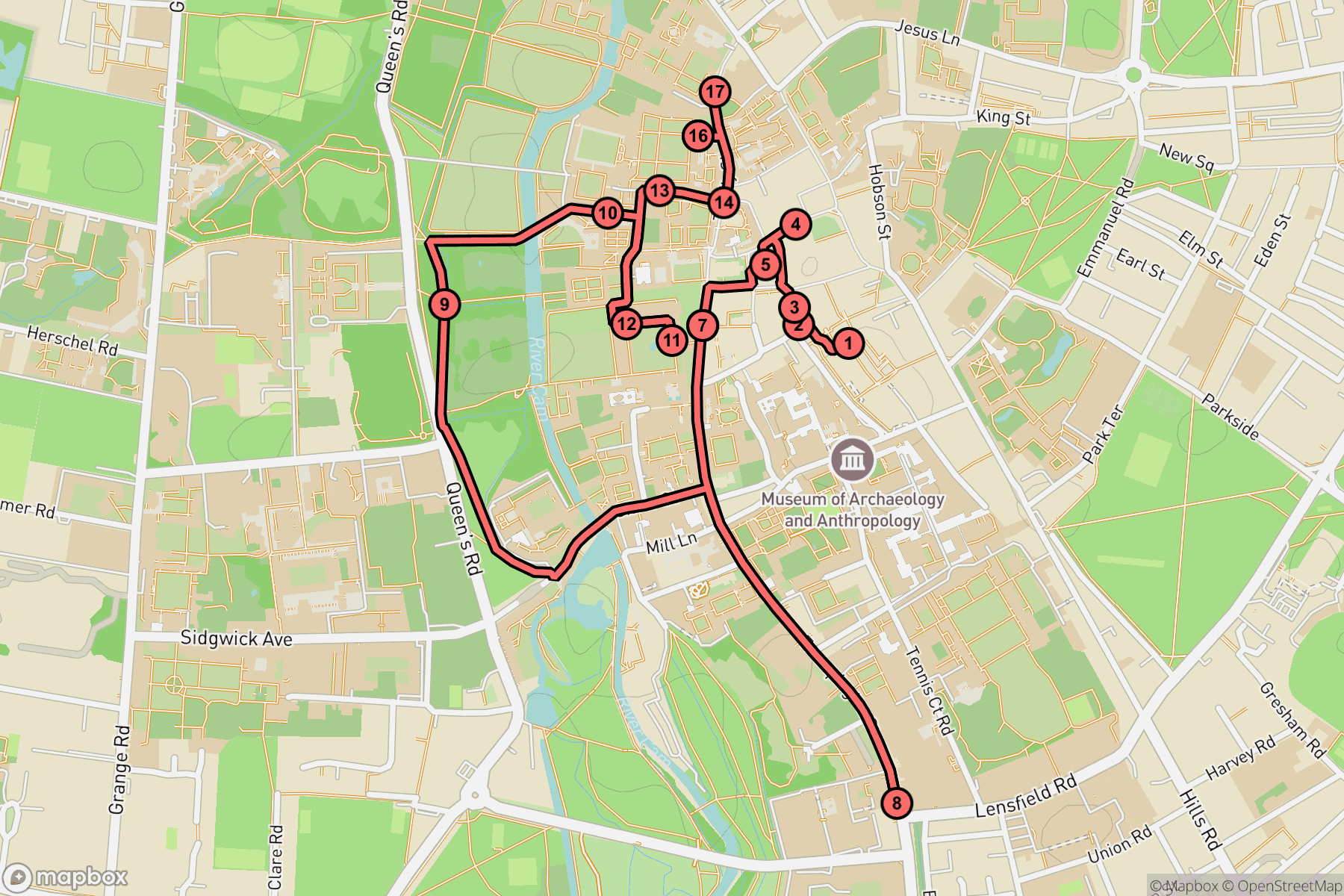
- straighten4.1 km walking routeFollow the guided path
- location_onLocationCambridge, United Kingdom
- wifi_offWorks offlineDownload once, use anywhere
- all_inclusiveLifetime accessReplay anytime, forever
- location_onStarts at Lion Yard
Stops on this tour
You’re actually at the heart of Cambridge’s city centre, with St Andrew’s Street, Corn Exchange Street, and Petty Cury surrounding you. This was once home to more than just shops:…Read moreShow less
You’re actually at the heart of Cambridge’s city centre, with St Andrew’s Street, Corn Exchange Street, and Petty Cury surrounding you. This was once home to more than just shops: there was a public library, a multi-storey car park, and even a magistrates’ court-imagine shopping for shoes and suddenly bumping into a judge in full robes! And although Lion Yard came before its bigger cousins, the Grafton Centre and the Grand Arcade, it has held its own. In fact, the Grand Arcade is directly connected to Lion Yard, so you could technically shop yourself dizzy from one centre to the next without ever seeing daylight! Now, do you notice anything missing at the centre of the atrium? For many years, there was a proud red lion statue perched on a tall white column-watching everyone’s shopping bags from above, out of reach of even the tallest basketball players. This lion paid tribute to the pub that used to stand here, but in 1999, it decided it needed more exercise and now lives at the Cambridge University rugby club’s ground. The red lion isn’t just any mascot; it’s the emblem of the entire University of Cambridge-and you’ll see traces of it all over town. Lion Yard saw a stylish refurbishment in the early 2000s, smoothing out its shopping wrinkles and adding even more reasons to visit. Above the main shopping floor, you’ll find the Central Library-one of the UK’s busiest libraries, by the way-alongside stores for outdoor gear and fashion. Offices like Lion House and St George House keep the centre humming during the week, while a chic colonnade wraps halfway along Petty Cury outside. So, whether you’re here to people-watch, browse high street brands, or spot a librarian on the move, you’re standing where centuries overlap-and where, once, a lion really ruled the yard!
Open dedicated page →Look straight ahead for a grand, square, sandy-brown building with symmetrical rows of tall windows and flower baskets, proudly sitting at the edge of the lively Market…Read moreShow less
Look straight ahead for a grand, square, sandy-brown building with symmetrical rows of tall windows and flower baskets, proudly sitting at the edge of the lively Market Hill. Alright! You’re now standing outside Cambridge Guildhall, a place where official business meets a fair bit of mischief and laughter. These walls have served almost every purpose you can imagine, from housing comedy acts and craft fairs to setting the stage for life-changing university exams and even the occasional wedding dance! It’s the command center for Cambridge City Council-picture council members plotting their next move just a few rooms away. But don’t let this impressive Neo-Georgian stonework fool you-there’s a story bubbling beneath its calm, orderly surface. Nearly 800 years ago, this site hosted a house owned by Benjamin, a local Jew. King Henry III, never one for half-measures, decided to grant it to the town. Did he have a party in mind? Not quite-it became Cambridge’s first prison, complete with an old synagogue next door that passed into the hands-and sandals-of Franciscans, before they wandered off to set up a convent where Sidney Sussex College sits today. By the 13th century, this spot transformed into the town’s “tolbooth,” a place for collecting fees and, less nobly, for staging lively plays. In Elizabethan times, you’d find Queen Elizabeth’s Men acting out drama after drama, while on the nearby Market Square, butter sellers called from their stalls. Don’t trip on your way past Butter Row! The present Guildhall, finished in 1939 for a whopping £150,000, blends all these layers: council hub, concert stage, and a backdrop for royal visits-even the Duke and Duchess of Cambridge once waved from its balcony, giving the crowds below a royal thrill. Just imagine exams, court cases, and craft fairs all under one roof. Not many buildings can claim such a varied cast of characters!
Open dedicated page →To spot Guildhall Street, just look for a street with a curious, chunky bronze statue (that’s Talos!) standing boldly outside a big brick building with tall windows-it’s right in…Read moreShow less
To spot Guildhall Street, just look for a street with a curious, chunky bronze statue (that’s Talos!) standing boldly outside a big brick building with tall windows-it’s right in front of you. Now, take a deep breath-imagine the busy, slightly messy buzz of a meat market here hundreds of years ago. Back in the 16th century, this was called Butcher Row, and instead of clothes shops, you’d have seen stalls piled high with fresh meat, butchers sharpening their knives, and townsfolk haggling for tonight’s dinner. If you think today’s market is lively, picture the old Guildhall Street: noisy, a bit smelly, but full of life, with wooden houses and stalls crammed side by side. To your left is the impressive Cambridge Guildhall-a site of local power and drama since the 14th century, even if the current building joined the party in the 1930s. And don’t miss Fisher House, that lovely timber-framed relic from Shakespeare’s time, hiding stories of faith and student secrets. Modern shoppers and mysterious sculpture aside, you’re walking through centuries of local politics, wild market days, and the odd scandalous pub tale from the Red Cow, built in style in 1898. Try to hear the echoes of the past with every footstep!
Open dedicated page →
Show 14 more stopsShow fewer stopsexpand_moreexpand_less
- location_on4
Cambridge Market Square
Buy tour to unlock all 21 tracksAhead of you, Market Street is a lively stretch lined with shops, cafes, and a mix of modern and historic buildings-just look for the bold blue WHSmith sign and the contemporary…Read moreShow less
Ahead of you, Market Street is a lively stretch lined with shops, cafes, and a mix of modern and historic buildings-just look for the bold blue WHSmith sign and the contemporary white apartments with quirky balconies overhead. Welcome to Market Street, where every step zings with Cambridge’s energy-between the tempting bookshops and the buzz of shoppers, you might even spot a student sprinting for an overdue essay (or maybe just a coffee). Imagine the smell of pastries wafting from nearby bakeries and the chatter echoing from Market Square just to your west. At the eastern end, Holy Trinity Church stands watch, its slender spire dating back to around 1400, making even the latest fashion trends here seem like newborns. Nearby is Henry Martyn Hall-once the proud project of architect Edward Schroeder Prior, boasting Arts and Crafts flair, it’s now partially home to shops rather than sermons. And above the shops on the north side, Radcliffe Court appears, the 1964 invention of Stanley R. Nevell-a residence that’s seen more last-minute market runs than any student flat ever has! From here, hidden passages like Petty Cury and Hobson’s Passage whisk you off to new discoveries. Soak up the character, both old and new-every corner has its own tale!
Open dedicated page → - location_on5
Cambridge Market Square
Buy tour to unlock all 21 tracksIn front of you, you’ll spot a lively square filled with colourful market stalls covered by canvas roofs, and behind them, rising proudly, is the mighty tower of Great St Mary’s…Read moreShow less
In front of you, you’ll spot a lively square filled with colourful market stalls covered by canvas roofs, and behind them, rising proudly, is the mighty tower of Great St Mary’s Church. Welcome to Market Hill, right at the heart of Cambridge! Imagine every morning here since Saxon times - yes, that’s over a thousand years - people have been setting up crusty bread, fresh apples, and all sorts of treasures for sale. The energy is electric, especially with Great St Mary’s Church keeping a watchful eye from the west. Today, the market’s still here, smelling of fruit and flowers, and ringing with the friendly calls of traders. If you tilted your head back to 1849, you might sniff smoke in the air. That year, a huge fire changed everything, clearing the old crowded lanes of the square. When they rebuilt, the town fountain in the middle became the star - and it wasn’t just about the splashing water. Thanks to Hobson’s Conduit, clean water rushed through here from 1614, right to the market fountain. You’d have seen people and horses lining up with buckets and barrels until the flow was cut off in the 1960s, when the Lion Yard shopping centre was built. But for a juicy bit of drama, picture 1381 during the Peasants’ Revolt - the square is packed and roaring. Suddenly, a local hero named Margery Starre and a crowd led by the mayor burst in. Their rallying cry? “Away with the learning of clerks, away with it!” They danced wild circles here, shredding the university’s records in protest. Whether you’re here for veggies, victory, or a bit of mischief, Market Hill’s always been the place for a good story... and maybe a strawberry or two if you’re lucky!
Open dedicated page → - location_on6
King's Parade
Buy tour to unlock all 21 tracksTo spot King’s Parade, look for the broad street lined with grand stone buildings-most strikingly the soaring King's College Chapel on one side and the white-pillared Senate House…Read moreShow less
To spot King’s Parade, look for the broad street lined with grand stone buildings-most strikingly the soaring King's College Chapel on one side and the white-pillared Senate House and the tall, square tower of Great St Mary’s Church on the other. Welcome to King’s Parade, the busy heart of Cambridge, where history and hustle blend together with the sound of bicycle bells and distant chatter from students racing to lectures. Picture yourself here hundreds of years ago: the air filled with the clop of horses’ hooves and the murmur of students gossiping beneath gas lamps. If you listen closely, you can almost hear it:. King’s Parade is more than just a street-it’s a living timeline. On your left, King’s College spreads out, its world-famous chapel dominating the scene like a castle from a fairy tale. But this wasn’t always so grand. In the 1830s, the entire west side of the street was demolished to make way for the majestic King’s College Gatehouse and stone Screen. Walk a little further and you’ll pass what used to be the White Horse Tavern, a smoky haunt in the 1500s where bold reformers whispered secrets about forbidden Lutheran ideas. Legend has it that lively debates inside could get so heated, you’d expect the tavern walls themselves to start sweating. The tavern is long gone, replaced by the quiet of Chetwynd Court, and marked only by a discreet blue plaque. Even the walls here listen to history. Peer across the street-see that welcoming bookstore on the far corner? That’s the site of the Bowes & Bowes bookshop, where books have been sold since 1581. It once claimed to be the oldest bookshop in the UK. Imagine all the hands that have rifled through dusty volumes here-professors, poets, pranksters-hoping to find wisdom (or maybe just an escape from their homework). Just north, you’ll see the University Senate House, where generations of students sweated and cheered through graduation ceremonies. And right next door, Great St Mary’s Church has been a witness to it all, ringing its bells for scholars and townsfolk alike. King’s Parade isn’t just for scholars-it’s been home to wine bars, milliners, and even teddy bear shops. In the 1970s, the birthplace of Sinclair Instrument Ltd was right here, before it helped spark the UK’s home computer revolution. Today, if you need to calm your nerves after all this excitement, you can stop by Inner Space Meditation Centre, right where technological history was made. And don’t miss the Corpus Clock at the street’s southern end-a shining, golden tribute to time that winks at you from the future. So take a deep breath, soak in the sights, and remember: on King’s Parade, every step is a story and every window hides a chapter from Cambridge’s extraordinary past.
Open dedicated page → - location_on7
St Edward's Passage
Buy tour to unlock all 21 tracksTo spot St Edward’s Passage, look for a narrow, Y-shaped alley with stone paving underfoot, squeezed between brick and whitewashed buildings, with bolder “BOOKS” signs hanging…Read moreShow less
To spot St Edward’s Passage, look for a narrow, Y-shaped alley with stone paving underfoot, squeezed between brick and whitewashed buildings, with bolder “BOOKS” signs hanging like friendly beacons and a few bicycles resting along the edges. Alright, let’s squeeze into the shadows of St Edward’s Passage, where history lurks behind every cobblestone! This little alley, once called Chain Lane, feels like a secret pathway straight out of a mystery novel-narrow, dark, and with so many stories nestled in those riven stones that you almost expect a whispering monk or a dashing student to dart past. Stand here, breathe in, and imagine the echo of footsteps from centuries ago, when the lane first wound its way through Cambridge in the 1200s. By the 1500s, it had already found fame on the earliest maps of the city, preserving that classic crowded, “cheek-by-jowl” Cambridge charm. Glance to the Peas Hill end, and you’ll find the ancient Church of St Edward King and Martyr, its entrance hiding at the passage’s elbow. They actually call this the cradle of the English Reformation! Imagine Christmas Eve, 1525: the church is heavy with the flicker of candlelight and thick with tension as Robert Barnes climbs the pulpit. His sermon? The first bolt fired by reformers, openly accusing the mighty Catholic Church of heresy-talk about a Christmas surprise! The drama didn’t end well for Barnes and his friends Bilney and Latimer, by the way; all three met a fiery fate. But the passage isn’t just fire and brimstone! Tucked alongside are friendly cottages, the Cambridge Arts Theatre, and the legendary G. David bookshop, keeping bibliophiles happy since 1896. There’s a quirky coffee shop, a haunted bookshop (spooky, right?), places for students to dream and plan mischief-all in the curve of a lane barely wide enough to swing a backpack. Through quiet and chaos, St Edward’s Passage has seen it all.
Open dedicated page → - location_on8
University of Cambridge
Buy tour to unlock all 21 tracksImagine it’s the year 1209. England is turbulent, townsfolk are getting feisty in Oxford, and suddenly a group of scholars flee, seeking safety and a new start. They arrive in…Read moreShow less
Imagine it’s the year 1209. England is turbulent, townsfolk are getting feisty in Oxford, and suddenly a group of scholars flee, seeking safety and a new start. They arrive in Cambridge-back then, just a sleepy town with sheep and monks from Ely Cathedral, not the city of intellect and invention you see today. Picture those scholars unpacking their books, arguing about Aristotle in candlelit rooms, and setting the spark for what would become the world’s third-oldest continuously operating university. Not long after, King Henry III hands Cambridge a royal charter-officially recognizing the upstart scholars and probably hoping they’d stop creating so much academic mischief. Over the years, the university blossomed into a vibrant world of mini-republics: 31 colleges, each with its own traditions, coat of arms, and dining hall food-ranging from surprisingly good to “well…it’s historic, let’s just say that!” Don’t be fooled, it hasn’t all been fine sherry and choir singing. The townspeople and students had their fair share of spats. In the 1300s, 'town and gown' riots sometimes broke out-imagine Market Square filled with yelling, flying loaves of bread, and students defending their right to wear silly hats. During the 1381 Peasants’ Revolt, angry locals actually raided and burned university property, their rallying cry ringing out: “Away with the learning of clerks!” The university’s Chancellor got special police powers after that. I guess higher education literally became a matter of law and order. Through it all, the University kept reinventing itself. The oldest college, Peterhouse, was founded in 1284. Over centuries, more colleges rose, each with legends of their own. Some were designed for praying for founders’ souls-today, students mainly pray for good Wi-Fi and a lenient examiner, but, you know, times change. Cambridge wove itself into the very fabric of British scientific history. The Mathematical Tripos-essentially the toughest math exam imaginable-produced legendary “Senior Wranglers.” The top prize for the lowest passing grade? A giant wooden spoon, once over a meter long. If you’re ever struggling, just remember: even ‘failure’ gets a trophy here-though you might need a very big drawer. It wasn’t only numbers and science. The halls echoed with the witty conversations of Bertrand Russell, the poetry of Sylvia Plath, the steely will of Oliver Cromwell, and the thoughts of John Maynard Keynes. Imagine an undergraduate Charles Darwin creeping through the nearby fields, jotting in his notebook, or a young Stephen Hawking zooming across college courts in his wheelchair, thinking up black holes. And if you get invited for tea, beware: for centuries, there were only male students sipping from the best china. Women were only grudgingly admitted in the late 19th and 20th centuries, first allowed to take exams, then finally full degrees after 1948. There was even a tradition where women who’d completed Cambridge studies got their degrees from the University of Dublin-good thing Ryanair didn’t exist back then, or the ritual might have been lost to cheap flights. You might notice the grand libraries. There are about 16 million books throughout the university, with 9 million just in the Cambridge University Library-a place so vast you practically need a map and a packed lunch to explore it all. And what about the iconic annual Festival of Nine Lessons and Carols, sent soaring over the airwaves each Christmas to millions around the globe? Today, Cambridge still dances between ages old and cutting-edge. It’s a leader in tech and biotech-a phenomenon locals call the “Cambridge Phenomenon”-hatching startups as fast as its students drink coffee. The colleges are like quirky families. Some are single sex, some are coed, but open the doors anywhere and you’ll find hard work, laughter, and maybe even a Nobel Prize or two (they’ve chalked up 126!). So, as you stand in front of this legendary university, imagine the centuries of squabbles, discoveries, dashing academic robes, and, yes, a lot of bicycles-this is the heart of Cambridge, where history is everywhere, and the next great idea might just be moments away. Seeking more information about the locations and buildings, organisation and administration or the academic profile? Ask away in the chat section and I'll fill you in.
Open dedicated page → - location_on9
The Backs
Buy tour to unlock all 21 tracksLook ahead and you'll spot The Backs: a lush green riverside sweep, lined with grand college buildings to your right, wide lawns, and grazing cows casually munching grass beside…Read moreShow less
Look ahead and you'll spot The Backs: a lush green riverside sweep, lined with grand college buildings to your right, wide lawns, and grazing cows casually munching grass beside the River Cam. Standing here along The Backs, let me paint the picture-quite literally, since this spot has inspired so many artists and visitors alike! The Backs is a magical stretch where several of Cambridge’s most famous colleges show off their rear views (yes, their “backs,” making the name feel both clever and obvious), all opening onto the banks of the gentle River Cam. From this vantage, you might spot the palatial stone walls of King’s College, the mathematical curve of a bridge, or maybe even a cow who looks like he wandered in from a Jane Austen novel. Back in the 1500s, this area wasn’t quite so polished. Imagine grassy pastures, tangled orchards, and humble wooden bridges instead of these manicured lawns and stately spans. College fellows might’ve strolled through apple trees here, dreaming of equations or maybe just a slice of pie. The river? That was the original city highway, alive with the splash of punts and the clip-clop of carts headed to the old mill by Silver Street. St John’s, Trinity, Clare, King’s, and Queens’-each college stakes its claim to a patch of the riverbank. Some have buildings on both sides, and a few are linked by bridges so iconic they’re in every tourist’s photo album. Have you heard of the Bridge of Sighs? Well, we’ve got one here-and ours comes free with the fresh, leafy scent of Cambridge! Fast forward to the 18th century, and one of England’s most famous landscape designers, the magnificently named Lancelot “Capability” Brown, was called in. He had big ideas: smooth out the college boundaries, add romantic clusters of trees, maybe turn the river into a posh lake. Rumor has it, his grand plan would’ve changed the whole feel of the place-but the colleges, being as stubborn about their boundaries then as they are now, put their collective slipper down. No lake, thanks! Instead, the avenues of chestnuts and elms you see today began to spring up, framing the walkways and making perfect homes for wildlife (and a few secret midnight student escapades, I’m sure). Over time, the backdrop evolved-a bit of livestock grazing here, a splash of new tree planting there-but even trees face tough times. In the 1970s, Dutch elm disease had the upper hand. The colleges teamed up, surely after much debating over many cups of tea, and formed a special committee to save The Backs’ leafy charm. They cut down the sick trees, planted new ones, and, just like any timeless university debate, the meetings trickled to an end a few years later. Today, The Backs is both a Grade 1 Historic Park and one of England’s most admired views-recognized by the National Trust, beloved by students and visitors, and even subject to long-term landscape plans balancing beauty, tradition, and nature. Whether you’re here for punting, pictures, or just a bit of riverside daydreaming, know that you stand in centuries of careful compromise, quirky Cambridge tradition, and a dash of wild English spirit. Alright, onward to our next stop! Seeking more information about the the name, present-day and future development or the gallery? Ask away in the chat section and I'll fill you in.
Open dedicated page → - location_on10
Trinity Hall Cambridge
Buy tour to unlock all 21 tracksRight in front of you, Trinity Hall reveals itself as a dignified golden-stone building with elegant arched windows, nestled among clusters of bicycles and graced by a traditional…Read moreShow less
Right in front of you, Trinity Hall reveals itself as a dignified golden-stone building with elegant arched windows, nestled among clusters of bicycles and graced by a traditional lantern above its entrance-look for the stately doorway and symmetrical façade just ahead on your right. Welcome to Trinity Hall-officially known as The College or Hall of the Holy Trinity-which is actually older than most of the jokes you’ll hear from Cambridge comedians! Founded in 1350, this place was dreamed up by William Bateman, the Bishop of Norwich, who, after losing nearly 700 priests to the Black Death, had a bit of a crisis: not enough clergymen and, perhaps, too many ghosts. Standing here, imagine the medieval clatter as bustling students in robes rushed into these courts, muddy boots trailing bits of Cambridgeshire--all under the worried gaze of Bishop Bateman himself. The first thing Bateman did was snap up this site, originally belonging to Gonville Hall, another college struggling to keep the lights on. His goal was to make sure the church-and the laws of the land-had plenty of smart minds, so Trinity Hall was all about canon and civil law from the very start. Even today, the college has a bit of a legal legend around it, with a knack for turning students into legal eagles or philosophical owls. And if you think the name “Trinity Hall” sounds a bit odd next to the mighty Trinity College next door, you’re not alone. Back in the days of King Henry VIII, the new giant Trinity College showed up, and our dear Trinity Hall stubbornly clung to its original title-perhaps because its then-master had annoyed the king. So, Hall it remained! It’s a bit like having two Bob’s Burgers next to each other, and only one insists on keeping the original recipe. Now, cast your eyes up at the front façade: the medieval bones are still very much here, but they’re covered in 18th-century baroque flair courtesy of Sir Nathaniel Lloyd. The grand Dining Hall and Chapel inside are so padded with wainscot and carving, you almost expect to find Sir Nathaniel himself standing behind the high table, immortalized in a portrait that is, legend has it, glued to the wall so securely that no one could ever banish his face from dinner! The traditions here are as serious as the studies, but not without a little mischief. Trinity Hall’s boat club, founded in 1827, once ruled the River Cam, holding onto victory for 33 days straight-take that, Oxford! The college is also famous for its literary gatherings, once hosting T.S. Eliot and J.B. Priestley, and even giving the world a spy or two-though hopefully not in your tour group. Of course, the tale of any ancient institution has darker turns. In recent years, Trinity Hall has faced challenges involving allegations of misconduct and calls for reform. These events have led the college to look inward, to launch independent inquiries and work to rebuild trust and culture inside these old walls. It’s a reminder that even in places lined with centuries of history, the work of shaping a better future never stops. If the spirit of the place feels especially brainy yet quirky, you’re in good company-luminaries like Stephen Hawking, novelist J.B. Priestley, Canadian Governor General David Johnston, and even Oscar-winning actress Rachel Weisz once hurried down this very path, perhaps dodging the odd careening bicycle. Even today, behind those stone walls, you’ll find vibrant undergraduate and postgraduate communities. From the library’s rare chained books to the boathouse bustling with rowers, and even the secrets of the hidden chapel door, Trinity Hall brims with tales not yet finished. Who knows-maybe the next legendary story will come from someone standing right where you are! Yearning to grasp further insights on the buildings, student life or the gallery? Dive into the chat section below and ask away.
Open dedicated page → - location_on11
King's College, Cambridge
Buy tour to unlock all 21 tracksTo spot King's College, look for the enormous chapel rising like a crown above the lawns, with its forest of stone pinnacles and breathtaking stained glass windows just ahead,…Read moreShow less
To spot King's College, look for the enormous chapel rising like a crown above the lawns, with its forest of stone pinnacles and breathtaking stained glass windows just ahead, right beside the river. Now, let’s dive into the story of this grand place-watch your step, you’re about to follow in royal footsteps, and I’d hate for you to trip on history! Picture the year 1441: young King Henry VI, barely older than a Cambridge fresher, founded King’s College to bring together “12 poor scholars” and a rector, hoping to outdo his nemesis at Winchester and New College, Oxford. The college began in a modest garden-not quite Hogwarts, more like a mud patch-but his ambitions quickly grew much, much bigger. Soon, Henry teamed up King’s with Eton College so tightly that, for centuries, only Eton boys could get in. He was in the middle of building a courtyard with grand gates, a massive chapel, and-wait for it-the world’s fanciest buttery (that means dining hall, not just a tub of margarine). Sadly, the Wars of the Roses rolled in, pockets emptied, and even kings have trouble getting things finished when they lose their job. It didn’t help that the college site sat unfinished for years; “temporary” buildings became less ‘under construction,’ more ‘permanently on hold.’ But then along came Henry VII and Henry VIII-the ultimate family renovation dream team, if you ignore all the beheadings. The chapel, which looked a little like a castle that forgot to stop growing, finally soared to completion in 1544. The outside is all soaring stone and delicate details, though inside, it’s a playground for the eye: the fan-vaulted ceiling stretches upward like an elegant stone web, while sunlight floods through huge panes of stained glass, casting rainbows onto centuries-old tombs. There’s more to King’s than just magnificent architecture. The college has seen waves of change-Victorian rebels insisted on letting in students not from Eton (shocking at the time!), and eventually even allowed women in 1972. The classic rivalry for academic glory thrived here: story goes, undergrads at King’s didn’t have to pass university exams for years, just win over their own tutors-not a bad deal! The gardens have heard everything from ghost stories by M.R. James to open mic nights, mingled with the squawks of rugby teams and the tunes of the legendary King’s College Choir. Speaking of music, if you stand here on Christmas Eve, you might just imagine the distant voices of the world-famous choir. Every December, the Festival of Nine Lessons and Carols is broadcast live, a tradition born right here that brings the warmth of King’s to living rooms and cathedrals all around the globe. The college is also fiercely brainy-nine Nobel laureates have called it home, including Alan Turing and John Maynard Keynes. Celebrities and thinkers have wandered these lawns too, from Zadie Smith and Salman Rushdie to the man who invented the flush toilet (Sir John Harington-so yes, even your bathroom break has royal connections). King’s students love to turn tradition upside-down. Instead of a May Ball, here they throw the King’s Affair, a zany June party with costumes, music, and the sort of dancing that would scandalize a medieval bishop. You’ll find clubs for politics, drama, DJing, and even kayaking on the Cam. There was even a rumor about the world’s first bonsai tree sprouting in King’s, although evidence is… well, a bit stunted. Whether you’re gazing at those majestic windows or just admiring the gardens where scholars and squirrels alike race by, King’s College stands as a beacon of ambition, art, music, and just a dash of royal mischief. Go on-take in the view and, if you feel inspired to belt out a carol, I won’t judge! Exploring the realm of the buildings and grounds, academic profile or the student life? Feel free to consult the chat section for additional information.
Open dedicated page → - location_on12
King's College Chapel
Buy tour to unlock all 21 tracksTo spot King’s College Chapel, look for the grand, pale stone building right in front of you, with towering spires and enormous arched windows rising up against the sky. What…Read moreShow less
To spot King’s College Chapel, look for the grand, pale stone building right in front of you, with towering spires and enormous arched windows rising up against the sky. What you’re looking at now is the pride and joy of Cambridge: King’s College Chapel, a masterpiece of late Gothic architecture and so dazzling that even Henry VIII might have given it a double-take. Imagine the air filled with the scent of fresh stone as the first block was laid back in 1446 - Henry VI himself oversaw the beginning of this enormous project. In fact, Henry wanted a counterpart to Eton College, but on a scale to make everyone else just a bit jealous. Reginald Ely, the architect, must have had his hands full, wrangling skilled craftsmen while navigating royal commands and unexpected wars. The Chapel’s construction reads a little like a medieval soap opera. Building started with grand ambitions, with lierne vaulting planned for the ceiling, but after a few years, the Wars of the Roses erupted and the project was paused as kings lost their thrones and England went a bit haywire. By the time Richard III’s reign limped to an end, just five bays were complete and a temporary timber roof perched on top. Picture workers pausing their chisels as royal armies stomped through Cambridge, and you’ve got a sense of the chaos. But Cambridge doesn’t give up easily. Enter Henry VII-think of him as the world’s most enthusiastic Kickstarter backer-who rolled up, paid the bills, and revived the dream in 1506. By 1515, just as Henry VIII came to the throne and spent less time worrying about his wives and more about buildings, the Chapel finally stood as you see it today, though still waiting for its iconic windows. Now, lift your eyes to those windows-there are twelve on each side, and grand ones at each end. Most of these were pieced together by Flemish glassmakers between 1515 and 1531, each panel alive with color and throwbacks to a time when stained glass was pretty much the medieval version of a blockbuster film. When World War II loomed, chapel staff hid most of this precious glass away, tucking it somewhere safe. Thankfully, the Chapel escaped both Civil War and World War II with barely a scratch-rumor has it that Oliver Cromwell himself, a former Cambridge student, convinced soldiers to leave these incredible windows alone. And while you’re near the entrance, try to imagine the sound of England’s most famous choir-King’s College Choir-rehearsing inside, their voices floating up toward that fan-vaulted ceiling. This vaulted ceiling isn’t just for show: it’s the largest of its kind in the world, a forest of stone fans all fanning out as if the masons ran wild with creativity. The acoustics are so perfect, the BBC has broadcast the world-famous “Nine Lessons and Carols” service from here every Christmas Eve since forever (or at least since radios became a thing). Then there’s a dash of controversy: above the altar hangs The Adoration of the Magi by Rubens, installed in the 1960s amid much grumbling about how its swirling colors might clash with the stained glass. Some thought it looked a bit like a postage stamp compared to the grand window behind, so handy wooden shutters were added to help the painting stand out. Imagine the arguments-“It’s too bright!” “It’s too small!” “Can we just paint the window blue?” Luckily, architect Martyn Beckett came up with the best compromise, and now everyone seems to agree it works. And if you’re feeling brave, peek along the walls near the altar. There’s centuries-old graffiti left by Parliamentarian soldiers during the Civil War. Instead of hearts and initials, these guys carved messages and left marks that outlasted their muskets. Today, King’s College Chapel isn’t just a relic. It’s a living, breathing heart of Cambridge, hosting worship, music, concerts, and grand college events. Each time you walk past those spiky towers and golden windows, think of the kings, craftsmen, students, rebels, and choirs, all woven into this place’s story-who knew so much history could fit under one beautiful roof? And, if you want a quick summary, just ask a local what really defines Cambridge-they’ll probably just point straight at these soaring spires. Want to explore the construction, great windows or the rood screen in more depth? Join me in the chat section for a detailed discussion.
Open dedicated page → - location_on13
Great Court, Trinity College, Cambridge
Buy tour to unlock all 21 tracksDirectly ahead, you’ll spot a vast square lined with honey-coloured buildings, neat lawns, and right at the center-an elaborate stone fountain under a carved canopy, with the…Read moreShow less
Directly ahead, you’ll spot a vast square lined with honey-coloured buildings, neat lawns, and right at the center-an elaborate stone fountain under a carved canopy, with the clock tower and grand gates marking the edges. Welcome to the legendary Great Court of Trinity College! Take a look around you and imagine stepping back in time to the early 1600s, when Thomas Nevile-part master planner, part college mastermind-took a collection of mismatched buildings and cleverly arranged them into the enormous court you see today. In fact, Great Court is said to be the largest enclosed courtyard in all of Europe. That’s right, you could host a royal game of hide and seek here and still have room for a picnic. Let’s start our clockwise stroll, beginning up in the northeast corner at the E staircase, where a young Isaac Newton once puzzled over apples and gravity in his very own rooms. Right next door is the grand Porters' Lodge beside the Great Gate, where, if you look up, you might notice Henry VIII holding a rather suspicious scepter-if you squint, you might realize it’s actually a chair leg! Local legend has it that mischievous students swapped out the real scepter in the 19th century, and somehow, nobody’s bothered to give the king his proper stick back. As you stand in the heart of Great Court, you’ll notice the college’s elegant architecture ringing you in-a view worthy of any Harry Potter film, though the broomsticks here are strictly metaphorical. Every corner tells a story: the East Range with its fellows’ rooms, the Queen’s Gate (named for none other than Elizabeth I), the imposing Great Hall of the West Range where students still dine beneath portraits of past masters, and, if you listen closely, the peal of the Trinity College clock. Legend says that the bells here don’t ring the hour just once-they chime twelve twice, once for Trinity and once for the rival St John’s College, thanks to a very dedicated Master Bentley in the 17th century. If you’re here at noon, you may even catch a mad dash: the Great Court Run. Picture students, nervous with excitement (and perhaps slightly underdressed), lining up to sprint the full 339 meters around the court-trying to complete the full circuit before those 24 chimes finish. This legendary feat is so tricky that it inspired the famous scene in Chariots of Fire, though Hollywood filmed it at Eton and missed one detail; only a handful have actually beaten the bells, including Olympic champ Lord Burghley and, much, much later, George Mears (admittedly, on a day when the clock was a bit sluggish). But the Great Court Run isn’t just about speed-there’s a quirky side, too. Every year, students in wild costumes strut and stumble round the circuit, cheered on by tourists and the Dean alike, with the grand prize being, not glory, but a pint of beer! Back in the center, that ornate fountain you see, built in Nevile’s day and supplied by a hidden pipe from the countryside, has witnessed centuries of scholarly debates, secret midnight gatherings, and possibly a prank or two. Surrounding you on all sides, those ancient staircases and halls have seen kings, poets, and more than a few future scientists, while the chapel at one end houses a famous organ and statues honoring Trinity’s finest minds. If you pause and close your eyes, you can almost feel the patter of racing feet on cobbles, the clatter of dining hall dishes, and the faint echo of laughter from generations past. Great Court is the beating heart of Trinity-a place where history, tradition, and a splash of good British mischief live on. To delve deeper into the description, the great court run or the caucus race, simply drop your query in the chat section and I'll provide more information.
Open dedicated page → - location_on14
Trinity Hall Cambridge
Buy tour to unlock all 21 tracksAhead of you is Trinity Street: look for the cobbled lane lined with striking college buildings, beautiful gothic windows, and age-old church spires, with a signature bright red…Read moreShow less
Ahead of you is Trinity Street: look for the cobbled lane lined with striking college buildings, beautiful gothic windows, and age-old church spires, with a signature bright red post box standing sentinel on the right. Take a deep breath; you're standing in the heart of centuries-old Cambridge! Imagine the hustle and bustle here in the Middle Ages-when Trinity Street was called the High Street, or, if you were posh, the magna strata. Back then, this avenue was the main artery of the city, alive with scholars, horses, merchants, and the ever-watchful eyes of the clergy. On your left looms Trinity College, named after the mighty institution that anchors one side of the street. But there's more! Just south, look for the grand structures belonging to Gonville and Caius College; their buildings even reach across the road towards St Michael’s Church, weaving their courtly secrets into the street itself. Speaking of secrets, did you know the mighty Michaelhouse College once stood here? Born in 1324 and named for St Michael’s, it became part of the legendary Trinity College when Henry VIII played matchmaker and merged it with King’s Hall in 1546. Fancy a ghostly book? Number 1 Trinity Street claimed to be the oldest bookshop spot in Britain, selling tomes since 1581-think of all the ink-stained fingers! The famous Bowes & Bowes bookshop gave way to the Cambridge University Press bookshop, while the Heffers bookshop across the way jingles with the past as well as present-day students’ hopes. Trinity Lane, running off to the west, is almost like a secret corridor, twisting behind colleges and churches. And somewhere in Cambridge’s clubbier moments, the Hawks’ Club-founded for sports legends-began its days right here. So as you stroll along these storied stones, listen for the whispers of old scholars, the laughter of book lovers, and just maybe the echo of a college prank or two. Welcome to Cambridge history-alive right under your feet!
Open dedicated page → - location_on15
Trinity College
Buy tour to unlock all 21 tracksTo spot Trinity College, just look ahead for an enormous golden courtyard framed by impressive towers and elegant stone buildings, topped with a magnificent clock and ornate…Read moreShow less
To spot Trinity College, just look ahead for an enormous golden courtyard framed by impressive towers and elegant stone buildings, topped with a magnificent clock and ornate details-all right at the heart of Cambridge. Welcome to Trinity College, a place bursting with enough stories, legends, and curious traditions to fill every corner of these grand old walls. Imagine the year is 1546. The bustling streets behind you are alive with the news-King Henry VIII has just founded Trinity by merging two older colleges and a handful of medieval hostels. Now, don’t worry-the king wasn’t emptying his own royal pockets to make it happen! Under pressure (mainly from his final wife, Catherine Parr), he decided to create a new powerhouse rather than shut Cambridge down entirely. Smart move, right? Trinity’s Great Gate, which you see looming before you, is watched over by a statue of old Henry himself. Fun fact: years ago, some cheeky students swapped his sceptre for a bicycle pump! You might notice the stone lions, the intricate coats of arms, and above all-ornate spires stretching for the clouds. This place is so architecturally dazzling thanks to Thomas Nevile, a visionary Master in the 16th century who went on a building spree, even if it left the college totally broke for a while. Step into Trinity’s legendary Great Court-a vast square so big, it’s the largest enclosed courtyard in Europe. Here’s where Cambridge tradition takes a wild turn: picture students sprinting the 400-yard circuit during the “Great Court Run,” racing against the college clock as it strikes twelve. Not Olympic level, but not far off! The run’s so famous, it inspired a scene in "Chariots of Fire"-though the actual race was filmed elsewhere. Even Sebastian Coe, the Olympic runner, gave it a try…and the court won! Trinity College isn’t just about speed and style-it’s an academic superstar. It boasts more Nobel Prize winners than any college at Oxford or Cambridge (34 in all), plus Fields Medals, Turing and Abel Prizes. Here, ancient brains like Isaac Newton and Srinivasa Ramanujan pondered mysteries in quiet cloisters, while literary greats like Lord Byron and A.A. Milne brought a bit of mischief and charm. Byron, famously told he couldn’t keep a dog, decided to keep a bear in his rooms instead-because, well, logic. As you stand here, listen and imagine the echo of footsteps on the old stones, the chime of the ancient clock, and the low rumble of conversation drifting beneath the arches. The library, designed by none other than Christopher Wren, houses Newton’s handwritten notes and a pair of Shakespeare’s First Folios. If you ever thought libraries were boring, this one makes you think again. Tradition runs wild here. There’s the “Singing from the Towers” every June, where the choir splits up and sings from the rooftops, their harmonies flying over the court like musical birds. Later, they “Sing on the River” floating past in punts, lanterns bobbing on the water. Rivalry? Trinity has it in spades, especially with St John’s-just next door. There are even old cannons on the bowling green pointing “accidentally” toward their rivals. The clock rings the hour twice, or so legend says, because St John’s complained about the noise. And if you look in the Great Hall, you might spot a wooden duck in the rafters, moved now and then by daring students. Today, Trinity is one of the wealthiest colleges in England, with land and treasures that range from office buildings to the O2 Arena in London. It’s posh, smart, and just a little bit mad. You’re standing in the shadow of geniuses, kings, rebels, and one exceptionally clever bear. Where else could you possibly find so much history-and so many stories-packed into a single, beautiful court? Exploring the realm of the buildings and grounds, academic profile or the traditions? Feel free to consult the chat section for additional information.
Open dedicated page → - location_on16
Trinity College Chapel, Cambridge
Buy tour to unlock all 21 tracksLook for a grand, golden stone chapel with towering stained-glass windows, spiky Gothic pinnacles along the roof, and a castle-like entrance just ahead of you, facing out onto the…Read moreShow less
Look for a grand, golden stone chapel with towering stained-glass windows, spiky Gothic pinnacles along the roof, and a castle-like entrance just ahead of you, facing out onto the green. Welcome to Trinity College Chapel! Picture yourself in the mid-16th century, when Queen Mary gave the orders for this very building to rise-a chapel so magnificent, even her half-sister Elizabeth I couldn’t resist finishing the job. As you stand here, you’re gazing at classic Tudor-Gothic style: lofty windows stretching skyward, perpendicular tracery, and dramatic battlements that make you half-expect a knight to stroll out looking for his lost horse. Imagine the clang of masons' chisels echoing against the stone as the walls and roof took shape. Legend has it, the roof over your head may be even older than the chapel itself-possibly rescued from an older college that once stood in its place. Centuries rolled by, and the chapel had a facelift or two. In the Victorian era, Edward Blore came along to fix it up, and later Arthur Blomfield added special rooms and gave the place a snazzy coat of paint. Now, peek at those dazzling stained-glass windows-reimagined in the 1870s by Henry Holiday, a Pre-Raphaelite artist whose name sounds straight from a Dickens novel. Each window tells a swirling story in colored glass, arranged by scholars with a penchant for both faith and a good narrative. If you listen closely, you might catch the gentle creak of old glass settling. Inside, rows of gleaming memorials line the walls-statues, brasses, and plaques dedicated to Trinity’s finest minds, some honoring those lost in world wars, others resting peacefully beneath your feet since centuries past. The sound of music often flows through this space, thanks to a splendid organ. The original was built way back in 1694, and it’s had more upgrades than your average smartphone-the pipes so big, some couldn’t even fit upstairs and had to spill into another room. Today, a choir of talented students fills the chapel with soaring voices every week, led by a music director whose baton might be the busiest in Cambridge. All around are stories-of deans guiding with steady hands, alumni forever immortalized in glass and stone, even a special burial ground honoring twenty-seven fellows of Trinity. Sometimes, when the light hits just right, or the choir begins to sing, you can almost feel the echoes of nearly five centuries of history humming in the air. Welcome to a living piece of Cambridge’s soul! Intrigued by the building and architecture, windows or the organ? Make your way to the chat section and I'll be happy to provide further details.
Open dedicated page → - location_on17
St John's College
Buy tour to unlock all 21 tracksIn front of you stands a grand sweep of cream-colored stone buildings, topped with towers and spires, the tallest rising to the right; look straight across the wide green lawn to…Read moreShow less
In front of you stands a grand sweep of cream-colored stone buildings, topped with towers and spires, the tallest rising to the right; look straight across the wide green lawn to spot the impressive Gothic gatehouse which marks the entrance to St John’s College. Welcome to St John’s College, the jewel at the heart of Cambridge, where stories echo through stone and dreams seem to bounce right off the ancient lawns! Take a deep breath and imagine yourself stepping back five hundred years. The stately college in front of you was founded in 1511 by Lady Margaret Beaufort, the fierce and clever mother of King Henry VII-imagine someone who could outwit Tudor rulers before breakfast. Thanks to her, and her determined bishop John Fisher, these dignified courts were born out of a crumbling medieval hospital. You can almost hear the echo of the monks’ footfalls on chilly flagstones, centuries ago. St John’s has grown and stretched since those early days-twelve courts in all, more than any college in Oxford or Cambridge! The gatehouse that greets you is crowned with Lady Margaret’s own symbols: red roses, portcullises, and some wild, mythical ‘yales’ perched like stone security guards with swiveling horns. A statue of St John the Evangelist watches over the entry, holding a chalice-the college’s spiritual patron, but also a reminder that legends and superstition run deep here. That Great Gate opens into First Court, where stone walls witnessed the stormy history of England. Imagine: royal visits, the hall swept by the sound of Queen Elizabeth I and her royal horses trotting right through on a stately visit-she wasn’t even asked to wipe her hooves! And then there are wartime whispers-in the 1640s, parts of the court were turned into a prison during the English Civil War. Students today might moan about exams, but no one’s expecting the guards to lock the doors at dusk anymore. St John’s has its share of mysteries and legends. Be careful where you linger too long-some say the ghost of James Wood, a former student so poor he used to study by the light in the stairwell, still haunts the Second Court. If you hear moans and groans, don’t panic… though you might want to steer clear of the shadowy corners just in case. The college’s buildings are nothing short of breathtaking. The old library’s oriel window gazes out onto the River Cam. New Court, called the “Wedding Cake” for its decorative style, is more flamboyant than the strict, geometrical Tudor courts-you’ll find battlements, spires, and a clock tower with no clock faces, which is either a mischievous prank or a case of classic Cambridge rivalry with Trinity next door. Speaking of rivalry, don’t bring up “J staircases” to a Trinity student, or they’ll launch into tales about missing alphabets and sneaky competition. Wander over the famous Bridge of Sighs, so named not for sorrow but for the sighs of relief from students after exams. The Hall-lined with 16th-century woodwork, echoing with laughter during feasts-is watched over by the arms of benefactors and the painted ceiling beams. In spring, the gardens come alive and the sound of choirs drifts from the chapel, where music has stirred the hearts of scholars for centuries. Inside these walls, you’re in good company. Romantic poet William Wordsworth strolled here, as did abolitionists Wilberforce and Clarkson-men who changed the world for the better. Nobel Prize winners have bent over their books here, and even a few princes have practiced punting on the river. If you listen closely, you might catch the gentle chant of grace before dinner or the Choir’s soaring harmonies, blending centuries of tradition with modern voices. Here in St John’s, every stone has a secret, every echo is a story, and every rumour might just be true. Who knows-maybe someday, your story will join the chorus! Eager to learn more about the buildings and grounds, college choirs or the traditions and legends? Simply drop your inquiries in the chat section and I'll provide the details you need.
Open dedicated page →
Frequently asked questions
How do I start the tour?
After purchase, download the AudaTours app and enter your redemption code. The tour will be ready to start immediately - just tap play and follow the GPS-guided route.
Do I need internet during the tour?
No! Download the tour before you start and enjoy it fully offline. Only the chat feature requires internet. We recommend downloading on WiFi to save mobile data.
Is this a guided group tour?
No - this is a self-guided audio tour. You explore independently at your own pace, with audio narration playing through your phone. No tour guide, no group, no schedule.
How long does the tour take?
Most tours take 60–90 minutes to complete, but you control the pace entirely. Pause, skip stops, or take breaks whenever you want.
What if I can't finish the tour today?
No problem! Tours have lifetime access. Pause and resume whenever you like - tomorrow, next week, or next year. Your progress is saved.
What languages are available?
All tours are available in 50+ languages. Select your preferred language when redeeming your code. Note: language cannot be changed after tour generation.
Where do I access the tour after purchase?
Download the free AudaTours app from the App Store or Google Play. Enter your redemption code (sent via email) and the tour will appear in your library, ready to download and start.
If you don't enjoy the tour, we'll refund your purchase. Contact us at [email protected]
Checkout securely with 


