
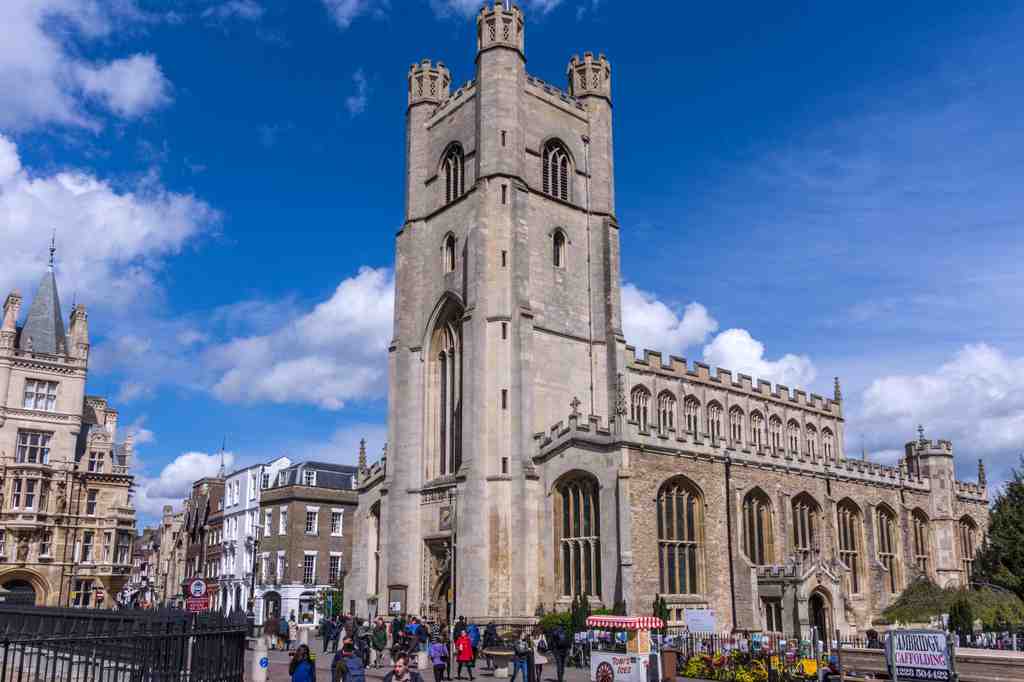
To spot the Church of St Mary the Great, look just ahead for a grand, creamy-yellow stone building with a tall, square tower and battlements at the top, right at the north end of King's Parade.
Welcome to Great St Mary’s, the heart and soul of Cambridge’s city centre! You’re standing in front of a building that’s been through more drama than a reality TV show, with a tower stretching confidently over King’s Parade-as if it’s keeping a close watch on all of Cambridge’s secrets. If you listen closely, you might hear the bells preparing to ring out their famous “Cambridge Quarters,” a sound so iconic that Big Ben himself borrowed the tune.
But how did this magnificent church get here? Let’s stroll back through time, past bustling market stalls and curious students, to the days of King John in 1205. Imagine a more ancient stone church, its earliest foundations possibly from around 1010, which survived for almost 300 years-until the flames arrived in 1290. In the aftermath, the townsfolk blamed the city’s Jewish community and closed the synagogue, a dark chapter in the city’s history.
Fast forward through the centuries and you’ll find Great St Mary’s serving not just as a parish church but as the official university church. If you’ve ever wondered why Cambridge students don’t stray too far, thank this church! University officers can’t live further than 20 miles, and undergraduates can’t go more than three miles from here. It’s as if the church casts a medieval “stay close” spell on everyone.
In the Middle Ages, Great St Mary’s wasn’t just for prayers-it was also the main gathering place for fiery university debates and major decisions. Imagine the chatter echoing off those Late Perpendicular stone walls. The patrons of the church have changed hats a few times, too-going from the crown to King’s Hall, and then to Trinity College, where the right to name its leader still rests.
Now, picture the year 1381: the Peasants’ Revolt erupts across the country, and angry townsfolk storm the church. Official charters, bulls, even university title deeds went up in flames right here, leaving officials scrambling to pick up the pieces. The building you see now-its present, stately form-began to rise in 1478, towering anew by 1519 and finished off with that iconic tower in 1608, thanks to the likes of Richard III and Henry VII. Clearly, the kings couldn’t agree on much, but they did agree on the importance of Great St Mary’s!
Step inside (in your mind’s eye for now): the sunlight glimmers warmly through stained glass windows, the work of Hardman, added in the late 1800s. The font dates from 1632, and, behind the high altar, you’ll find a sculpture of Christ in Majesty-an impressive work by Alan Durst from 1960 that almost seems to watch over the congregation.
And then there’s the sound! The bells were first housed outdoors, but by 1515 they proudly rang from the tower. The Society of Cambridge Youths-one of the oldest bellringing groups in Britain-has kept those bells resonating for centuries. Some of the original bells still chime today, joined by new ones, ringing in all their pealing glory.
There’s also a hint of musical rivalry. Great St Mary’s has not one, but two pipe organs: the Parish Organ for the locals and the grand University Organ-originally crafted by the legendary “Father” Bernard Smith in 1698 and rebuilt over the years to suit changing musical tastes. You can picture fingers flying across the keys during a rousing University Service or a solemn sermon.
Greats from history have stood where you stand. Erasmus, Martin Bucer, and more-some even buried here (though, in Bucer’s case, his remains had a rather dramatic journey involving burning, dust, and final rest under a brass plate). More recently, the ashes of Stephen Hawking were honoured here before being laid to rest in Westminster Abbey.
Today, Great St Mary’s is known for its open, inclusive spirit. As the bells ring and sunlight dances on stone, know you’re part of a centuries-old story-a story filled with fire, faith, debate, judgement, and the occasional Cambridge student still trying to live within three miles of the action. Quite the landmark, isn’t it?
To delve deeper into the architecture and features, list of vicars or the burials and funerals, simply drop your query in the chat section and I'll provide more information.


