
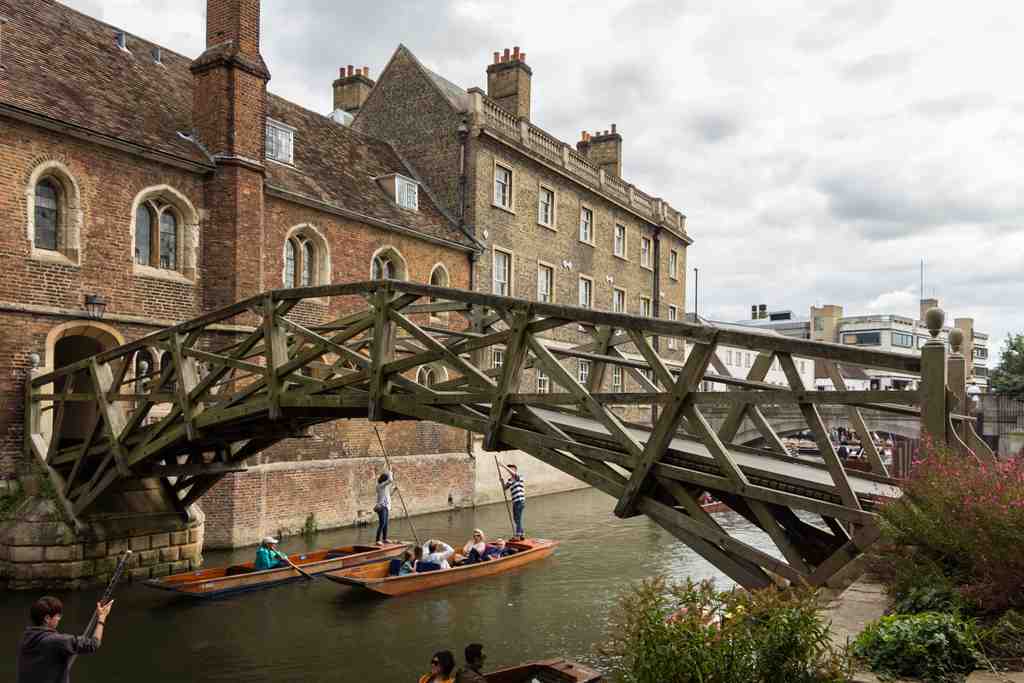
The Mathematical Bridge is a pale wooden footbridge with a strikingly geometric, criss-crossing design, arching gracefully over the River Cam between two centuries-old, brick university buildings-look out toward the water, just northwest of Silver Street Bridge, to spot it.
Welcome to your first stop! Take a good look at the Mathematical Bridge before you-its wooden curve seems almost magical, doesn’t it? Imagine yourself back in the year 1749, the air buzzing with the sound of carpenters at work as William Etheridge, a masterful designer, brings his vision to life with the help of James Essex and his builders. They didn’t have power tools or lasers, just pure genius and a lot of elbow grease. Now, this bridge doesn’t actually bend, even though it looks like a perfect wooden rainbow. No, it’s actually made up entirely of straight timbers, cleverly bolted and fitted together to form that beautiful arc.
This engineering wizardry is what earned the bridge its nickname. Why call it the Mathematical Bridge? Well, Etheridge’s trick was to use a series of straight beams, arranged in clever tangents and radii, to form a strong, self-supporting arch. The tangents take on the weight, feeling the squeeze of compression, while the radial timbers are pulled tight, almost humming with tension. So next time you’re challenged by a tricky math problem, just remember - with the right angles and a little patience, you could probably build a bridge!
But here’s where things get mysterious. For years, a popular legend swept through Cambridge, whispering that none other than Sir Isaac Newton himself built this bridge-using nothing more than his massive brainpower, and apparently, not a single bolt or nut. Some versions of the story say students tried to disassemble and then reassemble it, but without the “secret” knowledge, they had to use nuts and bolts to keep it standing. Talk about exam stress! But the truth is, our good friend Newton had already shuffled off this mortal coil a full twenty-two years before the bridge was ever built. The real reason for the myth was more hidden than his apple: Iron spikes were hammered in from the outside where no one could see-giving the illusion of a magical, bolt-free bridge.
Despite the myths and the fact it’s been rebuilt a few times, the Mathematical Bridge stands as a testament to clever engineering-and to the power of a good story. As you stand here, listen to the gentle lap of the river and maybe the distant laughter of punters coasting beneath the bridge, and know you’re in a place where math, myth, and imagination all come together. Ready for your next stop? Let’s continue our journey!


