
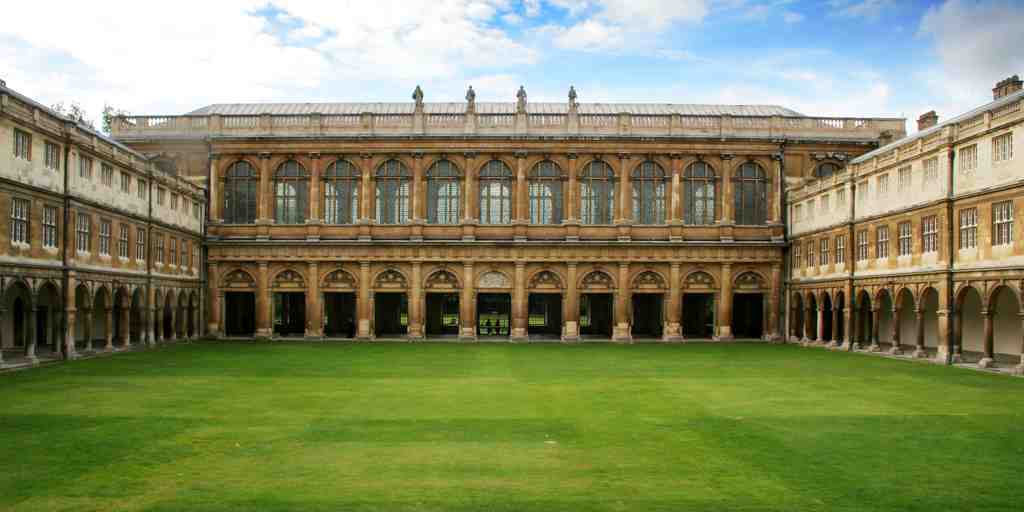
To spot the Wren Library, just look straight ahead for a long, elegant building standing above an open row of arches, with huge windows shining down on the grass of Nevile's Court and four statues proudly perched along the roof.
Now, pause for a moment and breathe in the quiet energy around you. You’re standing before the Wren Library, and you might as well imagine the scent of old books and the gentle shuffle of scholars plotting world-changing ideas. This majestic building was dreamt up by Sir Christopher Wren back in 1676-yes, the very same man who gave London its St Paul’s Cathedral after the Great Fire. When it finally opened in 1695, the people of Cambridge were buzzing: Wren’s design looked like nothing seen before. While libraries were once dark, stuffy places, this one flooded readers with light-those giant windows above you were truly a revolution. In fact, you could say it was the first time students could actually see what they were reading, rather than just guessing. The floor inside drops lower than the outside façade, a clever trick to keep those graceful proportions without squishing the ceiling.
Imagine stepping through the ground-floor arches, climbing up, and arriving in a single vast room-sunbeams pouring across shelves lined with treasures. Bookcases march in file beneath the windows, each crowned by intricate limewood carvings, fluttering and curling as if alive, made by the famous Grinling Gibbons. Above those, busts of writers from every age seem to peer down-were they watching for overdue library books, or just daydreaming along with the students? The marble figures on plinths were mostly carved by Louis-François Roubiliac-every face with its own story. And yes, that’s a full-sized statue of Lord Byron, looking rather dashing. He was once offered a spot in Poets' Corner at Westminster Abbey, but let’s just say his wild adventures put off the gatekeepers. Thank goodness, or he’d never have ended up here.
Now, lift your eyes to the roof. On the east balustrade, four statues gaze out: Divinity, Law, Physic (that’s medicine), and Mathematics. It’s as if the very foundations of knowledge are keeping watch. The atmosphere inside is hushed, interrupted only by your own footsteps-imagine the whispers of Newton or Francis Bacon echoing underneath the vast ceiling. At the far end, you’d find a towering stained-glass window, designed by Giovanni Battista Cipriani. In this riot of colored glass, Fame herself presents Isaac Newton to King George III (who looks fairly comfortable, considering), while cherubim and a trumpet-blowing lady make it a celebration worth pausing for. In the 19th century, this window was hidden behind thick curtains, so scholars wouldn’t get distracted-honestly, I think they were more worried about staring contests with the bare-breasted muse.
The library is bursting at the seams with relics: Newton’s own annotated copy of Principia, medieval manuscripts, the earliest books printed in English, A. A. Milne’s original Winnie-the-Pooh stories, and even Robert Oppenheimer’s own notes on the atomic bomb. The inventory is so rich that you half expect to bump into Winnie-the-Pooh and Isaac Newton debating next to a shelf of Shakespeare’s first folios. Today, most of these treasures have been lovingly digitized, ready for readers from all over the world.
Though its doors are sometimes guarded by limited opening hours, a walk by the Wren Library is always worth it. If you listen closely, you might almost hear the pages turning through 300 years of history-a living testament to the curiosity that fuels Cambridge itself.




