
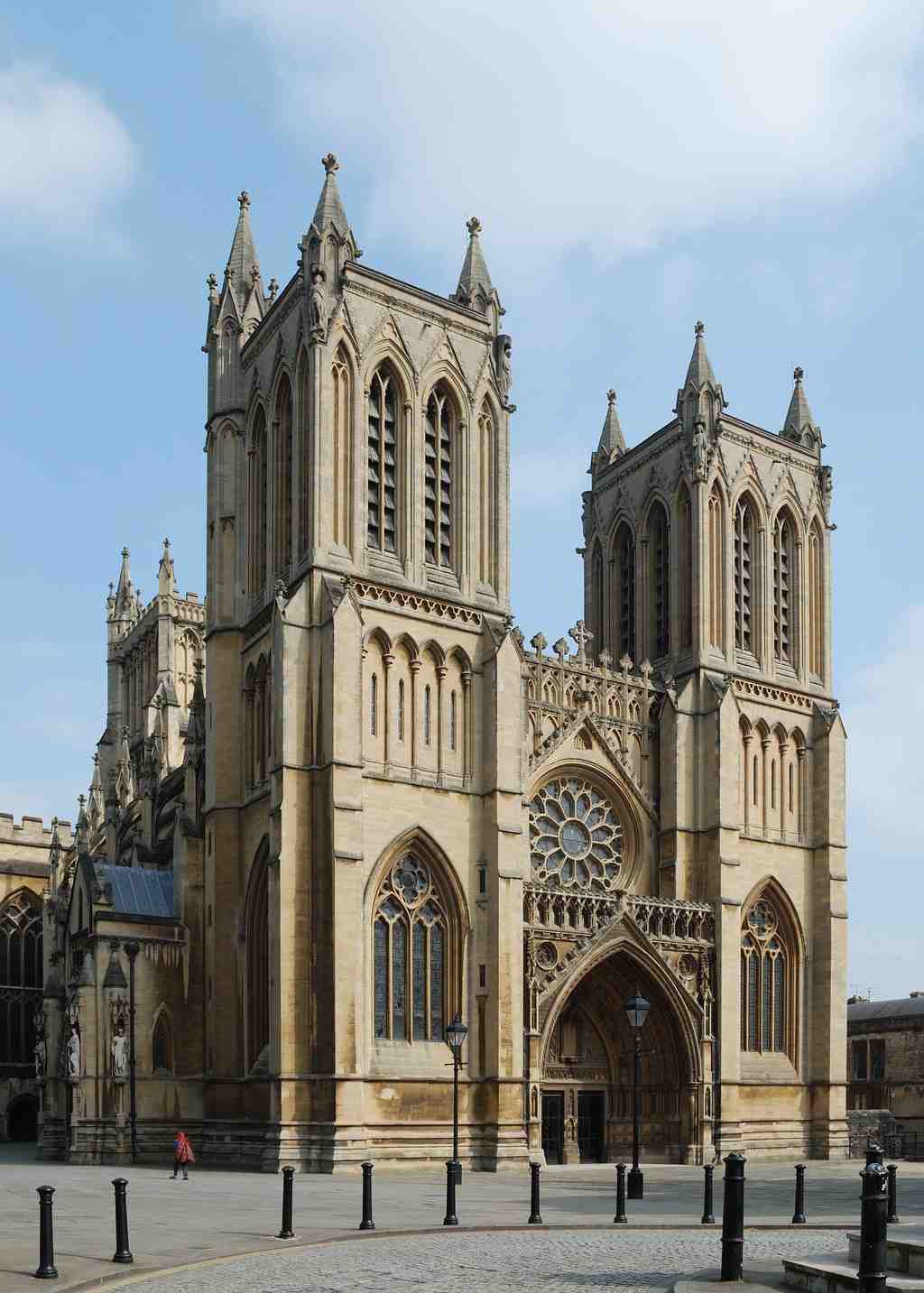
As you're approaching on your right, you'll see an impressive, grand structure with twin towers that resemble something straight out of a medieval fantasy film. The facade of the building boasts intricate Gothic architecture with tall, narrow windows punctuated by striking stonework. At the base, there's a stunning arched entrance with detailed carvings, and if you look carefully, you'll spot a rose window right above it, sparkling like a giant medieval eye.
Ah, welcome to the marvelous Bristol Cathedral! Or, if you’re feeling fancy, the Cathedral Church of the Holy and Undivided Trinity. This place is like a living history book, blending architecture through the ages. Founded way back in 1140 by a well-off local landowner named Robert Fitzharding, it was initially an abbey dedicated to St Augustine. It was consecrated in 1148, just in time to catch the High Middle Ages in full swing - thank goodness for that timing.
In 1542, after King Henry VIII’s grand ol' dissolution of the monasteries, the abbey got an upgrade to become the seat of the new Diocese of Bristol. Talk about a glow-up! It also took on the role of being the Bishop of Bristol’s fancy office.
Now, the cathedral is not only a Grade I listed building, which means it’s of exceptional interest, but it also showcases some groundbreaking architectural bits. The late 12th-century chapter house, for example, is among the first to feature pointed arches in England. If those arches could talk, they’d probably boast about being trendsetters.
The Elder Lady Chapel, dating back to the early 13th century, holds the title of the oldest part of the eastern end. The rest of the east side underwent a serious makeover in the 14th century, adopting the English Decorated Gothic style. Think high ceilings and stunning symmetry.
Fast forward to the 19th century, the cathedral’s nave was lovingly replaced in the Gothic Revival style by George Edmund Street. And the grandeur we see today spans all the way to the towering designs of John Loughborough Pearson, completed in 1888.
Inside, you’ll find an assortment of memorials and a historic organ that still fills the cathedral with music. Mind you, the original stained glass didn’t have much luck surviving - thanks to the Victorian era and World War II’s Bristol Blitz - but what remains still tells the tale.
In summary, it’s a mashup of medieval flair and Victorian ingenuity wrapped in one cathedral-shaped package. Enjoy gazing at this piece of history as you soak in the Bristol vibes!
For a more comprehensive understanding of the architecture, decoration, monuments and burials or the music, engage with me in the chat section below.


