
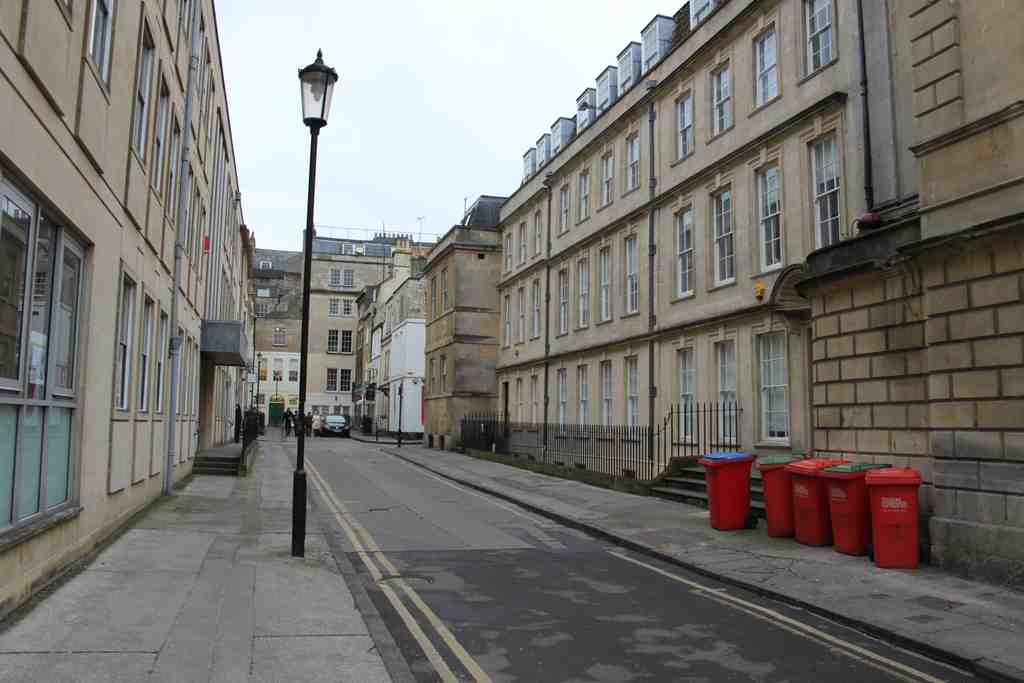
You’re standing right at the heart of Trim Street. Look around and you’ll spot a narrow, quiet street framed on both sides by tall, honey-colored stone buildings with neat rows of big sash windows. You’ll notice some of these buildings are three or even four stories high, with sloping mansard roofs peeking out at the top. If you want to make sure you’re in the right place, just glance to your right-you’ll see those classic Bath railings running along the pale stone, and maybe even a few bright red rubbish bins waiting for collection day, a sign that history and everyday life still mingle side by side here.
Now, picture yourself here back in 1707 when Trim Street was brand new-built for both houses and shops, with carriages rattling along the cobbles and maybe the smell of fresh bread or horses in the air. It was named after George Trim, the man who owned the land, and you could say this street has seen more than its fair share of famous faces and secrets.
Take Number 5, for example-a two-storey building with a strong, solid look, thanks to its chunky rusticated corners. If you ever see its doorway, check out the elegant Ionic columns and the tympanum decorated with what looks like a starter pack for a warrior: swords, shields, and other implements of war. This was where General James Wolfe stayed the night before he got a letter-no, not by email-a real letter, delivered by William Pitt the Elder himself, commanding him to go capture Quebec. No pressure, right?
Numbers 6, 7, 8, and 9, with their extra-tall, three-storey facades and stylish mansard roofs, tell a story of growing families and changing tastes. Number 10 stands out with its attic at the top-perfect for hiding your secrets (or maybe just extra boxes). Its front door has classic Doric columns and a proper pediment, lending just a hint of ancient Greece to the heart of Bath.
Look up and down the street, and you’ll see how the old shops have become modern flats and the grand homes now share space with office workers, locals, and the occasional lost tourist. Once upon a time, Jane Austen herself called this street home. It was her fourth Bath address-and each new move for the Austen family seemed to shrink both in size and fanciness. Even famous writers have to put up with dodgy landlords and awkward neighbors.
And over on Trim Street, the Unitarian Church, built by John Palmer in 1795, has seen its fair share of spiritual searching and romantic beginnings. The antiquarian Joseph Hunter not only preached here but also fell in love-marrying Mary Hayward and having six children. Who says history can’t have a happy ending?
So as you breathe in the air along Trim Street, imagine the wheels of history turning, soldiers and ministers plotting their futures, writers dreaming up novels, and everyday Bathonians making Trim Street their home. And don’t forget: even the grandest stories sometimes start in the humblest places-maybe even just across from a row of bright red bins.




