Swindon Audio Tour: Swindon’s Unexpected Heritage Trail
Beneath Swindon’s quiet skyline, echoes of riots, radio revolutions and theatrical whispers pulse just out of sight. This city hides stories you will not find in the guidebooks. This self-guided audio tour leads you through Swindon’s heart, unlocking scandals, rivalries and backstage secrets that even locals overlook. With each stop, step into hidden histories as dramatic as any play or broadcast. Which chilling political standoff once shattered the calm at Swindon Town Hall? Who vanished from the BBC Radio Wiltshire studio without a trace? What legendary prank still echoes behind the curtains of the Wyvern Theatre? Move through buzzing streets and hushed corridors where drama unfolded and reputations were made or lost. Discover Swindon not just by sight but by scandal, laughter and suspense with every stride. Begin your walk now and let Swindon reveal its most electrifying secrets.
Tour preview
About this tour
- scheduleDuration 100–120 minsGo at your own pace
- straighten4.6 km walking routeFollow the guided path
- location_onLocationSwindon, United Kingdom
- wifi_offWorks offlineDownload once, use anywhere
- all_inclusiveLifetime accessReplay anytime, forever
- location_onStarts at Swindon Law Courts
Stops on this tour
lock_open 3 free previews · 10 unlock with purchase
In front of you is a red-brick, angular court building with a recessed corner entrance, square windows, and a Royal coat of arms fixed to a plain central wall. Swindon handled…Read moreShow less
Open dedicated page →In front of you is a red-brick, angular court building with a recessed corner entrance, square windows, and a Royal coat of arms fixed to a plain central wall.
Swindon handled justice in a rather improvised way for years. In the nineteenth century, petty sessions - the lower-level local hearings - met first in the Goddard Arms on the High Street, then in the Old Town Hall, and later the New Town Hall. Practical, yes. Grand? Not especially. By nineteen sixty-five, the town finally got proper Courts of Justice in Princes Street, now the magistrates' court. But Swindon kept growing, and so did its legal workload.
So in nineteen eighty-five, this building opened on Islington Street, on land where terraced houses had stood before. The Property Services Agency designed it in a Modernist style - meaning clean lines, blunt shapes, and very little interest in ornament for ornament's sake. If you glance at the photo in the app, you can see that slightly awkward, asymmetrical frontage for yourself. The recessed corner creates a little breathing room, and inside, the plan made space for seven courtrooms.
This is a combined court centre: Crown Court for serious criminal trials, often with a jury, and County Court for civil disputes - money, property, contracts, the arguments that arrive without handcuffs. It has also handled cases with devastating consequences, reminding you that these rooms deal in very human realities.
If you need the practical detail, the courts generally operate Monday to Friday, nine AM to five PM. This place reminds you that justice is rarely tidy, even when the architecture tries to be. When you're ready, continue on to the Wyvern Theatre.
On your right, look for a pale concrete and glass building with a low, angular frontage and the Wyvern Theatre name fixed across the facade. This is the Wyvern Theatre, Swindon’s…Read moreShow less
Open dedicated page →On your right, look for a pale concrete and glass building with a low, angular frontage and the Wyvern Theatre name fixed across the facade.
This is the Wyvern Theatre, Swindon’s six hundred and thirty-five seat indoor auditorium, and it opened in September, nineteen seventy-one as part of the Civic Centre designed by Casson, Conder and Partners. Its name reaches much further back than the building itself. A wyvern is a dragon-like creature with two legs and wings, and it once served as an emblem of the kings of Wessex. So this theatre carries a bit of local myth in its title... which is exactly the sort of thing a theatre ought to do.
Queen Elizabeth the Second and Prince Philip opened it on the seventh of September, nineteen seventy-one. The first performance came from a Ukrainian dance company, which feels like a strong opening note for a place meant to hold all sorts of voices, stories, and styles. If you glance at the image on your screen, you can catch that civic-centre look clearly: solid, practical, a little stern, and entirely uninterested in being fashionable.
But theatres are not really about concrete. They are about accumulated applause. Inside this building, generations of Swindon families learned the sacred rules of pantomime: cheer the hero, boo the villain, and abandon all standards of dignity before the interval. The Christmas shows became a proper local tradition, starting with Dick Whittington and His Cat in the first season and continuing through decades of Aladdin, Cinderella, Jack and the Beanstalk, Peter Pan, Sleeping Beauty, and more. Familiar names kept turning up too, including Keith Chegwin, Adam Woodyatt, Michelle Collins, Anne Hegerty, and David Ashley, who seems to have logged enough appearances here to qualify for his own dressing room postcode.
The Wyvern also did something more important than hosting visiting stars. Its Summer Youth Project gave local young performers a serious stage for musicals like Bugsy Malone, Oliver!, West Side Story, Grease, Hairspray, Legally Blonde, and The Wizard of Oz. That kind of tradition keeps a theatre alive. The backstage photo in the app shows the less glamorous magic behind the curtain: the working spaces, the hidden effort, the machinery of make-believe.
The building has had its own dramatic turns. In two thousand and six, inspectors found traces of asbestos in the offices and roof void, the concealed space beneath the roof structure. The theatre shut for about a year, then used the pause for a one point three million pound refurbishment, adding new decor, bars, cafes, disabled entrances, and new seating. It closed again during the coronavirus disease pandemic, C-O-V-I-D nineteen, and reopened between August and September, twenty twenty-one. Swindon Borough Council owns the theatre, and Trafalgar Entertainment has operated it since twenty twenty-one.
Its future is still being argued over. In twenty nineteen, the council said structural and maintenance reports suggested the building could reach the end of its life by twenty twenty-seven without major investment. By September, twenty twenty-four, proposals had appeared for a larger multi-purpose theatre on the bus station site, while this building would stay and be repurposed for community arts groups. Not a final curtain, then... more of a cast change.
If you need it later, the box office is generally open Monday to Saturday from eleven in the morning to five in the afternoon, and it is closed on Sunday.
The Wyvern shows how a town gives itself a stage, then spends decades filling it with memory.
When you are ready, head on to the Museum of Computing, where Swindon's next surprise is all circuits and code.
On your left, look for a compact brick-fronted unit with broad rectangular windows and a simple sign set into Theatre Square. This modest frontage hides a big claim: it became…Read moreShow less
Open dedicated page →On your left, look for a compact brick-fronted unit with broad rectangular windows and a simple sign set into Theatre Square.
This modest frontage hides a big claim: it became the first museum in the United Kingdom devoted entirely to the history of computing, opening in February two thousand and three. It preserves early computers as an educational resource and a repository for historians and collectors... in plainer English, it saves machines before they vanish into attics. Inside, volunteers keep working computers and interactive exhibits alive; one show ran from Pong to PlayStation, and more than thirty machines helped Gordon Laing write Digital Retro in two thousand and four. Sir Clive Sinclair launched a calculator exhibition here in March two thousand and six, and in two thousand and ten the museum marked Pac-Man's thirtieth birthday with a real-life game. It moved to this Theatre Square spot in July two thousand and nine, between the library and theatre. Rather fittingly, this not-for-profit still runs largely on volunteers, and it usually opens only on Saturdays from nine thirty to five. When you're ready, continue toward the Victorian Turkish Baths.
Show 10 more stopsShow fewer stopsexpand_moreexpand_less
On your left, look for the solid red-brick building with its broad rectangular frontage, pale stone trim, and the separate Milton Street entrance that once led straight into the…Read moreShow less
Open dedicated page →On your left, look for the solid red-brick building with its broad rectangular frontage, pale stone trim, and the separate Milton Street entrance that once led straight into the baths.
This place holds an oddly glorious record: Swindon’s Turkish Baths are often described as the longest surviving Victorian Turkish baths establishment in the world. Not just in Britain... anywhere. Which is not the sort of title you collect by accident.
To see why they mattered, picture New Swindon as a railway company town, built around the Great Western Railway Company, G-W-R, and its vast works. The company did not just employ people; it helped shape their housing, education, religion, and healthcare through the Medical Fund Society. In eighteen sixty, G-W-R approved Turkish baths for workers and their families, but only if the society paid for them itself. Sensible accounting, perhaps... less thrilling for anyone waiting to wash properly. One supporter even said he could build a bath for one hundred pounds, roughly fifteen thousand pounds today, but the plan stalled. A later proposal needed two hundred and fifty pounds, about thirty-five thousand today, and that also proved a bit too ambitious.
So the first proper Turkish baths finally opened on the first of October, eighteen sixty-eight, in Taunton Street. A Turkish bath, despite the name, is really a sequence of heated rooms, washing, massage, and cooling down. Think of it as deep cleaning with a side order of discipline.
The baths here opened on the tenth of December, nineteen oh six, as part of the Medical Fund Society’s newer baths and dispensary building, with their own entrance around the corner in Milton Street. Strictly speaking, that makes them Edwardian, because Queen Victoria had already gone, but they were designed so firmly in the Victorian style that only a dedicated pedant would pick that fight.
Inside, the men’s suite was the showpiece. Three original hot rooms still survive almost unchanged. Then came a shampooing room - in bath-house language, that meant a vigorous wash and massage - with two marble slabs and a circular needle shower, a ring of fine water jets. There was also a Russian steam bath, a cold plunge pool nine feet wide, unusually generous for its kind, and a spacious cooling room with mosaic floors, a large fireplace, and a clock over the mantel. The women’s baths upstairs were smaller, with two hot rooms, six dressing cubicles, and their own shampooing room. They closed by the mid-nineteen fifties, but the door survives, still carrying a colored glass panel designed by a company employee, Mr Rice.
After nineteen forty-eight, the National Health Service, N-H-S, took over the fund’s medical services, and the building became the N-H-S Health Centre and Milton Road Baths. In nineteen eighty-six, the council took charge, refurbished the baths, and relaunched them as the Swindon Health Hydro. Today the building is Grade Two star listed, meaning it is officially protected for exceptional historic importance.
Since twenty twenty-three, the baths have been closed while the roof is repaired, and the rest of the restoration still depends on more funding, so this rare survivor is waiting for its next chapter.
The posted hours still read six in the morning to nine at night from Monday to Friday, six till four on Saturday, and eight till five on Sunday, but for now this old steam-soaked marvel remains closed pending refurbishment. When you’re ready, continue on toward Swindon Town Hall.
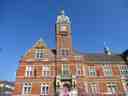
On your left, look for a red-brick Victorian building with a broad round-arched entrance, pale stone trim, and a tall clock tower rising above the roofline. This is Swindon Town…Read moreShow less
Open dedicated page →
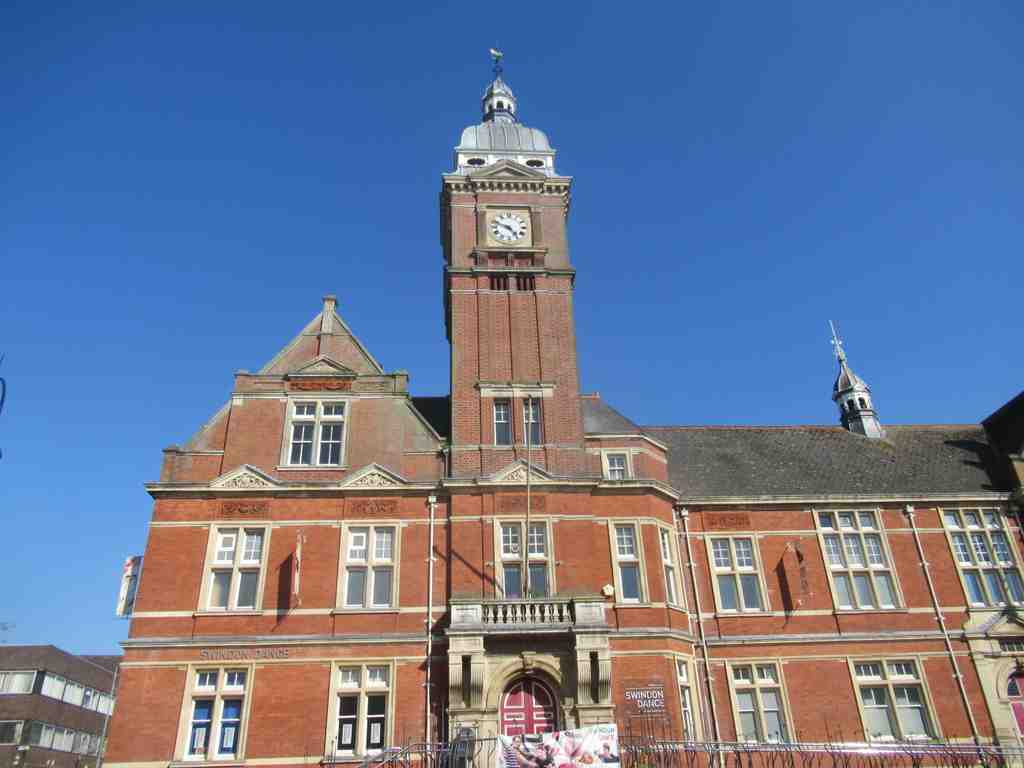
Swindon Town HallPhoto: Mewwiii, Wikimedia Commons, CC BY-SA 4.0. Cropped & resized. On your left, look for a red-brick Victorian building with a broad round-arched entrance, pale stone trim, and a tall clock tower rising above the roofline.
This is Swindon Town Hall, opened on the twenty-first of October, eighteen ninety-one, when New Swindon wanted a civic headquarters with some presence. The local board chose this spot in Regent Circus very carefully: halfway between the Railway Village and Old Town, a place meant to say, yes, this is the center now. Colonel William Vilett Rolleston sold the site, and from twenty design competition entries, the architect Brightwen Binyon of Ipswich won the job.
The building repaid that ambition in full. Right in front of you, the main entrance is framed by a big rounded arch, with paired fluted brackets - decorative supports with vertical grooves - and a balustrade, a low rail of little stone posts, above. Then your eye climbs to the ninety-foot clock tower, fitted with a clock by Thwaites and Reed. If you want a cleaner view of the whole composition, take a glance at the image in the app.
This place also sat at the center of a political tug-of-war. It replaced the old town hall in Old Town, and when New Swindon and Old Town finally merged in nineteen oh one, this became the borough council’s home until nineteen thirty-eight. Later it hosted magistrates’ hearings, housed the reference library until two thousand and six, and now serves Swindon Dance, a national dance agency. It is also Grade Two listed, meaning the building is legally protected for its historic character.
So this town hall marks the moment Swindon tried to pull its two halves into one story. When you’re ready, continue on to the museum and art gallery.
On your left stands a long pale stone and brick civic block with rounded Moderne corners, flat bands of windows, and a confident nineteen-thirties frontage that looks determined…Read moreShow less
Open dedicated page →On your left stands a long pale stone and brick civic block with rounded Moderne corners, flat bands of windows, and a confident nineteen-thirties frontage that looks determined to stay modern forever.
This is Museum and Art Swindon, and its latest chapter is a neat little story of survival. The collection began in nineteen forty-four, when local benefactor H-J-P Bomford gave the town a substantial donation of artworks. For years, people came to Apsley House to see them, along with displays on Swindon’s Jurassic geology, Roman connections, and local social history. Then things stalled. Apsley House closed in March twenty twenty during the pandemic, and by the summer of twenty twenty-one the council decided the building needed major repairs and no longer suited the museum. So the collection went into storage... which is never a glamorous sentence in museum history.
In July twenty twenty-four, it reopened here after Swindon Borough Council spent five hundred and twenty thousand pounds converting the first floor of these Civic Offices. If you glance at your screen, the image shows this streamlined exterior clearly. Historic England calls the building, completed in nineteen thirty-nine, a striking and well-realised Moderne design. That means sleek curves, long horizontal lines, and a faith in progress poured into architecture.
Inside, the focus is twentieth- and twenty-first-century British art: names like Henry Moore, Lucian Freud, Ben Nicholson, L-S Lowry, and Grayson Perry, alongside photography and studio pottery. If you want to go in, it opens Tuesday to Saturday from ten thirty to four thirty, and stays closed on Sundays and Mondays.
So this place is less a dusty storehouse than a collection that refused to disappear. When you’re ready, continue on to Holy Rood Church for another kind of Swindon memory.
On your left is a red-brick Gothic church with a steep slate roof, tall pointed-arch windows, and a stone-framed entrance that gives this corner a sturdy, upright presence. Holy…Read moreShow less
Open dedicated page →On your left is a red-brick Gothic church with a steep slate roof, tall pointed-arch windows, and a stone-framed entrance that gives this corner a sturdy, upright presence.
Holy Rood tells a story about Swindon growing faster than its first Catholic congregation could keep up. In eighteen forty-eight, before Catholic bishops were formally restored in England, a priest travelled from Fairford once a month to celebrate Mass here. Three years later, local Catholics opened a small chapel between Regent Street and Sanford Street. By eighteen fifty-seven, they had their own resident priest... and before long, even that chapel felt cramped.
So the congregation improvised. In eighteen eighty-two they bought a disused Unitarian church at Regent Circus, a Gothic Revival building completed in eighteen seventy-five for two thousand five hundred pounds, or roughly the equivalent of well over three hundred thousand pounds today. A vestry, the room where clergy prepare for services, followed in eighteen eighty-seven. Practical holiness often needs extra storage.
But Swindon kept expanding, and so did the parish. Edward Doran Webb, who also designed the Birmingham Oratory, drew up this larger church in the same Gothic Revival style, meaning a deliberate return to medieval forms like pointed arches and vertical lines. He opened it in nineteen oh five, making Holy Rood the first Roman Catholic church built in and around Swindon since the Reformation, when England broke from Rome in the sixteenth century. Canon J. J. Noonan then spent years raising six to seven thousand pounds, roughly half a million today, to clear the building debt before Bishop William Lee consecrated the church in nineteen thirty-two. If you check the image on your screen, you can see that confident Durham Street view of Webb’s design.
If you want to look inside later, the church is generally open from eight in the morning until six in the evening every day.
Holy Rood stands here as a quiet marker of return, persistence, and a community that simply refused to stay small.
When you’re ready, continue on toward Queens Park for a change of mood and a bit more breathing space.
On your right, Queens Park spreads out as broad lawns framed by winding gravel paths and a curving lake, with the Garden of Remembrance as its clearest marker. This is one of…Read moreShow less
Open dedicated page →On your right, Queens Park spreads out as broad lawns framed by winding gravel paths and a curving lake, with the Garden of Remembrance as its clearest marker.
This is one of central Swindon's quieter achievements... a Grade Two listed public park, protected for its historic character and giving the town a little breathing room without making a fuss about it. The whole site covers about twelve acres, and roughly two of those belong to the lake, which helps explain why the park feels larger than its map suggests. Around it, ornamental trees and shrubs were planted for beauty rather than efficiency... a refreshingly unindustrial choice in Swindon. If you glance at your screen, you can see that balance of water, planting, and open space laid out neatly here.
The most solemn corner is the Garden of Remembrance, which Princess Elizabeth officially opened on the fifteenth of November, nineteen fifty, to honor local people who died in the Second World War. Since two thousand and eighteen, South Swindon Parish Council has cared for the park under a ninety-nine-year lease. It is generally open daily from seven in the morning until nine-thirty at night.
Queens Park shows how a town remembers, rests, and gets on with life all in one place.
When you're ready, carry on toward Christ Church.
On your left, Christ Church rises in pale stone with a steep slate roof and a tall needle-like spire that pins the skyline. George Gilbert Scott designed this church in eighteen…Read moreShow less
Open dedicated page →
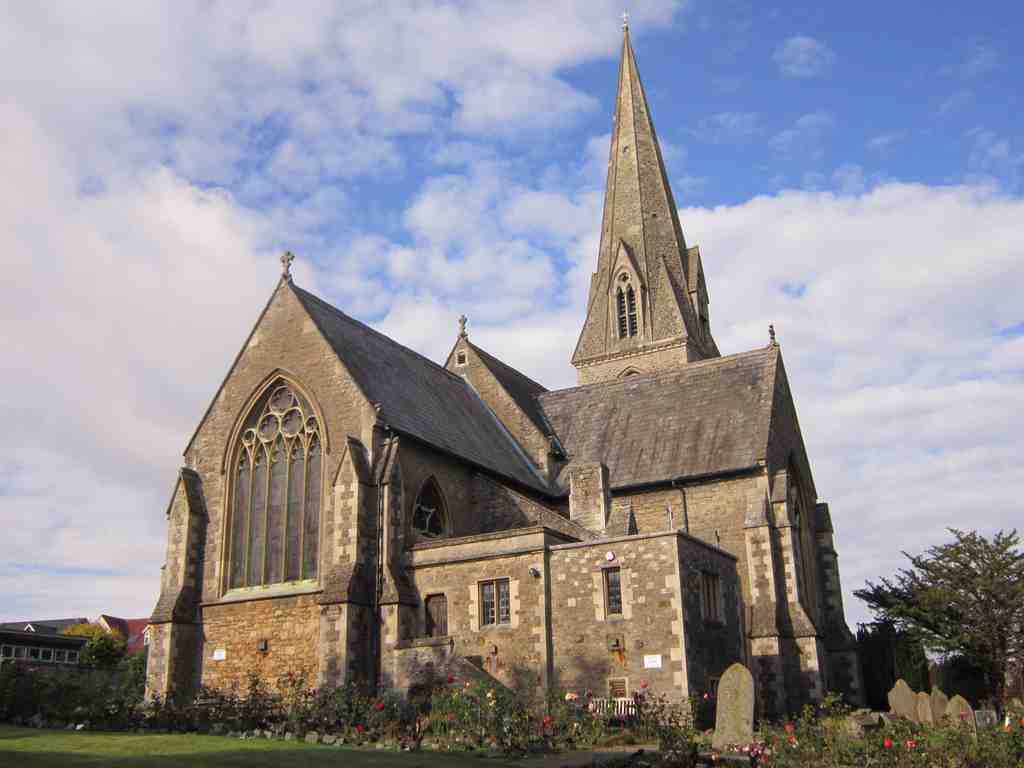
Christ Church, SwindonPhoto: My another account, Wikimedia Commons, CC0. Cropped & resized. On your left, Christ Church rises in pale stone with a steep slate roof and a tall needle-like spire that pins the skyline.
George Gilbert Scott designed this church in eighteen fifty-one, and Swindon later gave it Grade Two Star listed status... a polite British way of saying, “hands off, this one matters.” It became one of Old Town’s two big civic landmarks, along with the old town hall. Inside, the two thousand and seventeen remodel kept the nave pews - the church’s main seating in the central hall - but fixed them so they can be removed for larger events, while adding better access, gas heating, and L-E-D lighting. If you glance at the before-and-after image, you can see how the Victorian streetscape changed while the chancel, transept, and soaring spire barely blinked. In the grounds lies jockey Tommy Cullinan, buried in a Commonwealth War Grave after becoming the first rider to win National Hunt racing’s unofficial Triple Crown in one season, in nineteen thirty.
If you want to look inside, Christ Church is generally open daily from nine in the morning to five in the afternoon.
This place still balances worship, memory, and community rather gracefully. When you’re ready, continue on toward B-B-C Radio Wiltshire.
Look for a compact brick-and-glass building with a plain rectangular frontage and a fixed B-B-C sign marking the entrance. This is B-B-C, the British Broadcasting Corporation,…Read moreShow less
Open dedicated page →

BBC Radio WiltshirePhoto: British Broadcasting Corporation, Wikimedia Commons, CC BY-SA 4.0. Cropped & resized. Look for a compact brick-and-glass building with a plain rectangular frontage and a fixed B-B-C sign marking the entrance.
This is B-B-C, the British Broadcasting Corporation, Radio Wiltshire, broadcasting from Prospect Place and sending Swindon and the wider county a steady stream of news, sport, conversation, and the occasional spirited opinion about local life. In other words, the sort of thing people insist they never listen to... right before quoting it word for word.
The station began here on the fourth of April, nineteen eighty-nine, but not under its current name. It launched as B-B-C Wiltshire Sound because its commercial rival, G-W-R, owned the trademark for the words “Wiltshire” and “Radio” used together. Radio history can be gloriously petty. The first voice listeners heard belonged to Paul Chantler, and the early logo borrowed one of Wiltshire’s proudest symbols, the Westbury White Horse.
From the start, the station built its reputation on solid local programming. Under programme editor Mike Gray in the early nineteen nineties, it took some lively chances too. He gave a seventeen-year-old Swindon student named Mark Franklin his own shows; that led to Franklin being spotted and hired for Top of the Pops, which is not a bad career jump for a local presenter. Another specialist voice came from jazz singer Rosemary Squires.
Then there was Acrebury, the station’s long-running radio soap. Presenter and actor Gerry Hughes voiced every single character himself and earned a Guinness World Record for doing it. That is either heroic versatility or a sign nobody in the building escaped quickly enough. Salisbury even got its own breakfast show for a while, simply because it sits far enough from Swindon to feel like its own radio world.
In two thousand, the station relaunched. Acrebury disappeared, the Salisbury breakfast show went too, and some presenters left. Listeners were unhappy enough to protest outside these headquarters, and the local paper had a field day. The relaunch also gave Swindon separate programmes from the rest of the county, reflecting the town’s rapid growth and new unitary authority status, meaning Swindon now ran its own local council services rather than sharing them at county level.
The app image shows that awkward middle chapter in two thousand and six, when the service carried a split identity as B-B-C Radio Swindon and B-B-C Radio Wiltshire before the two strands reunited. In two thousand and eight the station became simply B-B-C Wiltshire, then in twenty twenty it reverted to B-B-C Radio Wiltshire again, partly because the new jingle package needed a name that fit. Broadcasting, as ever, runs on both public service and practicalities.
Today, the sound from this building still travels widely: on F-M, D-A-B, Freeview, and B-B-C Sounds. By December twenty twenty-three, the official audience body R-A-J-A-R counted eighty-nine thousand weekly listeners, with a six point two percent share.
For all the renaming and reshuffling, this place still does one very old job: it helps a county hear itself.
When you are ready, continue to Apsley House for a very different kind of local story.
On your right, Apsley House is a Bath-stone villa with a shallow porch, crisp rectangular windows, and a neat classical front. Between about eighteen thirty and eighteen forty,…Read moreShow less
Open dedicated page →On your right, Apsley House is a Bath-stone villa with a shallow porch, crisp rectangular windows, and a neat classical front.
Between about eighteen thirty and eighteen forty, builders raised this smart ashlar house; ashlar simply means stone cut smooth and square, the Victorian equivalent of showing up properly dressed. The porch over the middle entrance borrows the sturdy Doric look of an ancient Greek temple, without getting too theatrical about it. The Toomer family lived and worked here for years, running their coke and coal business from the house. Then, in nineteen thirty, Swindon turned it into the Swindon Museum and Art Gallery, and it kept that role until twenty twenty-one. The image in the app catches that museum chapter near its end. To the right, a modernist extension from nineteen sixty-three and nineteen sixty-four stretches above the shops on Victoria Road. In nineteen fifty-one, the U-K gave the house Grade Two listed status, legal protection for a building of special interest, and one historian later called it a good ashlar villa. Apsley House proves a solid house can live several lives. When you’re ready, continue toward the Arts Centre.
On your left is a low brick-and-glass building with a broad flat frontage, a recessed entrance, and permanent Swindon Arts Centre lettering marking the doorway. This is one of…Read moreShow less
Open dedicated page →On your left is a low brick-and-glass building with a broad flat frontage, a recessed entrance, and permanent Swindon Arts Centre lettering marking the doorway.
This is one of Old Town’s quieter workhorses: a two hundred and twelve seat venue that opened officially on Saturday, the first of September, nineteen fifty-six. Mayor N-V Toze did the honors with Llewelyn Wyn Griffith, the vice-chairman of the Arts Council of Great Britain. But the idea was older than the building. About ten years earlier, Swindon had already set up an arts centre in a former Methodist Hall in the town centre... which is a very Swindon solution, really: culture first, ideal building later.
What matters is that this place never aimed to be grand for grand’s sake. It hosts professional shows and amateur productions side by side, which gives it a healthy lack of snobbery. In January two thousand and three, a refurbishment added a lift in the new foyer, better access to the first-floor auditorium, accessible toilets, and new seats. Then, in twenty ten, the ground floor got a full rethink: a performance studio, bar, café, and space for the Old Town public library.
If you check your screen, the bronze veneer sculpture Applause outside sums up the spirit nicely. A theatre that literally put clapping in the forecourt. Richard Digance became the venue’s first patron in twenty ten, and Pam Ayres supports its Friends. Today, Trafalgar Theatres manages it for Swindon Borough Council.
If you plan to return, it usually opens from eleven in the morning until three in the afternoon, Monday to Saturday, and stays closed on Sunday. This place proves that a modest stage can still hold a town’s cultural nerve. When you’re ready, head on to the Old Town Hall for our final stop.
On your right is a broad ashlar-stone building with a symmetrical five-bay front, tall flat pilasters dividing the facade, and a neat roof lantern rising above the central…Read moreShow less
Open dedicated page →On your right is a broad ashlar-stone building with a symmetrical five-bay front, tall flat pilasters dividing the facade, and a neat roof lantern rising above the central pediment.
This started life in eighteen fifty-four as Swindon’s town hall, designed by Sampson Sage and E. Robertson in a neoclassical style that aimed for dignity without showing off too much. Those pilasters are shallow columns attached to the wall... a classical trick for making a building look more authoritative. Before this, the council held meetings in the Goddard Arms, a much smaller High Street pub that had earlier traded as the Crown. Practical, yes. Grand, not exactly.
In eighteen sixty-six, Wilson and Willcox of Bath added the tower and space for a corn exchange, where grain dealers could trade under cover. An adjoining wine store even lent its upper hall to the magistrates’ court for a couple of decades. If you glance at your screen, you can see that later, fuller version of the building here
Then the plot thickened. Civic business moved out in eighteen ninety-one, and this place reinvented itself again and again: roller skating rink in nineteen ten, cinema in nineteen nineteen, then after the Second World War, the Locarno dance hall. Not a bad second career. Cilla Black sang here in nineteen sixty-four; so did The Yardbirds, The Who, Small Faces, and Fleetwood Mac. There’s a glimpse of that leisure chapter on your phone too
After bingo, vacancy, and fires in two thousand and three and two thousand and four, the building slipped into serious decay. By twenty nineteen, the Victorian Society listed it among Britain’s most endangered buildings... a reminder that survival, in Swindon, often depends on stubbornness.
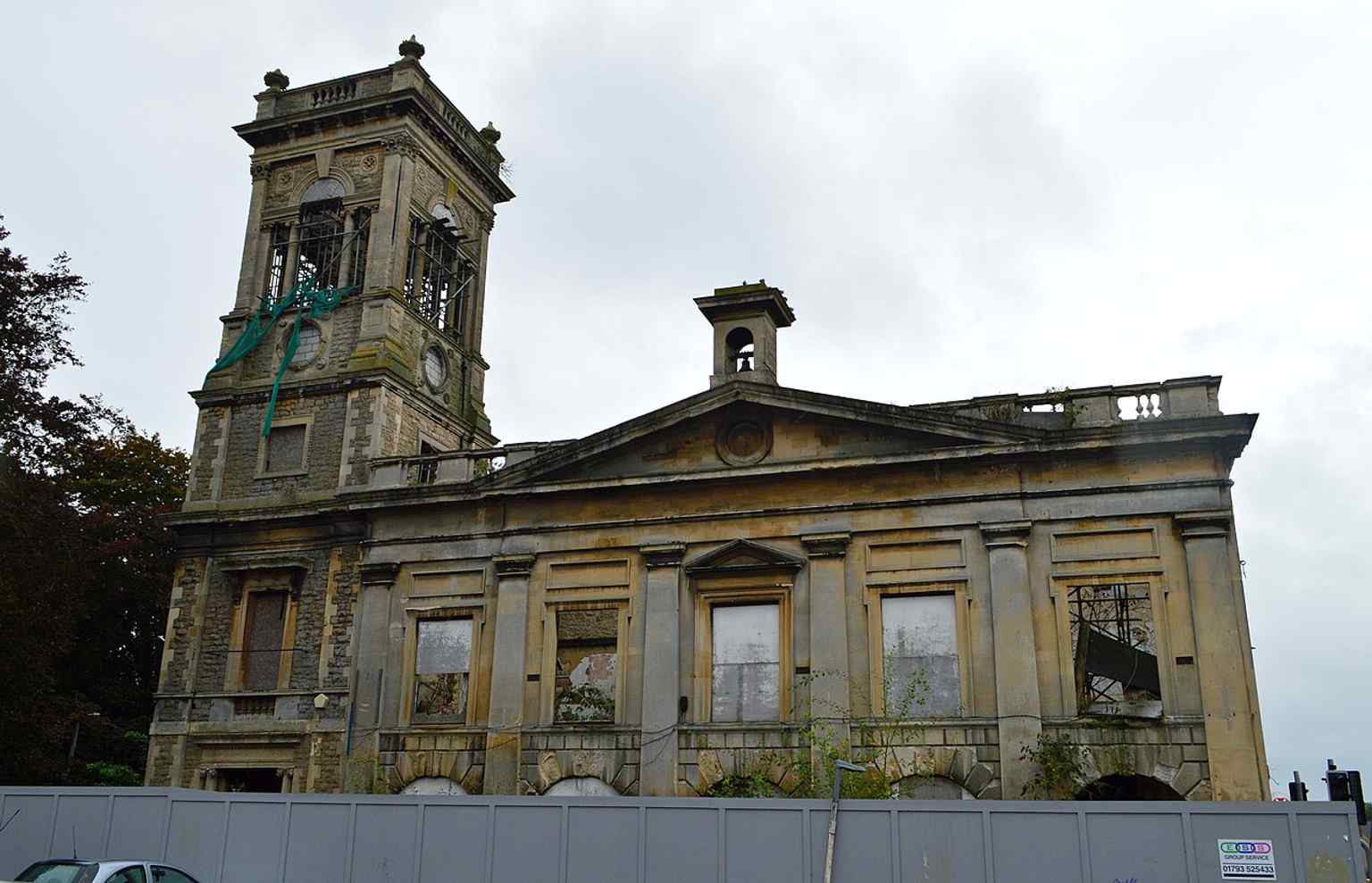
A clear modern view of Swindon’s Old Town Hall and Corn Exchange, the Grade II listed building that began life as the 1854 town hall.Photo: Switchwitch2007, Wikimedia Commons, CC BY-SA 4.0. Cropped & resized.
Frequently asked questions
How do I start the tour?
After purchase, download the AudaTours app and enter your redemption code. The tour will be ready to start immediately - just tap play and follow the GPS-guided route.
Do I need internet during the tour?
No! Download the tour before you start and enjoy it fully offline. Only the chat feature requires internet. We recommend downloading on WiFi to save mobile data.
Is this a guided group tour?
No - this is a self-guided audio tour. You explore independently at your own pace, with audio narration playing through your phone. No tour guide, no group, no schedule.
How long does the tour take?
Most tours take 60–90 minutes to complete, but you control the pace entirely. Pause, skip stops, or take breaks whenever you want.
What if I can't finish the tour today?
No problem! Tours have lifetime access. Pause and resume whenever you like - tomorrow, next week, or next year. Your progress is saved.
What languages are available?
All tours are available in 50+ languages. Select your preferred language when redeeming your code. Note: language cannot be changed after tour generation.
Where do I access the tour after purchase?
Download the free AudaTours app from the App Store or Google Play. Enter your redemption code (sent via email) and the tour will appear in your library, ready to download and start.
If you don't enjoy the tour, we'll refund your purchase. Contact us at [email protected]
Checkout securely with