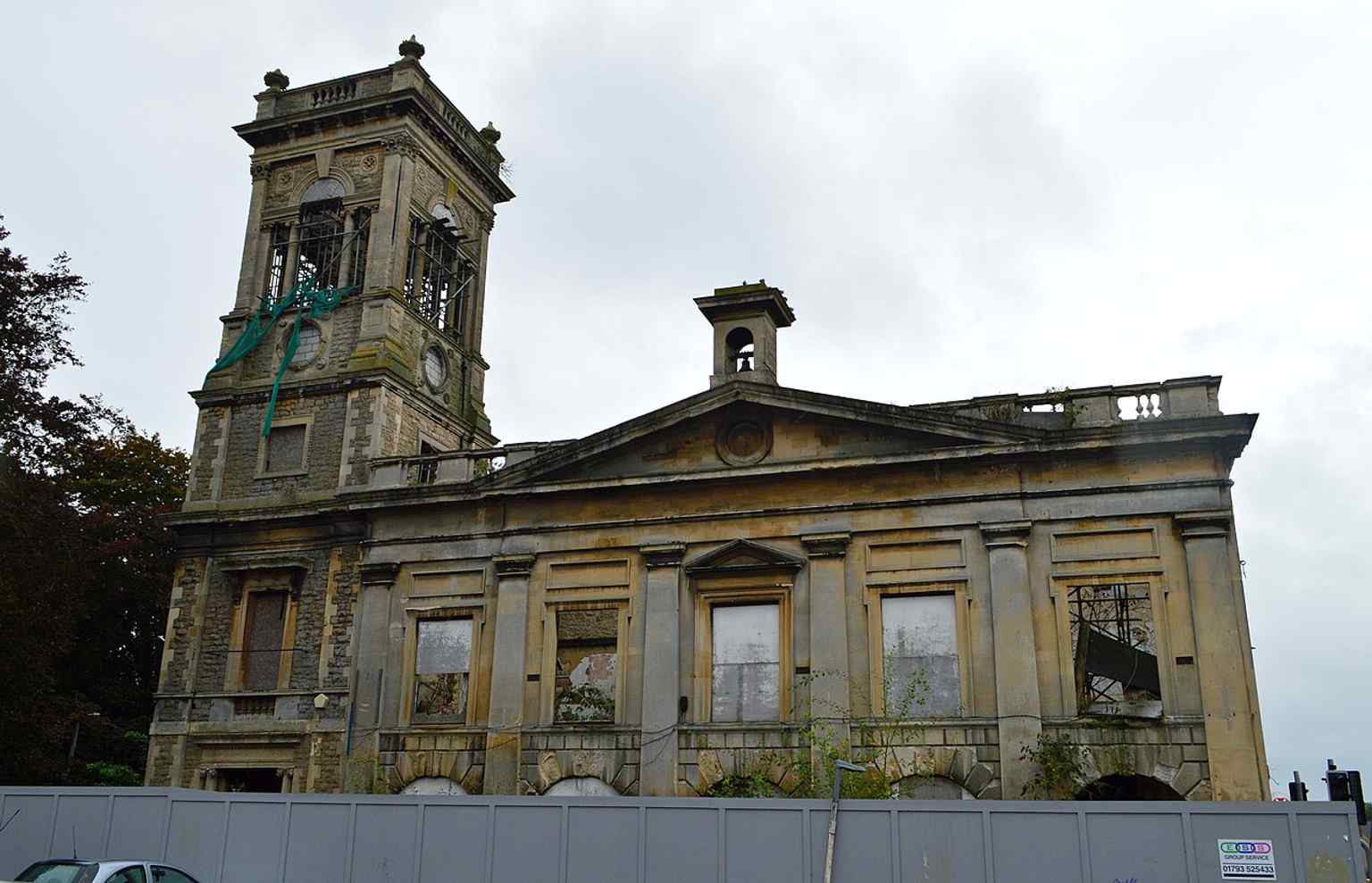
On your right is a broad ashlar-stone building with a symmetrical five-bay front, tall flat pilasters dividing the facade, and a neat roof lantern rising above the central pediment.
This started life in eighteen fifty-four as Swindon’s town hall, designed by Sampson Sage and E. Robertson in a neoclassical style that aimed for dignity without showing off too much. Those pilasters are shallow columns attached to the wall... a classical trick for making a building look more authoritative. Before this, the council held meetings in the Goddard Arms, a much smaller High Street pub that had earlier traded as the Crown. Practical, yes. Grand, not exactly.
In eighteen sixty-six, Wilson and Willcox of Bath added the tower and space for a corn exchange, where grain dealers could trade under cover. An adjoining wine store even lent its upper hall to the magistrates’ court for a couple of decades. If you glance at your screen, you can see that later, fuller version of the building here
Then the plot thickened. Civic business moved out in eighteen ninety-one, and this place reinvented itself again and again: roller skating rink in nineteen ten, cinema in nineteen nineteen, then after the Second World War, the Locarno dance hall. Not a bad second career. Cilla Black sang here in nineteen sixty-four; so did The Yardbirds, The Who, Small Faces, and Fleetwood Mac. There’s a glimpse of that leisure chapter on your phone too
After bingo, vacancy, and fires in two thousand and three and two thousand and four, the building slipped into serious decay. By twenty nineteen, the Victorian Society listed it among Britain’s most endangered buildings... a reminder that survival, in Swindon, often depends on stubbornness.