
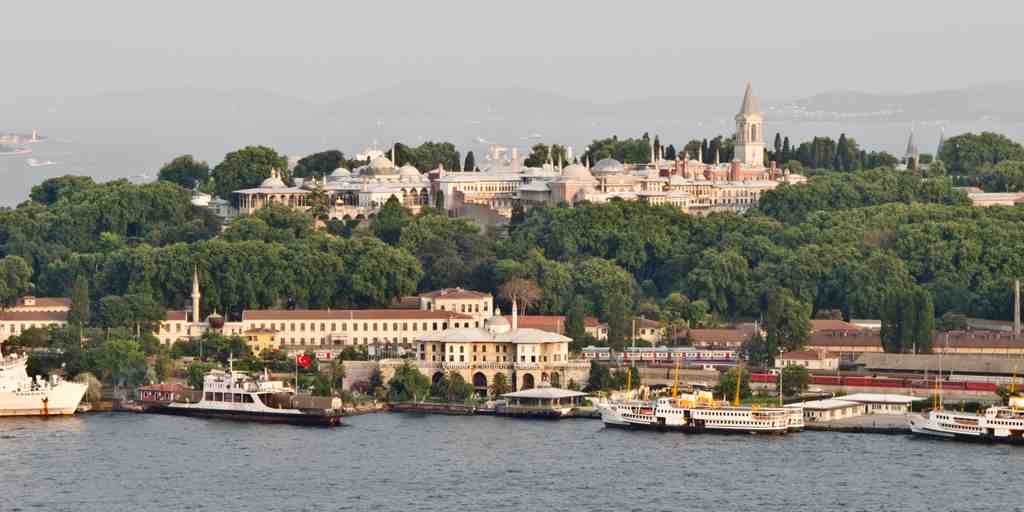
To spot Topkapı Palace, look up the hill past the trees and you’ll see a cluster of cream-colored buildings and domes crowned by a pointed tower, rising along the edge of the promontory above the Bosphorus.
Alright, time to step into the world of sultans, secrets, and treasures! Imagine, right where you stand, the Topkapı Palace has gazed out over the shimmering waters for over five centuries. It’s not just one big building-it’s a bustling maze of courtyards, gardens, and mysterious halls, each with its own tale to tell.
Our story begins in the smoky aftermath of battle-1459. Istanbul, or as folks used to call it, Constantinople, is fresh under Ottoman rule. Sultan Mehmed the Conqueror decides it’s time for a palace worthy of an empire. Instead of patching up the old wrecked Byzantine palace, he picks this breezy, hilly spot where the waters of the Bosphorus, the Golden Horn, and the Sea of Marmara meet. Can you hear the drum of hammers and saws, and the shouts of workers from every corner of the empire?
Back then, this wasn’t the “Topkapı Palace” you see today, but the “New Palace.” But as centuries rolled by and the seaside palace down the way was lost to flames, the name “Cannon Gate”-Topkapı-stuck around. By the time you passed through its massive Imperial Gate, covered with golden calligraphy and towering marble, you’d know you’d arrived somewhere extraordinary. And don’t try riding a horse through those gates-unless you’re the sultan, you’d have to dismount!
Step inside those high, stone walls, and you’d find the First Courtyard-a bustling stage for judges, janissaries, and the unlucky few who’d visit the legendary Fountain of the Executioner. Imagine crowds gathering, the clang of armor, and whispers swirling about grand viziers and royal intrigue.
Venture deeper, and the palace opens up like a storybook. Four courtyards unfold, each more secretive than the last. The palace kitchens-oh, the smells!-once fed a small army of 4,000 people, from sultans to stable boys. Picture gigantic bubbling pots, spices floating in the air, and chefs working double-time to prepare banquets fit for royalty. The Ottoman sultans also loved their porcelain so much that by the 18th century, their collection was the envy of China, Japan, and pretty much everyone who liked a decent cup of tea.
Let’s not forget the mysterious Harem. Over 400 rooms of intrigue, politics, love, and just a pinch of danger. The great Hürrem Sultan, wife to Suleiman the Magnificent, once convinced Suleiman to house the entire royal harem here after a fire destroyed the Old Palace. Overnight, this place transformed from a sultan’s playground into the beating heart of imperial family life-and one or two soap opera-worthy dramas, if the walls could talk!
Meetings of empire-shaking importance took place in the Imperial Council’s domed chamber. The sultan himself could listen in from a secret window behind a golden grill. I mean, who needs reality TV when you can eavesdrop on your ministers while they nervously ponder the fate of nations, right?
Should you have been lucky enough to make it through to the Inner Courtyard-the fabled Gate of Felicity, mind you-you’d have made it to the real heart of power. Here, lush gardens and the sultan’s private chambers bathed in dappled sunlight, lined with marble, echoed only with whispers and the patter of slippered feet. Inside the treasury, guarded by soldiers who probably never smiled, you’d find priceless jewels like the Spoonmaker’s Diamond and the dazzling Topkapı Dagger-enough treasure to make any pirate green with envy.
As centuries passed, the palace grew, suffered earthquakes and fires, but always picked itself up, piece by piece. By the 19th century, it began to lose its shine as a royal home when the sultans fell for the modern luxuries of Dolmabahçe Palace by the Bosphorus. But Topkapı never faded into obscurity-it turned into Turkey’s first museum in 1924, opening its doors to the world, and the stories only grew richer.
Today, you stand before the Palace of Felicity, a world of intrigue, celebration, cautionary tales, and wild feasts-a place where silence was golden and secrets were the ultimate treasure. So, as you gaze at its walls and towers, remember: behind each door, history is never far from the present.
For further insights on the name, imperial gate or the first courtyard, feel free to navigate to the chat section below and inquire.




