
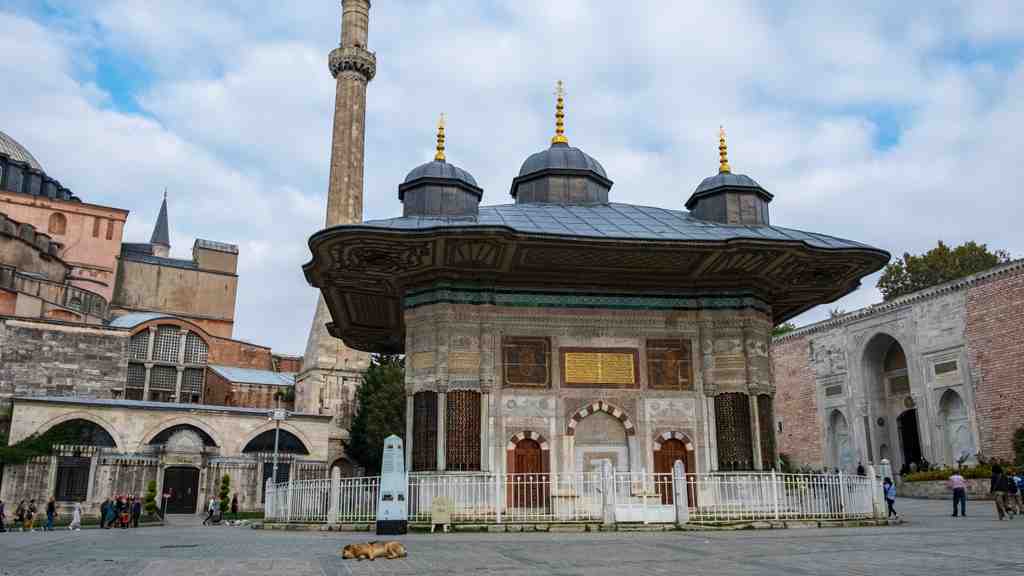
Just ahead of you, you’ll spot a lavish stone fountain with a wide, overhanging roof topped by five little domes, richly decorated with tiles and golden calligraphy-right there in the middle of the square, just in front of the Imperial Gate of Topkapı Palace.
Imagine it’s the year 1728, and you’re strolling through the bustling heart of old Constantinople. Sultan Ahmed III, a lover of flowers, poetry, and luxury, wants to make the city bloom with beauty and refreshment. So he builds this extravagant fountain-a true jewel of the Tulip Period, an age where everyone had a bit of a tulip obsession! The Sultan’s grand fountain isn’t just for show; it’s a social hot spot, where people once gathered to chat, trade gossip, and enjoy cool water or a sweet sherbet, all for free. You’d simply step up, and an attendant, hidden behind a lattice grille, would pass you a cup of refreshment.
Imagine grand ladies in silk robes and merchants with mustaches curling up at the ends, all meeting here, maybe to swap news or simply show off their newest tulip bulbs. The air would be thick with laughter, different languages, and-if you’re lucky-the sound of a poem! Look closely at the fountain’s walls. Each side is covered in flowing, beautiful calligraphy: a 14-line poem dedicated to water, written by the chief judge of Halep and Kayseri. If you could read Ottoman Turkish, you’d find a message of gratitude to water and its donor, swirling around the fountain like a river of words.
Corner niches hide little sebils, triple-grilled and mysterious, as if inviting you to guess what’s behind them. And atop each side, golden finials catch the sun, shining like a crown on the city’s proudest fountain. Years later, the fountain would even be famous enough to appear on Turkish banknotes. That’s quite an upgrade from your average water cooler, isn’t it?




