
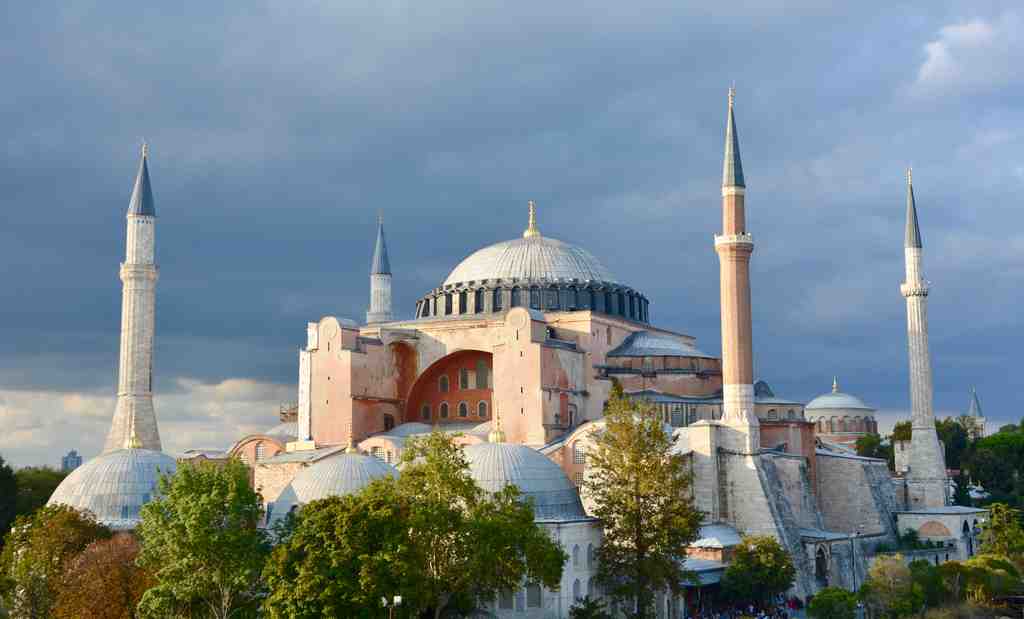
To spot the Hagia Sophia, just look ahead for the massive, pinkish building with a giant silver-gray dome in the middle, surrounded at the corners by four tall, slender minarets pointing at the sky like cosmic pencils.
So, you’re standing before one of the world’s most legendary buildings-welcome to Hagia Sophia! Try to imagine: in 537 AD, crowds gathered right where you are, eyes wide as Emperor Justinian unveiled a church so vast and shimmery with marble that it looked like it was built for the gods and not mere mortals. Justinian himself supposedly looked up at the soaring dome and declared, “Solomon, I have surpassed thee!” Talk about architectural confidence! The dome above you was a wonder-soaring, glittering, and-to the people of the time-an almost magical canopy of gold and colored mosaics that seemed to float in midair.
But Hagia Sophia hasn’t had an easy life. Even in its earliest days, this site was marked by drama. The first church here went up in the days of Emperor Constantius II, but it didn’t last. Fires, riots, and earthquakes kept testing its strength. The great Nika riots of 532 burned its predecessor to the ground, and the emperors couldn’t get insurance-so they built bigger, stronger, and more splendid every time disaster struck!
The architects behind Hagia Sophia were two Greeks, Isidore of Miletus and Anthemius of Tralles, real-life math and engineering wizards-not a blue-collar duo but scientists sketching out the first truly monumental pendentive dome in history. Their creation was so massive, it made people dizzy trying to count the windows. And don’t get me started on the scavenger hunt for fancy columns-some say they were borrowed (with a little force) from temples all around the Mediterranean. If you see different colors and sizes, you’ll know why!
As centuries rolled on, tremors shook the city, and the dome cracked and even collapsed at times. Picture feverish repairs as teams of craftsmen scrambled around scaffolding, chanting, roaring, and dodging falling stones. By 562, Hagia Sophia wore her crown again, bigger and taller than ever.
Here’s where the plot thickens: Hagia Sophia wasn’t just a monument-it was a stage. For nearly a thousand years, it was the largest cathedral in the world, and the center of the mighty Byzantine Empire’s religious life. Crowds of worshippers, patriarchs in golden robes, and emperors with star-studded cloaks gathered here for coronations and ceremonies. At times, this place was so sacred, people spoke in whispers, listening as sunlight filtered through golden mosaics, making everything glow.
But the world changed-sometimes thunderously! In 1204, Crusaders from the West stormed in, and you wouldn’t have wanted to be here for the party: looting, shouting, and even mules tramping down sacred halls. After all the chaos, the cathedral sat battered and bruised, until the Byzantines took it back and patched up the wounds.
Then came 1453-drums and cannons of the Ottomans filled the air as Constantinople fell. Sultan Mehmed the Conqueror marched in, stood where you now stand, looked up in awe, and turned Hagia Sophia into a mosque. Soon, minarets shot up to the heavens, and the call to prayer echoed across the city.
Over time, Hagia Sophia became a symbol for everyone. In 1935, it became a museum, so people from every background, faith, and corner of the world could admire its wonders. But the story wasn’t over-since 2020, Hagia Sophia has resumed its life as a mosque, and in 2024, the upper floor once again became a museum too.
This building is a survivor-church, mosque, museum, and now a mix of all three, brimming with centuries of stories. If you listen close, you might still hear the echoes of past prayers, chants, and the distant hustle of ancient Constantinople just beyond the walls. And if a seagull swoops by-well, maybe it’s just carrying a bit of history in its wings!
Interested in knowing more about the architecture, notable elements and decorations or the mosaics




