
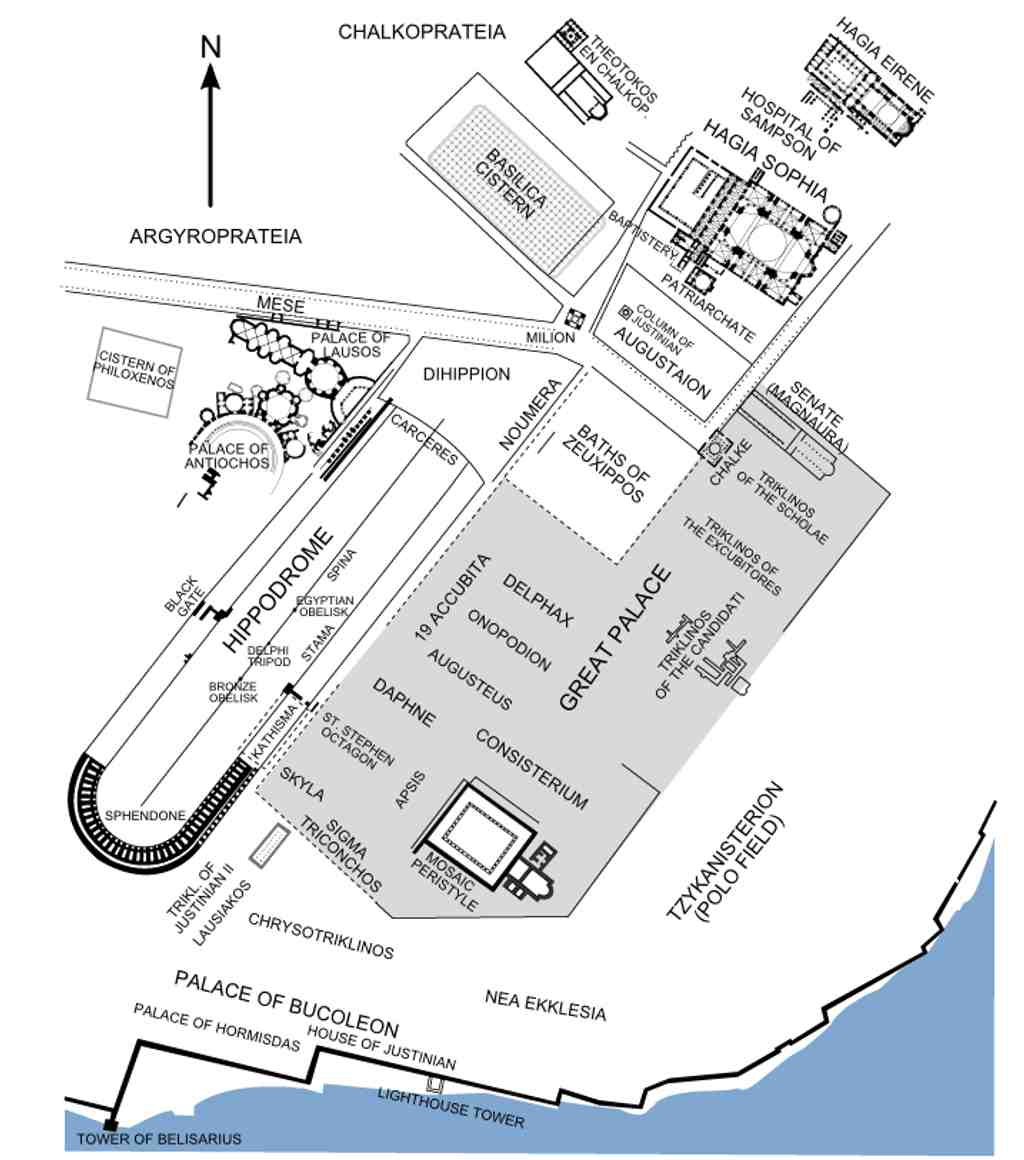
To spot the Augustaion, look ahead for an open area framed by modern paving and bustling tourists-this square once lay east of where the Hagia Sophia looms grandly, in what’s now Aya Sofya Meydanı; imagine it bordered by columned walkways and ancient structures on every side.
Welcome to the heart of ancient Constantinople! If you stand here and listen carefully, you might just hear the echoes of footsteps from emperors, senators, and crowds milling about nearly 1,500 years ago. This square before you was called the Augustaion, and you’re walking atop layers of a truly grand story-one full of ambition, catastrophe, and a little family drama that could rival any soap opera.
Close your eyes for a second and picture this place as it was in the time of Rome: a market square alive with bakers, fruit sellers, and townsfolk haggling over olives and bread. The Augustaion started as a simple agora-a public market-nestled within the growing city. But then along came Septimius Severus, that old Roman emperor who loved a bit of grandeur, and he transformed the original space into a mighty square lined with elegant porticoes. Right in the center stood a dazzling statue of Helios, the sun god, shining down on everyone like an ancient disco ball.
But the best was yet to come. In the early 4th century, Emperor Constantine decided he’d turn Byzantium into the capital of his entire empire. With his power and purse, he built even more towering buildings, carving off a section of that old square to create a new one-the Augustaion, named after his beloved mother, Helena. A massive porphyry column went up, crowned with her statue-imagine it gleaming purple-red, catching the sunrise just right.
Generations came and went, and so did the Augustaion’s fortunes. The square was rebuilt in 459 by Emperor Leo I, then again in the wild days after the Nika riots almost tore the city apart. Justinian-yes, the man who gave us the Hagia Sophia-waltzed in, patched things up, and turned this once public place into a much more exclusive courtyard. Now only the most important folks got to wander through here, surrounded by marble paving and fancy porticoes that stretched overhead in every direction.
In those days, the Augustaion wasn’t just a pretty space-it was the crossroads of empire. To the north, you had the mighty Hagia Sophia and the Patriarch’s palace. To the east, the grand Senate house, rebuilt by Justinian himself, stood with a white-marble face and a line of six giant columns at its entrance. The monumental Chalkē Gate to the Great Palace was nearby, and if you listened closely, you might catch the cheer of the crowds drifting from the Hippodrome to the southwest.
The Augustaion brimmed with statues, each one telling a story. There was Constantine atop his column, surrounded by his three sons-almost like a proud dad at a family reunion, but with a bit more marble. Later on, Theodosius the Great swapped out some statues for an equestrian version of himself, flanked by his sons yet again. Not to be outdone, Empress Aelia Eudoxia got her own statue here, but her noisy, pagan-loving inauguration was so rowdy it annoyed the patriarch, who ended up being exiled-proof that even in ancient times, parties could get out of hand.
Maybe the most dramatic monument of all was Justinian’s victory column, raised in 543 at the Augustaion’s west end. Imagine it-topped with an imperial statue reusing bits of Theodosius’s, and at the base, three kneeling barbarian kings paying tribute. That column stood for nearly a thousand years, until it was finally toppled and lost after the Ottomans took the city.
Curious travelers from the West visited in later centuries, only to find the Augustaion in ruins: lost columns jutting from the ground like ancient teeth, and marble stones scattered where emperors once strutted. Today, there’s little above ground, but if you listen carefully, you might imagine the clatter of horses, the rustle of silk robes, and maybe even a shout from an angry empress.
So, as you stand here, picture yourself where public markets turned to imperial ceremony, and where every stone told tales of ambition, rivalries, and the dreams of a mighty empire. Now, on to our next wonder!




