AudaTours logoAudaTours

Istanbul Audio Tour: Top landmarks in Istanbul

Audio guide9 stops

Giant domes once cast trembling shadows over emperors and sultans, but beneath Istanbul’s glittering skyline, secrets slumber under marble and tile. This self-guided audio tour takes you beyond the postcards—leading you through legendary halls and hidden passages where history cracked and splintered into myth. Who set fire to the ancient basilica just steps from the throne? What lies shrouded in darkness beneath the Basilica Cistern’s mysterious Medusa heads? Why did one Ottoman sultan risk everything to outshine his rivals with six minarets piercing the sky? Walk in the footsteps of rebels, visionaries, and conquerors. Trace revolutions where echoes still cling to sandstone. Uncover scandals that rewrote religions as you explore Hagia Sophia, Blue Mosque, and the shadowy cisterns between. Every corner promises revelation. Your path into Istanbul’s heart is waiting. Dare to step below the surface.

Tour preview

map

About this tour

  • schedule
    Duration 80–100 minsGo at your own pace
  • straighten
    3.9 km walking routeFollow the guided path
  • location_on
  • wifi_off
    Works offlineDownload once, use anywhere
  • all_inclusive
    Lifetime accessReplay anytime, forever
  • location_on
    Starts at Hagia Sophia

Stops on this tour

lock_open 3 free previews · 6 unlock with purchase

  1. Hagia Sophia, also known as Holy Wisdom, is a renowned mosque and significant cultural and historical landmark situated in Istanbul, Turkey. Constructed in 537 AD, it is the last…Read moreShow less

    Hagia Sophia, also known as Holy Wisdom, is a renowned mosque and significant cultural and historical landmark situated in Istanbul, Turkey. Constructed in 537 AD, it is the last of three church buildings built by the Eastern Roman Empire on this site. Originally an Orthodox church, it was converted into a mosque after the Ottoman conquest of Constantinople in 1453. Later, in 1935, it was transformed into a museum, only to be reconverted into a mosque in 2020. The monument also served as a Roman Catholic cathedral for a period during the Fourth Crusade in 1204. The current structure of Hagia Sophia was created by Byzantine emperor Justinian I between 532 and 537 as the primary Christian cathedral of Constantinople. This architectural masterpiece was designed by Greek geometers Isidore of Miletus and Anthemius of Tralles. Initially called the Church of the Holy Wisdom, it stands as one of the largest interior spaces in the world and is known for its innovative use of a fully pendentive dome. Its construction marked a pivotal moment in the history of architecture and is considered the epitome of Byzantine architectural style. This particular building is the third iteration of Hagia Sophia on this site, as the previous ones were destroyed during the Nika riots. Serving as the seat of the ecumenical patriarch of Constantinople, it held the distinction of being the largest cathedral for almost a millennium until the completion of Seville Cathedral in 1520. Its influence on subsequent Byzantine architecture was significant, with Hagia Sophia becoming the standard model for Orthodox church design. Remarkably, its architectural style was even emulated by Ottoman mosques, a testament to its enduring impact. Hagia Sophia is widely regarded as a paramount symbol of Byzantine and Eastern Orthodox civilizations, possessing a remarkable place within the Christian world. Its historical, religious, and cultural significance cannot be overstated, solidifying its status as an iconic landmark and a beloved touchstone of the past.

    Open dedicated page →
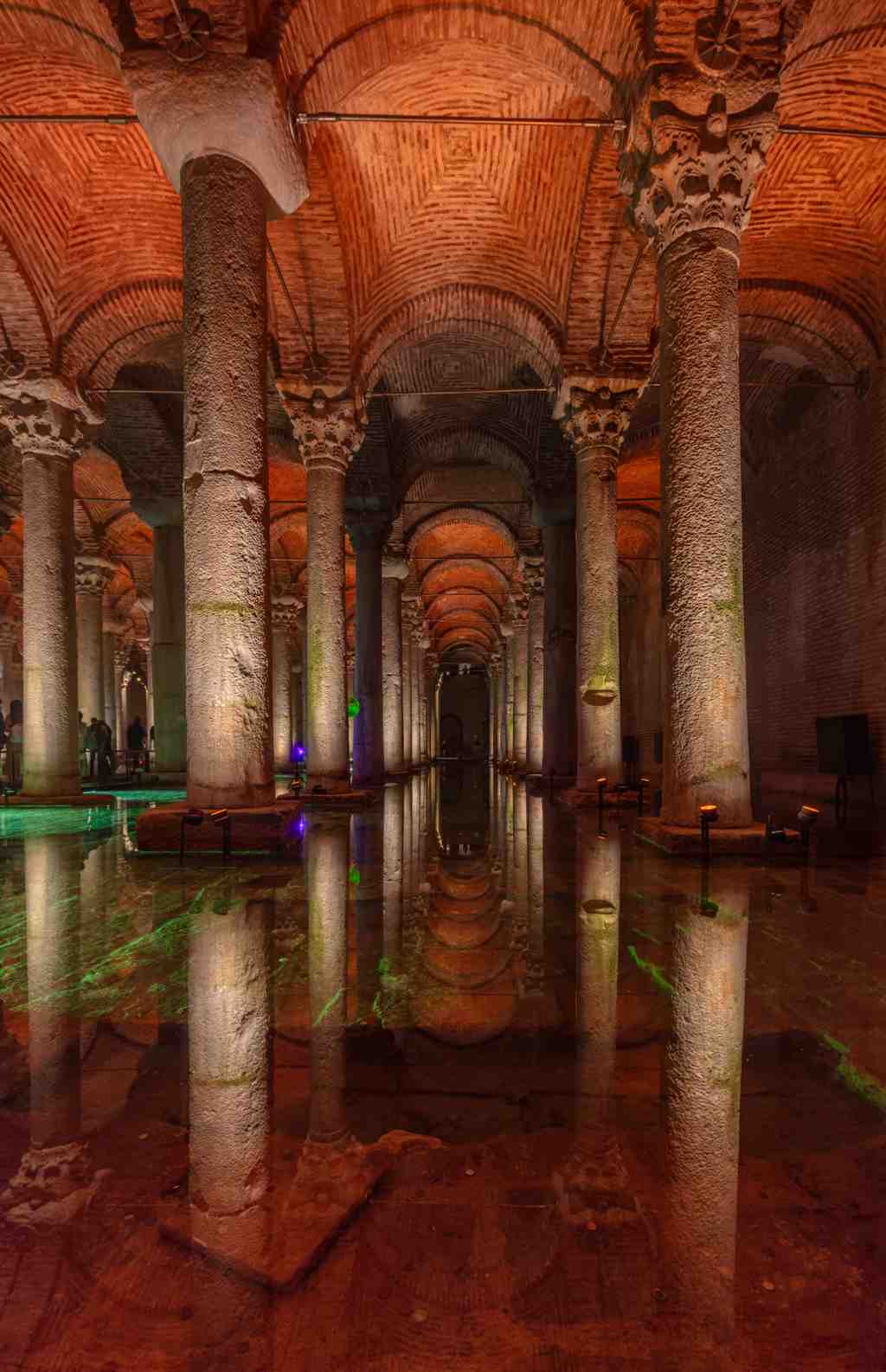
  2. Basilica Cistern
    2
    The Basilica Cistern, known as Cisterna Basilica in Greek and Yerebatan Sarnıcı or Yerebatan Saray in Turkish, is the largest among numerous ancient cisterns that are situated…Read moreShow less

    The Basilica Cistern, known as Cisterna Basilica in Greek and Yerebatan Sarnıcı or Yerebatan Saray in Turkish, is the largest among numerous ancient cisterns that are situated beneath the city of Istanbul in Turkey. This particular cistern, positioned 150 meters southwest of the Hagia Sophia on the historic peninsula of Sarayburnu, was constructed in the 6th century during the reign of Byzantine Emperor Justinian I. In the present day, it is maintained with minimal water to allow public access to its interior. The name "Basilica" was given to this underground cistern due to its location beneath a vast public square known as the Stoa Basilica on the First Hill of Constantinople. Before the cistern was built, a grand basilica stood in its place. This basilica was initially constructed during the Early Roman Age between the 3rd and 4th centuries and served as a center for commerce, law, and art. It was later reconstructed by Illus following a fire in 476. According to ancient sources, the basilica contained gardens enclosed by a colonnade that faced the Hagia Sophia. Emperor Constantine is said to have erected a structure there, which was subsequently rebuilt and expanded by Emperor Justinian after the Nika riots of 532 that ravaged the city. Historical accounts indicate that the construction of the cistern involved around 7,000 slaves. This enlarged cistern served as a water filtration system for the Great Palace of Constantinople and other structures on the First Hill. It continued to supply water to the Topkapı Palace even after the Ottoman conquest in 1453 and up until modern times. Over the years, knowledge of the cistern's existence faded away, except among the locals who still drew water from it. In 1565, the French traveler Petrus Gyllius left a record of his experience of rowing between the columns of the cistern and observing fish swimming in the water beneath his boat. In terms of measurements, this cistern has the magnitude of a cathedral. It is an underground chamber that spans approximately 138 meters by 65 meters.

    Open dedicated page →
  3. The Blue Mosque, officially known as the Sultan Ahmed Mosque, holds great historical significance as an Ottoman-era imperial mosque in Istanbul, Turkey. Its construction took…Read moreShow less

    The Blue Mosque, officially known as the Sultan Ahmed Mosque, holds great historical significance as an Ottoman-era imperial mosque in Istanbul, Turkey. Its construction took place between 1609 and 1617 under the rule of Ahmed I, and even today, it continues to serve as a functioning mosque while also attracting a large number of tourists. Renowned for its iconic Ottoman architecture, the Blue Mosque stands as one of the most popular landmarks in the city. The mosque follows a traditional Ottoman layout, featuring a central dome surrounded by four semi-domes above the prayer hall. It is accompanied by a spacious courtyard and six minarets, adding to its grandeur. Inside, the mosque is adorned with intricate Iznik tiles and stunning floral motifs, predominantly in shades of blue, from which it derives its common name. The mosque's religious complex, known as the külliye, includes Ahmed's tomb, a madrasa (educational institution), and several other buildings, each displaying different levels of preservation. Situated next to the former Hippodrome and facing the Hagia Sophia, another significant tourist attraction, the Blue Mosque holds a prominent position within the city. As a testament to its cultural and historical importance, it was included in the UNESCO World Heritage Site list in 1985 under the name "Historic Areas of Istanbul." The construction of the mosque was driven by Sultan Ahmed I's desire to regain Ottoman prestige following the Peace of Zsitvatorok. Being the first sultan in years to build an imperial mosque after Selim II, he saw it as an opportunity to seek divine favor. Strategically located near the Hagia Sophia, the most significant mosque of the Ottoman Empire, the Blue Mosque's presence symbolically dominates the skyline of Istanbul. Originally, the mosque occupied the space where the Hippodrome's bleachers and imperial box once stood. During excavations in the early 20th century, remnants of the ancient seats were discovered within the mosque's grounds. This highlights the historical depth of the site and its connection to Istanbul's rich past.

    Open dedicated page →
Show 6 more stopsShow fewer stopsexpand_moreexpand_less
  1. The Hippodrome of Constantinople, also known as the Circus Maximus Constantinopolitanus, was a significant structure in the city of Constantinople, which served as the capital of…Read moreShow less

    The Hippodrome of Constantinople, also known as the Circus Maximus Constantinopolitanus, was a significant structure in the city of Constantinople, which served as the capital of the Byzantine Empire. Today, this historic site has transformed into Sultanahmet Square in Istanbul, Turkey. The term "hippodrome" originates from the Greek words for "horse" and "path," reflecting its primary purpose as a venue for horse racing and chariot racing. Such entertainment was highly popular during the ancient Greek, Roman, and Byzantine periods, leading to the construction of hippodromes in numerous cities. The origins of the Hippodrome can be traced back to a time before Constantinople gained prominence as an imperial capital. Initially built during Byzantium's early days as a provincial town, it was Emperor Septimius Severus who, in the year 203 AD, rebuilt and expanded the city walls, establishing a hippodrome for various entertainments, particularly chariot races. Later, in 324 AD, Emperor Constantine the Great, following his victory in the Battle of Chrysopolis, decided to rebuild Byzantium and renamed it Nova Roma, or New Rome. However, this name did not resonate with the people, and the city soon became known as Constantinople, the City of Constantine. Constantine undertook extensive urban development projects, including the renovation of the Hippodrome. This grand structure was estimated to be approximately 450 meters (1,476 feet) long and 130 meters (427 feet) wide. The starting gates, referred to as carceres, were positioned at the northern end, while the southern end featured the sphendone, a curved tribune that remains partially preserved to this day. Running along the middle of the racecourse was the spina, which adorned with various monuments, including the towering and monolithic obelisk. This obelisk, now known as the Obelisk of Theodosius, still stands as a testament to the grandeur of the era. Overall, the Hippodrome of Constantinople held immense importance as an entertainment and social hub in the capital city. It served as a symbol of prosperity and cultural significance during the Byzantine Empire's reign, attracting crowds of spectators eager to witness thrilling horse and chariot races, as well as other festivities. The transformation of this historic site into Sultanahmet Square has allowed its legacy to endure, reminding us of the rich history and grandeur of the past.

    Open dedicated page →
  2. The Spice Bazaar, also known as the Mısır Çarşısı, holds great historic significance in Istanbul, Turkey. It stands as one of the largest bazaars in the city and is located in the…Read moreShow less

    The Spice Bazaar, also known as the Mısır Çarşısı, holds great historic significance in Istanbul, Turkey. It stands as one of the largest bazaars in the city and is located in the Eminönü quarter of the Fatih district. This renowned covered shopping complex is second only to the Grand Bazaar in popularity. The origins of its name can be traced back to several documents that suggest it was initially named the "New Bazaar." Eventually, it earned the moniker "Egyptian Bazaar" due to its construction being funded by the profits from the Ottoman eyalet of Egypt in 1660. The Turkish word "mısır" presents a double meaning, referring to both "Egypt" and "maize." Consequently, it is sometimes mistakenly translated as the "Corn Bazaar." The Spice Bazaar has long served as the epicenter of spice trade in Istanbul. However, in recent years, it has witnessed a gradual transition, with other types of shops replacing the spice sellers. Situated within the complex of the New Mosque, the rented shops within the bazaar have historically contributed to the financial upkeep of the mosque itself. The esteemed architect Koca Kasım Ağa designed the bazaar, but another court architect named Mustafa Ağa oversaw its construction. The work commenced in the final months of 1660, immediately following the devastating Great Fire of Istanbul, which lasted over two days. This catastrophe led to the destruction of numerous neighborhoods throughout the city. Consequently, a significant reconstruction effort commenced, including the resumption of the New Mosque's construction, which had been paused since 1603. The Spice Bazaar's construction likewise began in the same year, both projects commissioned by Sultana Turhan Hatice, the Valide Sultan (Queen Mother) of Sultan Mehmed IV. Presently, the Spice Bazaar boasts an impressive 85 shops that specialize in selling a wide variety of spices. Additionally, Turkish delights, herbal teas, dried fruits, and various other traditional products can be found within its bustling halls. It remains an important destination for locals and visitors alike, offering a glimpse into Istanbul's cultural heritage and trade history.

    Open dedicated page →
  3. Sirkeci railway station, also known as Istanbul railway station, is a significant terminal located in Istanbul, Turkey. Situated in Sirkeci, at the tip of Istanbul's historic…Read moreShow less

    Sirkeci railway station, also known as Istanbul railway station, is a significant terminal located in Istanbul, Turkey. Situated in Sirkeci, at the tip of Istanbul's historic peninsula, it stands proudly next to the Golden Horn and in close proximity to Gülhane Park and the Topkapı Palace. This terminal, along with Haydarpaşa Terminal on the Asian side, serves as one of Istanbul's main intercity and commuter railway stations. Dating back to 1890, Sirkeci Terminal was built by the Oriental Railway as the final stop of the famous Orient Express. Operating from 1883 to 2009, this iconic train once connected Paris and Istanbul, making Sirkeci Terminal a significant landmark in the city. However, as of 19 March 2013, the station's service was temporarily suspended due to the rehabilitation of the existing rail line between Kazlıçeşme and Halkalı. This suspension was necessary for the construction of the new Marmaray commuter rail line. On 29 October 2013, the public was delighted by the opening of a new underground station, designed to accommodate Marmaray trains traveling across the Bosphorus. With a total of four platforms (three above ground and one underground) and seven tracks (five above ground and two underground), Sirkeci Terminal ensures efficient transportation for commuters and travelers alike. Previously, commuter trains to Halkalı would depart from tracks 2, 3, and 4, while regional and international trains to various destinations, such as Kapıkule, Edirne, Uzunköprü, Bucharest, Sofia, and Belgrade, would depart from tracks 1 and 5. Looking back at its history, the necessity of a railway connecting Europe with Istanbul became evident to the Ottoman authorities after the Crimean War. The first contract for this ambitious project was signed in January 1857 with a British member of parliament named Labro. However, due to a lack of required investment capital, the contract was cancelled three months later. Similar attempts were made in 1860 and 1868 with British and Belgian entrepreneurs, but these contracts also ended in failure. Finally, on 17 April 1869, Baron Maurice de Hirsch (Moritz Freiherr Hirsch auf Gereuth) was awarded the concession for the "Rumeli Railroad," marking a turning point in the development of the railway system in Istanbul.

    Open dedicated page →
  4. The Sublime Porte, also known as the Ottoman Porte or High Porte, was the central government of the Ottoman Empire in Istanbul. The name originated from the tradition of the ruler…Read moreShow less

    The Sublime Porte, also known as the Ottoman Porte or High Porte, was the central government of the Ottoman Empire in Istanbul. The name originated from the tradition of the ruler announcing official decisions and judgements at the gate of the palace. This practice had been followed in the Byzantine Empire and was adopted by the Ottoman Turk sultans. Initially, the name referred to a palace in Bursa, Turkey. However, after the Ottoman conquest of Constantinople, the Imperial Gate, which led to the outermost courtyard of the Topkapı Palace, became known as the "High Gate" or the "Sublime Porte." In 1536, when Sultan Suleiman the Magnificent formed an alliance with King Francis I of France, French diplomats walked through the monumental gate, then called Bab-ı Ali, to reach the Vizierate of Constantinople, the seat of the Sultan's government. As French was the language of diplomacy, the French translation "Sublime Porte" was adopted in most European languages, including English, to refer to not only the actual gate but also as a symbol for the Ottoman Empire. During the 18th century, a new Italian-styled office building was constructed west of the Topkapı Palace area, across Alemdar Caddesi. This became the residence of the Grand Vizier and various ministries, and thus the building, along with the monumental gate leading to its courtyards, came to be known as the Sublime Porte or the Gate of the Pasha. Unfortunately, the building suffered significant damage in a fire in 1911. Today, these buildings house the Istanbul Governor's Office.

    Open dedicated page →
  5. The Topkapı Palace, also known as the Seraglio, is a significant museum and library situated in the eastern part of the Fatih district in Istanbul, Turkey. From the 1460s until…Read moreShow less

    The Topkapı Palace, also known as the Seraglio, is a significant museum and library situated in the eastern part of the Fatih district in Istanbul, Turkey. From the 1460s until the completion of Dolmabahçe Palace in 1856, it served as the administrative center of the Ottoman Empire and was the primary residence of the sultans. The construction of the palace was initiated in 1459 under the orders of Sultan Mehmed the Conqueror, six years after the conquest of Constantinople. Originally called the "New Palace" to differentiate it from the Old Palace in Beyazıt Square, it acquired the name Topkapı, meaning Cannon Gate, in the 19th century. Over the centuries, the complex underwent significant expansions and major renovations after the 1509 earthquake and the 1665 fire. It comprises four main courtyards and numerous smaller buildings. The harem housed female members of the Sultan's family, while the Imperial Council building hosted important state meetings, including those led by the Grand Vizier. As time progressed, Topkapı Palace gradually lost its prominence after the 17th century. The sultans of that era preferred to spend more time in their newly constructed palaces along the Bosphorus. In 1856, Sultan Abdulmejid I decided to relocate the court to the recently built Dolmabahçe Palace. However, Topkapı retained some of its functions, such as being the home of the imperial treasury, library, and mint. After the collapse of the Ottoman Empire in 1923, Topkapı Palace was transformed into a museum through a government decree issued on April 3, 1924. The Topkapı Palace Museum is now under the administration of Turkey's Ministry of Culture and Tourism. While the palace complex boasts hundreds of rooms and chambers, only the most significant ones are accessible to the public as of 2020. These include the Ottoman Imperial Harem, the treasury (known as hazine), which houses notable artifacts like the Spoonmaker's Diamond and the Topkapi Dagger. Additionally, the museum collection features Ottoman clothing, weapons, and various other historical artifacts.

    Open dedicated page →
  6. Hagia Irene, also known as Saint Irene, is a historical Eastern Orthodox church located in Istanbul. It holds the distinction of being the oldest known church in the city and is…Read moreShow less

    Hagia Irene, also known as Saint Irene, is a historical Eastern Orthodox church located in Istanbul. It holds the distinction of being the oldest known church in the city and is the only Byzantine church in Istanbul that has never been converted into a mosque. Instead, it served as an arsenal for storing weapons until the 19th century. Today, Hagia Irene functions as a museum and concert hall. The church was initially dedicated to the peace of God and was one of the three shrines that emperors devoted to different attributes of God, along with Hagia Sophia (Wisdom) and Hagia Dynamis. According to tradition, the building was constructed on the site of a pre-Christian temple. It was the first church to be completed in Constantinople, even before Hagia Sophia, during the city's transformation into the eastern capital of the Roman Empire. Emperor Constantine I is said to have commissioned the first Hagia Irene church in the 4th century, which was completed before the end of his reign in 337. It served as the church of the Patriarchate until Hagia Sophia was finished in 360 during the reign of Constantius II. Unfortunately, during the Nika revolt in 532, Hagia Irene was burned down. However, Emperor Justinian I had the church rebuilt in 548. It suffered damages again due to the Constantinople earthquake of October 20, 740, shortly before the death of Leo III. Emperor Constantine V ordered its restoration, which included the decoration of its interior with mosaics and frescoes. Some of these restorations still exist today. After the fall of Constantinople in 1453, the church was enclosed within the walls of the Topkapi Palace. It was subsequently used by the Janissaries as an arsenal until 1826. During this period, it functioned as a warehouse for military equipment and a repository for trophies of arms.

    Open dedicated page →

Frequently asked questions

How do I start the tour?

After purchase, download the AudaTours app and enter your redemption code. The tour will be ready to start immediately - just tap play and follow the GPS-guided route.

Do I need internet during the tour?

No! Download the tour before you start and enjoy it fully offline. Only the chat feature requires internet. We recommend downloading on WiFi to save mobile data.

Is this a guided group tour?

No - this is a self-guided audio tour. You explore independently at your own pace, with audio narration playing through your phone. No tour guide, no group, no schedule.

How long does the tour take?

Most tours take 60–90 minutes to complete, but you control the pace entirely. Pause, skip stops, or take breaks whenever you want.

What if I can't finish the tour today?

No problem! Tours have lifetime access. Pause and resume whenever you like - tomorrow, next week, or next year. Your progress is saved.

What languages are available?

All tours are available in 50+ languages. Select your preferred language when redeeming your code. Note: language cannot be changed after tour generation.

Where do I access the tour after purchase?

Download the free AudaTours app from the App Store or Google Play. Enter your redemption code (sent via email) and the tour will appear in your library, ready to download and start.

verified_user
Satisfaction guaranteed

If you don't enjoy the tour, we'll refund your purchase. Contact us at [email protected]

Checkout securely with

Apple PayGoogle PayVisaMastercardPayPal
Loved by travellers

Thousands of tours started.
Plenty of opinions.

4.8 across the App Store and Google Play. Here's a few we keep coming back to.

starstarstarstarstar
This was a solid way to get to know Brighton without feeling like a tourist. The narration had depth and context, but didn't overdo it.
Christoph
Christoph
Brighton Tour
starstarstarstarstar
Started this tour with a croissant in one hand and zero expectations. The app just vibes with you, no pressure, just you, your headphones, and some cool stories.
download Get the app

Pop your headphones in.
Step outside.

Free to download. Tours in every city. Start in 60 seconds — no account, no card.

Download on the App StoreGet it on Google Play
starstarstarstarstar_half
4.8
AudaTours app icon
headphones
~ 4 min until your first tour starts
public
1,000+ cities worldwide
all_inclusive
AudaTours
Unlimited

Every tour. Every city. One subscription.

3101 tours2271 cities138 countries50+ languages