
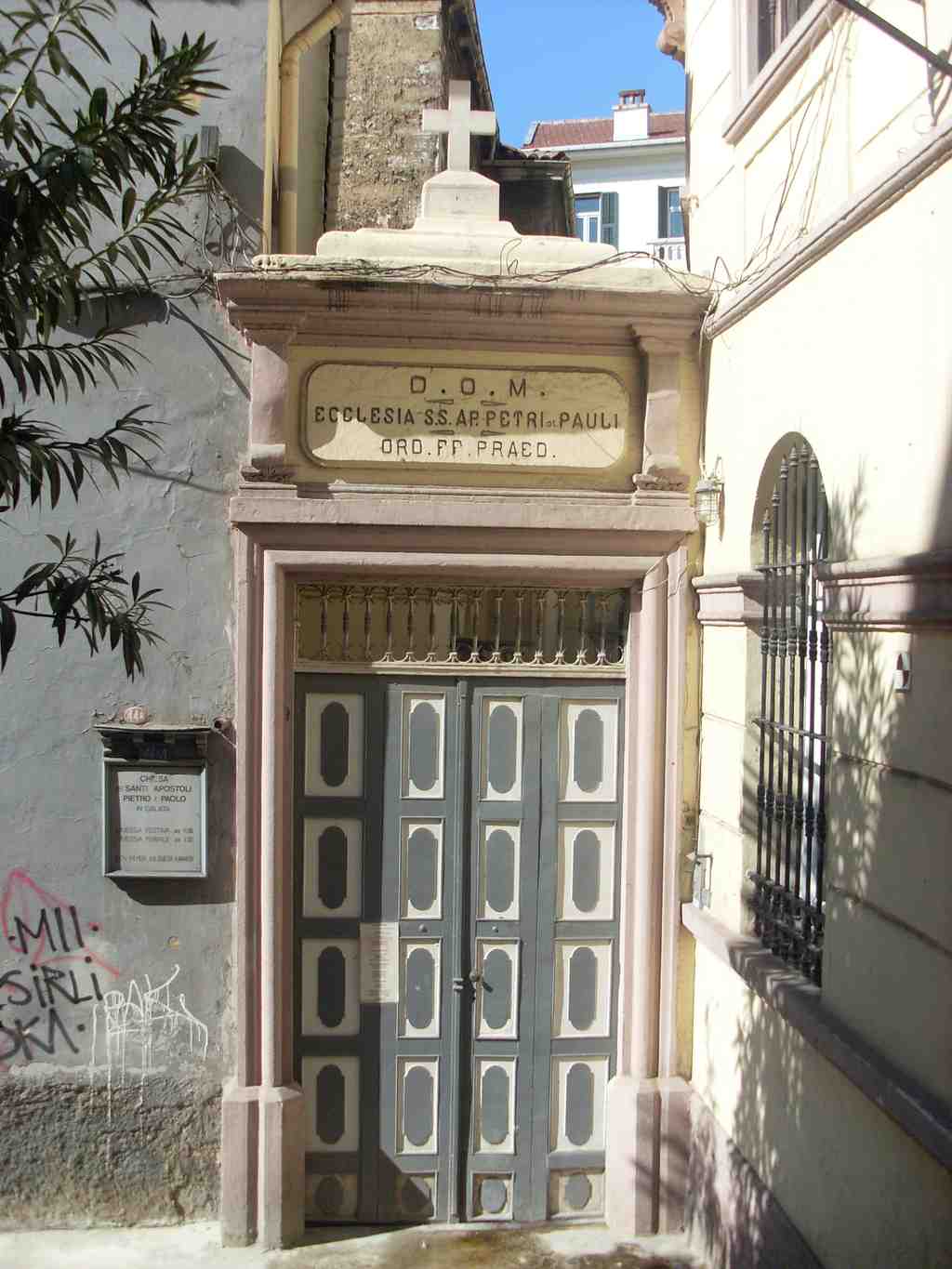
Look to your left for a modest stone-and-plaster entrance squeezed between buildings, with a pale cross on top and a Latin sign above blue-gray double doors.
This is the Church of Saints Peter and Paul-easy to miss at first glance, which is funny, because it’s been quietly refusing to disappear for about five and a half centuries. You’re standing in Karaköy, in old Galata, where every alley feels like it has paperwork in three languages and at least one secret.
The story starts with a hard reset. In 1475, Sultan Mehmed the Conqueror converted the Dominicans’ Church of San Paolo in Galata into a mosque. So the friars did what displaced communities always do: they adapted, packed up what mattered, and moved. Just a couple hundred meters east-still under the watchful bulk of Galata Tower-they set up in a house with a chapel on land tied to a Genoese family, the Zaccaria. Think of it like an early long-term lease with very specific house rules.
Those rules were… thorough. The Zaccaria family kept patron rights, watched the accounts, and could even push to remove clergy accused of misbehavior-basically, medieval oversight with a side of moral auditing. The friars, in return, paid for repairs, held memorial masses for the family, and offered a blessed candle on Candlemas. It’s the kind of agreement that sounds quaint until you realize it kept the place alive.
By the early 1600s, the small chapel grew into a larger church and monastery. Then international politics stepped in: an imperial decree placed the complex under French protection, and Venice even chipped in an annual subsidy-until a very human argument about art and ownership. The church held a prized icon of the Virgin, in the Hodegetria style, originally from a Dominican church in Caffa, Crimea. In 1640, when another Dominican church inside the old city was converted into a mosque, the icon was moved here for safekeeping.
Then came fire-because Galata loves a dramatic plot twist. In 1660, the church and monastery burned down so completely that, by Ottoman law, the land reverted to the state. The icon survived, though, which feels like the point of the story. With European powers leaning in, a new church was allowed in 1702. Venice later stopped paying when the Dominicans refused to hand the icon over. Around that time it was partially repainted-the Virgin’s mantle ended up decorated with French fleur-de-lis-so today, only her face and chest may be truly original. History, like Istanbul, is a layered renovation.
The building you’re near now is the 1840s rebuild by the Fossati brothers-Swiss-Italian architects with a talent for making sturdy, elegant things in a city that keeps testing them. Inside, it’s a basilica plan, with side altars and a choir dome painted sky blue with gold stars. And the rear wall? It’s literally backed into the old Genoese ramparts-this church is half sanctuary, half historical receipt.
It also served one of Beyoğlu’s Levantine parishes, keeping meticulous birth, marriage, and death records-an unglamorous but priceless window into the waves of European immigrants who first landed here in Galata. Today it still serves community life, especially the local Maltese, with Italian-language masses.
When you’re ready, the Italian Synagogue is a 3-minute walk heading southwest.




