
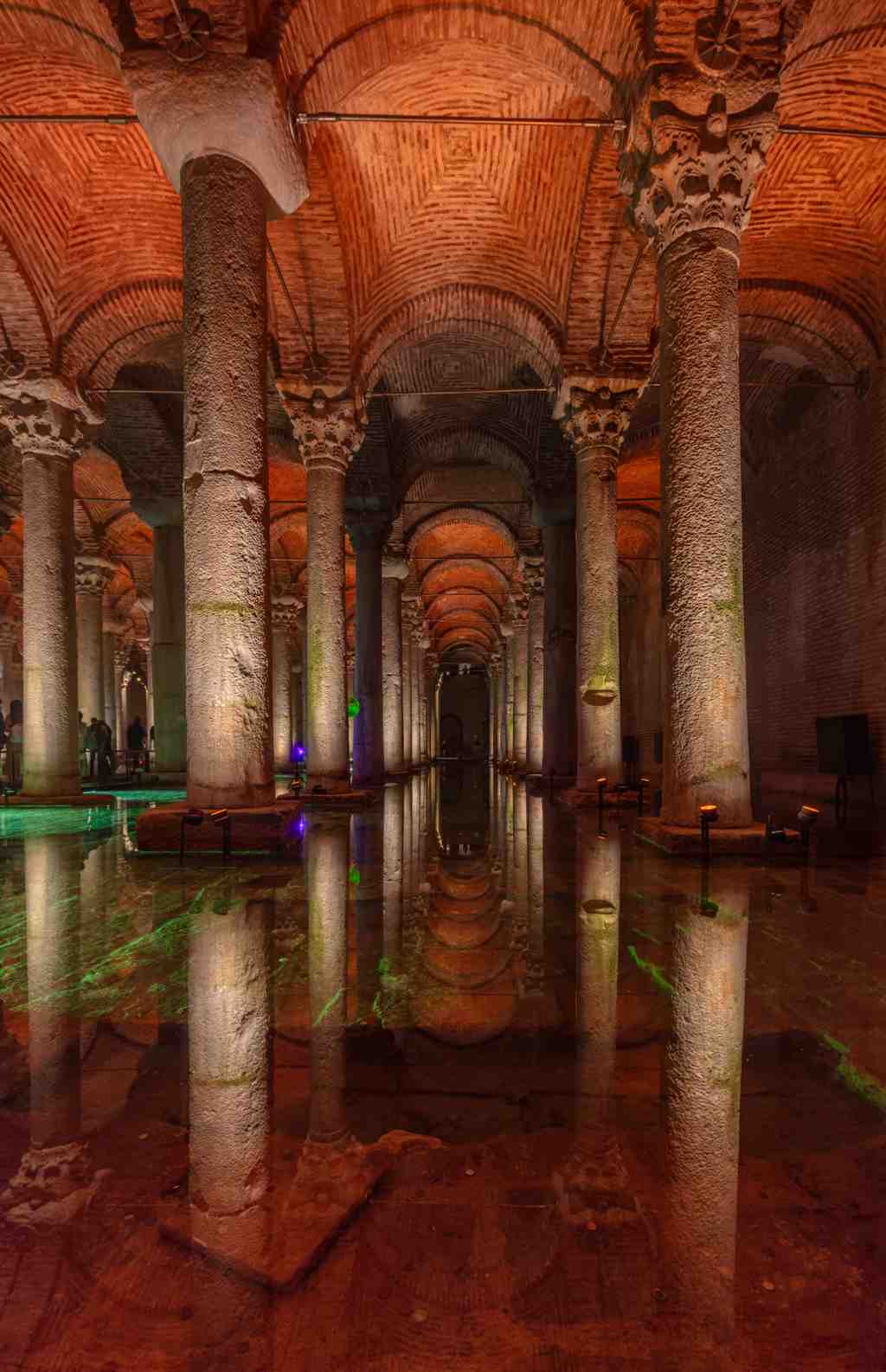
The Basilica Cistern, also known as the Cisterna Basilica, is a significant underground structure located beneath Istanbul, Turkey. It is the largest among numerous ancient cisterns found in the city. Situated about 150 meters southwest of the Hagia Sophia on the historical peninsula of Sarayburnu, it was originally constructed during the 6th century under the rule of Byzantine Emperor Justinian I.
The name "Basilica" was derived from the fact that this subterranean cistern existed underneath a vast public square known as the Stoa Basilica, situated on the First Hill of Constantinople. Prior to the cistern's creation, a grand basilica stood on the same site. It had been constructed between the 3rd and 4th centuries during the Early Roman Age, serving as an important center for commerce, legal matters, and artistic activities. After a fire in 476, the basilica was rebuilt by Illus.
Historical texts describe the basilica as having enclosed gardens surrounded by a colonnade that faced the Hagia Sophia. According to ancient historians, Emperor Constantine laid the foundation for a structure that was later expanded and reconstructed by Emperor Justinian following the devastating Nika riots of 532, which severely damaged the city.
Accounts from that time claim that around 7,000 slaves were involved in the construction of the cistern. This enlarged cistern served as a water filtration system for the Great Palace of Constantinople and various other buildings located on the First Hill. Even after the Ottoman conquest in 1453, the cistern continued to provide water to the Topkapı Palace and remained functional up until modern times.
Over time, knowledge of the cistern's existence faded, with only local people continuing to draw water from it. It wasn't until 1565 when the French traveler Petrus Gyllius visited the cistern and documented his experience. Gyllius described being rowed in a boat between the numerous columns and witnessing fish swimming in the water beneath.
In terms of measurements, this cistern is an immense underground chamber spanning approximately 138 meters by 65 meters.


