
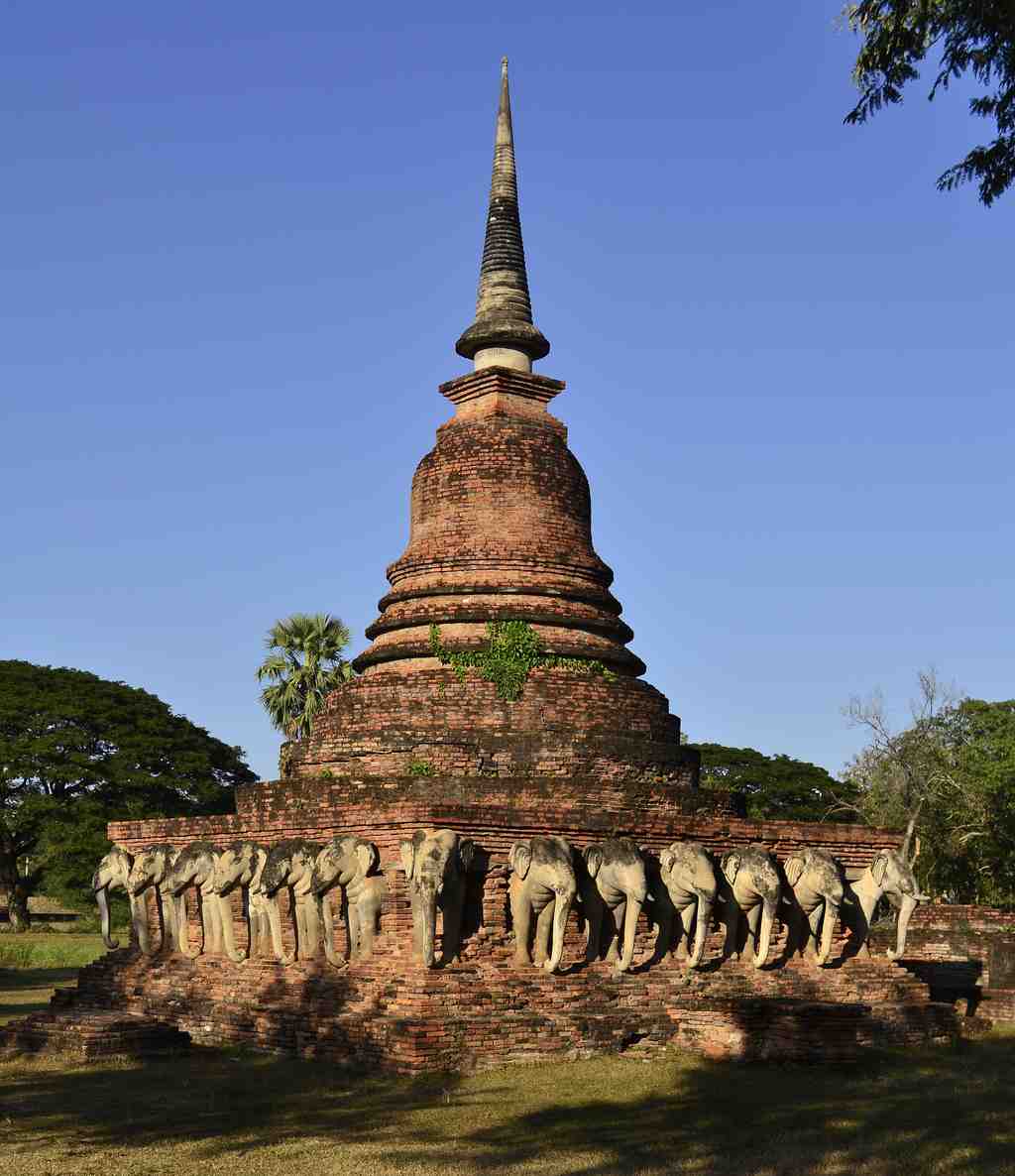
Wat Sorasak is a storied historical site nestled within the walls of the Sukhothai Historical Park, close to the Royal Court Gate on the northern side of the ancient city. The complex is home to a prominent stupa and a vihara. The stupa is a classic Ceylonese-style, featuring a round shape surrounded by elephant sculptures-a design deeply rooted in the Sukhothai era. Elephants were long believed to be royal animals suitable to support Buddhism for 5,000 years.
Originally, the stupa had succumbed to the ravages of time, leaving only its foundation and the encircling elephants. However, it was reconstructed in 2003 by the Fine Arts Department of Thailand.
Just in front of this main stupa, towards the east, there once stood a vihara. Judging by the remaining base and pillars, historians believe it had a gable roof with surrounding corridors. The temple was constructed according to royal decrees, indicating it was likely the work of royalty or high-ranking nobles, who needed royal permission to build such temples.
An intriguing part of Wat Sorasak’s history lies in the Sorasak Inscription, an ancient slate inscribed in the Sukhothai script. The inscription tells of an individual named Intharak and his land request to build the temple. Remarkably, it's also recorded that in 1955 AD, the young King Ramkhamhaeng II visited the temple to perform royal duties, accompanied by his mother and aunt.
The inscription reveals the potential location of the royal residence of Sukhothai’s rulers, believed to be west of Wat Sorasak. Additionally, it offers insight into the image of the "Phra Lila" - a Buddha statue depicted in a walking posture, confirming its existence, or at least its recognition, in the 13th century AD.
Quite the historical treasure trove, isn’t it? Thanks for joining the tour. Who knew ancient temples could elephant everything before wrapping up!


