
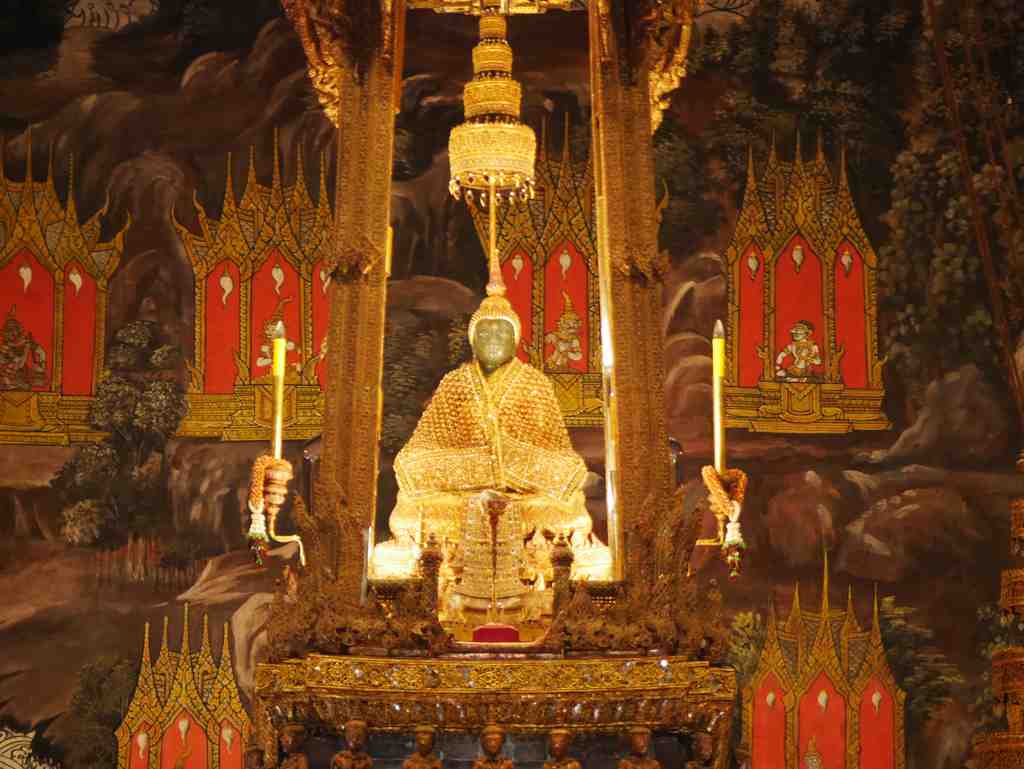
To spot the Emerald Buddha, look straight ahead for a small, dazzling green figure clothed in glittering gold, seated high above an intricate golden altar against a rich mural backdrop-its emerald color will catch your eye in the middle of all that splendor.
Ah, you’ve found it! Welcome to the extraordinary world of the Emerald Buddha, Thailand’s most revered and mysterious image. Standing here, take a deep breath and look up-imagine the cool, serene air inside the temple, mingled with the faint scent of incense. Right before you is a statue that’s not only beautifully dressed but also has a tale that jumps through centuries, storms, kingdoms, and legends, all while barely getting a scratch!
So, let’s travel back in time-over two thousand years ago, in the ancient city of Pataliputra in India, a wise sage named Nagasena decided that ordinary statues just wouldn’t do. With a twinkle in his eye, he summoned the mighty deities Vishnu and Indra-like the original superhero team-up-to help him craft a statue that would become a beacon of faith across five lands: Sri Lanka, Ramalakka, Dvaravati, Chiang Mai, and Laos. What did they use? Not emerald, but deep green jasper! I suppose the name “Jasper Buddha” didn't have the same ring to it.
Over the centuries, this precious figure began the ultimate game of “musical kingdoms.” According to Cambodian Royal Chronicles, after some three hundred years hanging out in India, the Emerald Buddha set sail for Sri Lanka to escape a civil war-imagine the suspense! Then, after a stop in Cambodia, it became the silent witness to sieges, plagues, and bold escapes. When Angkor Wat came under attack, the Emerald Buddha was whisked away for safety, journeying from Ayutthaya to Kamphaeng Phet, Laos, and eventually hidden away in Chiang Rai. There, a stroke of divine luck-or perhaps a handy thunderstorm-led to a lightning bolt striking a chedi. Locals discovered, under the cracked stucco, a glorious green figure waiting to shine. Talk about dramatic entrances!
From there, the statue seemed to decide its own destiny. King Sam Fang Kaen of Lan Na wanted it for Chiang Mai, but the elephant carrying it refused to go-no GPS mix-up here, just a stubborn pachyderm who believed in destiny. After 32 years in Lampang, then Chiang Mai, the Emerald Buddha continued its tour-de-force, taken to Laos by Prince Setthathirath, then to the new capital of Vientiane, where it would stay for over two centuries.
That would’ve been the end of its travels, but in 1779, General Chao Phraya Chakri, future King Rama I, had other plans. After capturing Vientiane, he brought the Emerald Buddha-pausing first for a victory lap at Wat Arun, then finally across the river to Bangkok. Here, in 1785, it was installed with grandeur in the magnificent temple you see today, at the very heart of Thai spirituality and royal tradition.
Now, let your eyes follow the sparkling gold robes covering the Buddha. Did you know these change with the seasons? No regular wardrobe here: there’s a special golden outfit for summer, a lovely monk’s robe for the rainy season, and for winter-a diamond-studded golden shawl. The King of Thailand himself changes these robes during a breathtaking ceremony, climbing up that altar, gently wiping the figure clean, and switching the regalia while the crowd waits in anticipation. Don’t be surprised if you feel goosebumps just imagining the solemn hush and the soft murmurs of prayer that fill the air.
This tiny, 66-centimeter-tall statue, glowing with green mystery and royal shimmer, has been paraded through the streets-for rain, for protection, or for hope. No statue in Thailand is treasured more: it is guardian, hero, and symbol, celebrated on Chakri Day and every season’s turn. The Emerald Buddha you see before you has survived war, weather, and wandering elephants, and still sits here-calm, composed, and, just maybe, a little proud of its own epic tale. If only statues could talk, right?
Want to explore the origin myths, description or the seasonal decoration in more depth? Join me in the chat section for a detailed discussion.




