
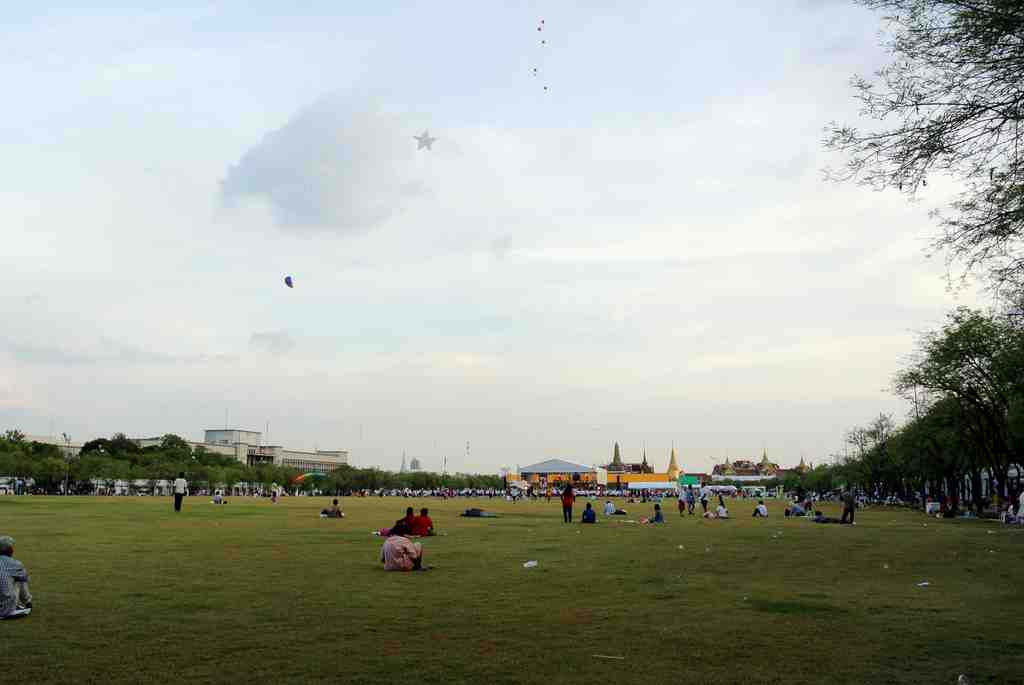
In front of you is an enormous green field, fringed by rows of tall tamarind trees, where people are scattered around relaxing or flying kites, and if you look ahead you'll spot the open expanse stretching towards the pointed golden spires of the Grand Palace.
Welcome to Sanam Luang, the beating heart of Bangkok’s royal history and a field with tales taller than any tree in this park. Close your eyes for a moment-well, keep them open if you’re walking-and imagine you’re not just standing on grass, but on a royal stage where history has played out for centuries. See this vast green lawn? It’s not just a park. It’s 74.5 rai of land-about 119,200 square meters-where kings have buried their loved ones, people have celebrated new rice sprouts, and kites have soared so high even the crows get jealous.
Sanam Luang, which means “royal turf,” sits perfectly between the sacred temples and royal palaces-almost as if the kings didn’t just want a nice front yard, but a battlefield for ceremonies and the occasional kingdom-sized picnic. The Royal Chronicle tells us that right here, royal cremations took place at the Phra Men Ground. Imagine golden pavilions, grand enough to impress even the gods, set up in the center, with royal music playing--each note competing with the breeze and the distant cries of vendors. Cremation fires flickered, royalty wept, and the nation gathered in honor, every emotion rippling across this field.
Originally, Sanam Luang was called “Thung Phra Men,” the royal cremation ground, and since the days of King Rama I, this place has seen the farewells of kings, queens, and princes-good-bye parties with a lot more pageantry than your last office send-off, that’s for sure. During the reign of King Rama IV in 1855, the name was changed to “Thong Sanam Luang,” but most folks just call it Sanam Luang now. Don’t worry, even the locals take shortcuts!
But don’t imagine it’s all solemnity here. The Royal Chronicles also paint lighter scenes. Picture the beginning of the tradewind season: the king, having swapped his crown for a kite string, letting a star-shaped Chula kite dance above the grass, while his brother, the Prince of the Front Palace, flew a Pakpao kite just across the way. Soon, the sky filled with color and laughter-okay, and maybe a touch of royal mischief. You can almost hear the laughter of children and the swoosh of kites tugging at their strings even today.
During Rama III’s reign, war with Vietnam added a little tension, so our king wanted to show off just how rich and fertile his kingdom was. What better way to show off abundance than by planting rice in the palace’s front yard? The very ground you’re on was once a rice field, ploughed and planted until the next royal funeral, when it was smoothed and transformed again. Rama IV brought back the ceremonial side, setting walls for the Royal Ploughing Ceremony and creating a stage for plays, prayers, and prophecies for good harvests. At the edge, a barn-yes, a real barn-waited to be filled with the rice from these sacred fields.
By the time Rama V took charge, he was inspired by palaces in Java and wanted a more peaceful, elegant park. He pulled down old buildings, expanded the square, and-taking a tip from the sultan-planted two rows of tamarind trees, encircling the field like a green embrace. Fun fact: those trees kept multiplying, and by 1967 there were 783 lining Sanam Luang’s edges, sheltering kite-fliers and lovers of shade alike.
Sanam Luang adapted to the times: under Rama VI, it hosted parades, racetracks, and even a golf course as the city’s foreigners arrived-nothing like a quick round of golf in front of the Grand Palace, right? The celebrations never stopped. In 1897, Bangkok’s 100th birthday bash turned Sanam Luang into party central, and pageantry here has marked every step in the city’s life, from the 1982 bicentennial to the golden jubilee in 1996.
But this ground has also seen darker days. In 1976, tragedy struck with a massacre right here and at nearby Thammasat University, when violence stole the peace from the crowd. More recently, massive crowds gathered in mourning after King Bhumibol’s death in 2016, their sorrow so powerful it felt like even the tamarind trees were bowing their heads.
Change is always in the air here: protests, royal ceremonies, kite flying, music, laughter. One day it's a rally, the next day a historic parade, and soon, Sanam Luang will even host the opening of the 2025 SEA Games. As you look around, imagine all these layers-past and present-rippling over the field, the wind carrying stories, hopes, and the occasional kite right over your head. This, my friend, is Sanam Luang-Bangkok’s green living room, where every blade of grass might hold a memory, a secret, or a celebration.




