
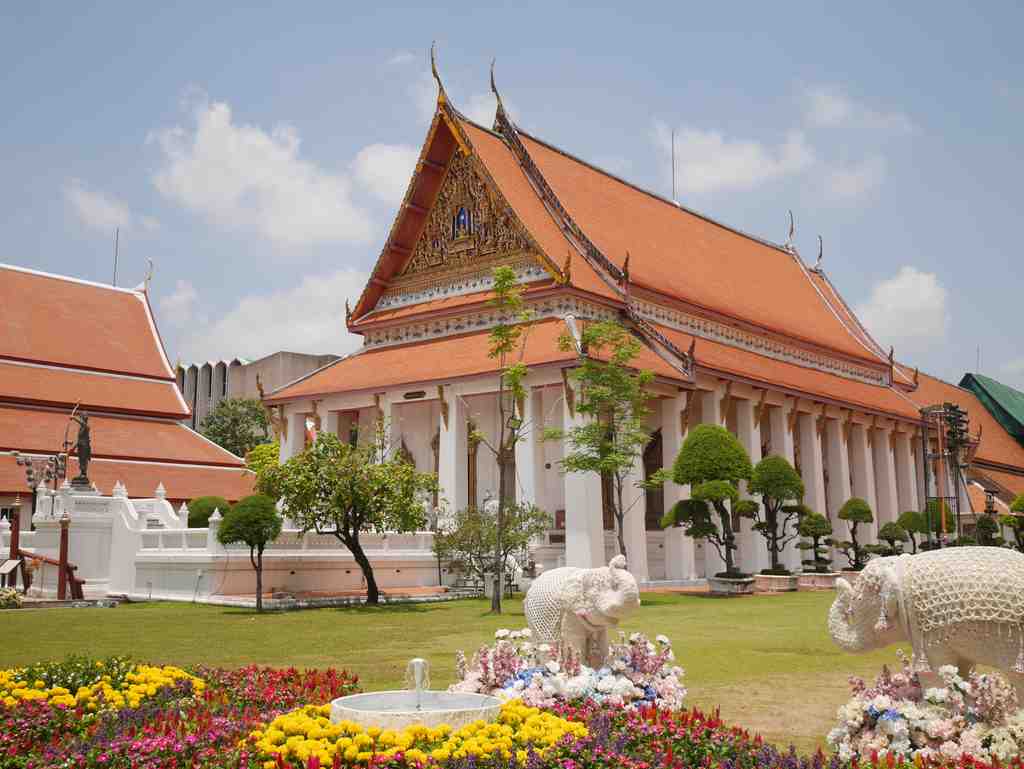
Standing before you, the Front Palace today reveals itself as an impressive cluster of traditional Thai and Western-influenced buildings, their salmon-colored walls and elegant gables peeking through the greenery-just look for the stately halls and the flags marking the entrance to the Bangkok National Museum, which now inhabits a portion of the compound.
Imagine, for a moment, the year is 1782, and you’re standing on the edge of a wild, buzzing city being born. The air crackles with the clang of construction, the shouts of workers, the pounding of wooden scaffolds being erected-all overseen by King Rama I’s younger brother, Surasinghanat, the first viceroy. The Front Palace, or Wang Na, became the grand residence of the vice-king-almost as powerful as the king himself-with its own army, courts, and sprawling gardens. Its outer court bustled with guards and military offices; the inner sanctums were a warren of royal halls, intricate pavilions, and women’s quarters.
But here’s where things get intense. The early years of the Front Palace were drenched in both ambition and anxiety. These halls weren’t just places to relax-they meant power and protection. The palace stood as the city’s northern sentinel, guarding Rattanakosin’s heart and shadowing the Grand Palace itself. The king and his viceroy were like two lions in a den-one by the river with the world at his feet, the other right out in front, always watching, always waiting.
Yet there’s a twist in this tale, just to keep everyone on their toes. As the story goes, Surasinghanat, the first viceroy, loved this palace dearly-so much so that when he lay dying in 1803, he asked to be carried about the grounds, lamenting his fate of not being able to enjoy the splendid architecture he’d created. Legend says he laid a curse: “Let no one but my own descendants live here in peace!” Now that’s one way to keep the in-laws at bay!
You might laugh, but this tale sent shivers down every royal spine for decades. When King Rama I tried to put his own son in the palace, the young prince politely refused, choosing to live elsewhere-better a drafty room than a wrathful ghost! For years, the Front Palace was left empty, its grand halls echoing with the footsteps of nervous servants and suspicious courtiers. On the rare occasions a prince did move in, he’d quickly marry one of Surasinghanat’s daughters-just to hedge his bets. It’s romance, politics, and supernatural insurance, all rolled into one!
As the years wore on, the palace changed and grew with the times. Princes commissioned new wings and audience halls. The Siwamokkhaphiman Hall was rebuilt in sturdy stone, and its western neighbor, Itsarawinitchai Hall, became a dazzling new throne room. There were elegant shrines, secretive women’s quarters, and even a chapel-Wat Bowon Sathan Sutthawat-hidden in the north corner.
Enter the drama of the 19th century, where the plot thickens with sibling rivalry. When King Mongkut-famed for his forward-thinking ways-named his brother Pinklao the “Second King,” the Front Palace came roaring back to life after years of neglect. But this time, modernization swept through the old wooden halls. Western-style pavilions sprang up alongside the old Thai buildings, and the lawns were transformed into lush gardens. Religious ceremonies were held to lift the old curse, enchantment pillars were buried at the gates, and the legendary Phra Phuttha Sihing Buddha image returned for a while to watch over the palace-Buddha versus ancient curse, who do you think won?
But not all was peaceful. After Pinklao’s death, politics erupted in the infamous Front Palace Crisis-brother against brother, with a bit of British diplomacy stirring the pot. Eventually, the power of the Front Palace waned, and its viceroy office was abolished by King Chulalongkorn in favor of a simple system: the Crown Prince. The mighty armies and bustling offices faded. The main palace buildings were converted into the Royal Museum-the first public museum in Thailand! Where soldiers once mustered, visitors now gazed at golden artifacts and ancient treasures.
By the 20th century, change galloped along faster than a royal horse. The Ministry of Public Instruction built new halls, the college of dramatic arts moved in, soldiers gave way to scholars as Thammasat University claimed part of the land, and the National Theatre took over the palace’s north. Only the most loyal ghosts remain, watching as tourists and students walk the echoing corridors, where the curse is now just another part of the legend-and, of course, a juicy bit of gossip for guides like me.
So enjoy standing at this crossroads of power, whispers, and culture. You’re living in a place where ancient royal intrigue meets the pulse of modern Bangkok, proving that a good palace-and a good story-never really dies.


