2
lock
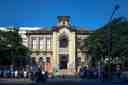
Former Tainan Public HallThe original Tainan Public Hall, located in the West Central District of Tainan City, Taiwan, was the first modern building in Tainan with public assembly functions during the Japanese colonial period. After the war, it was used for a long time as the Tainan Social Education Center. On June 26, 1998 (Year 87 of the Republic of China), it was designated as a Tainan City historic site. Currently, together with Wu Garden and Liuxia Canteen, it is open to the public as part of the "Wu Garden Art and Cultural Center."
The location of the Guild Hall was originally the Wu Garden of the gentry Wu Shangxin during the Daoguang period of the Qing Dynasty, and part of the Wu Garden still remains later. It is said that the location of Wu Garden was even earlier as the residence of He Bin, a Dutch interpreter who advised Zheng Chenggong to attack Taiwan during the Dutch colonial period. On May 3, 1661, Zheng Chenggong met here with Dutch envoys Thomas van Iperen and Leonard van Leonardus, who were guided by He Bin.
== History ==
In the early period of Japanese rule in Taiwan, due to the lack of public gathering places in the Tainan area, in the 40th year of Meiji (1907), Tainan Prefect Tsuda Kiichi convened Tainan officials and gentry to decide to establish the "Tainan Official Residence Incorporated Association," planning for each Tainan official and civilian to contribute 5 yen as a fund for its construction. At this time, due to the Wu family's financial difficulties and the need to sell their home, the organization planned to buy Wu Garden to build a Western-style mansion. Later, in July of Meiji 43 (1910), the "Tainan Residence Incorporated Association" was renamed the "Tainan Residence Incorporated Association." In the same year (1910), due to the upcoming "Southern Products Promotion Association" (held in February 1911), then Tainan Prefecture Chief Shigetoshi Matsuki appointed technician Shigemu Yatabai to design the building, with a public-private joint investment of over 40,000 yen.
Construction began on September 12, 1910 (Meiji 43), with the Sasaki Group under Sasaki Noritsuna responsible for construction. The completion ceremony was held on February 1 of the following year (1911). In Taisho 7 (1918), a 45-tsubo Japanese-style tatami room and a 12-tsubo Noh theater stage and control room were added outside the main building.
The building was originally called "Tainan Residence," but after the dissolution of the "Tainan Residence Foundation" on August 10, 1923 (Taisho 12), it was renamed Tainan Public Hall. This building was an important gathering place for Tainan citizens at the time, and also served the function of educating the people. At that time, important public policy formulations, speeches, and gatherings for Tainan City, Tainan Prefecture, and Kaohsiung Prefecture were held here. After the establishment of the Taiwan Cultural Association, figures such as Tsai Pei-huo and Lien Heng also gave speeches here.
After World War II, the government renamed the building Zhongshan Hall, which was used by the Air Force New Life Society and the Military Friends Club. Later, in June 1955, it was converted into the Provincial Tainan Social Education Center and renovated. After the Social Education Center moved to the Tainan City Phase 5 redevelopment zone in 1994, there was a proposal to demolish the building to make it a commercial district due to its location in the city center. Ultimately, this plan was scrapped, and the building was renamed the Wu Garden Art Museum. In recent years, after renovation projects, it has taken on its current appearance.
== Tainan Residence Foundation ==
The organization operating the "Tainan Mansion" does not have a dedicated manager; instead, the operating policies are decided by the board of directors' council. Under it are the General Affairs Section, Business Section, and Accounting Section, and in addition, there is one food manager.
After the organization was dissolved on August 10, 1923, the property rights of the Tainan Mansion were transferred to the Tainan City Office.
== Architectural Design ==
Tainan Public Hall is a Western-style classical building, with the overall space consisting of the front building and the large assembly hall at the rear. The assembly hall is wooden and sits on a base, emphasizing functionality without using Western historical architectural terminology. The front wing features more Western architectural vocabulary decorations. The second floor at the central entrance features a balcony, and above the triangular gable, intricate decorative reliefs are featured. Above the gable is the building's highest roof, with dormer windows protruding above and cow's eye windows inside. The main roof uses a French roof, covered with fish-scale tiles and crowned decorations.
The two wings of the front building have three slightly recessed arched windows on the front wall of the first floor, with the keystone of the windows integrated with the horizontal line of the wall; On the front wall of the second floor, four rare Ionic square pilasters are used in Taiwan to connect the lintel beams and the cantilever eaves, forming three bays. Beneath the columns are gracefully curved brackets—a rare treatment method. On the low walls at the front of the winged roofs, green glazed decorative tiles used in traditional Taiwanese architecture are installed, adding a local flavor to the building.
Next to the house is a round well, and below the assembly hall is a semicircular well.
=== Surrounding Facilities ===
The building to the right of the Tainan Public Hall is Liuxia Canteen, built in 1934 (Showa 9). It was one of the most famous restaurants in Tainan during the Japanese colonial period, and today serves as the tea room 'Serving Tea.' The 'Eighteen Mao' continues to operate. Behind it are the remaining facilities of the former Wu Garden, including Feilai Peak and Waterside Pavilion, and further back is the Far Eastern Department Store Park Store (formerly Tainan City Library, relocated and sold in 1974).
== External Links ==
Tainan City Government Cultural Affairs Bureau — Wu Garden (formerly Tainan Public Hall)
Hsinchu University of Education Digital Art Learning Network — Tainan Public Hall
Bureau of Cultural Heritage, Ministry of Culture — Former Tainan Public Hall (Archived page, stored in the Internet Archive)
== Notes ==
== References ==