
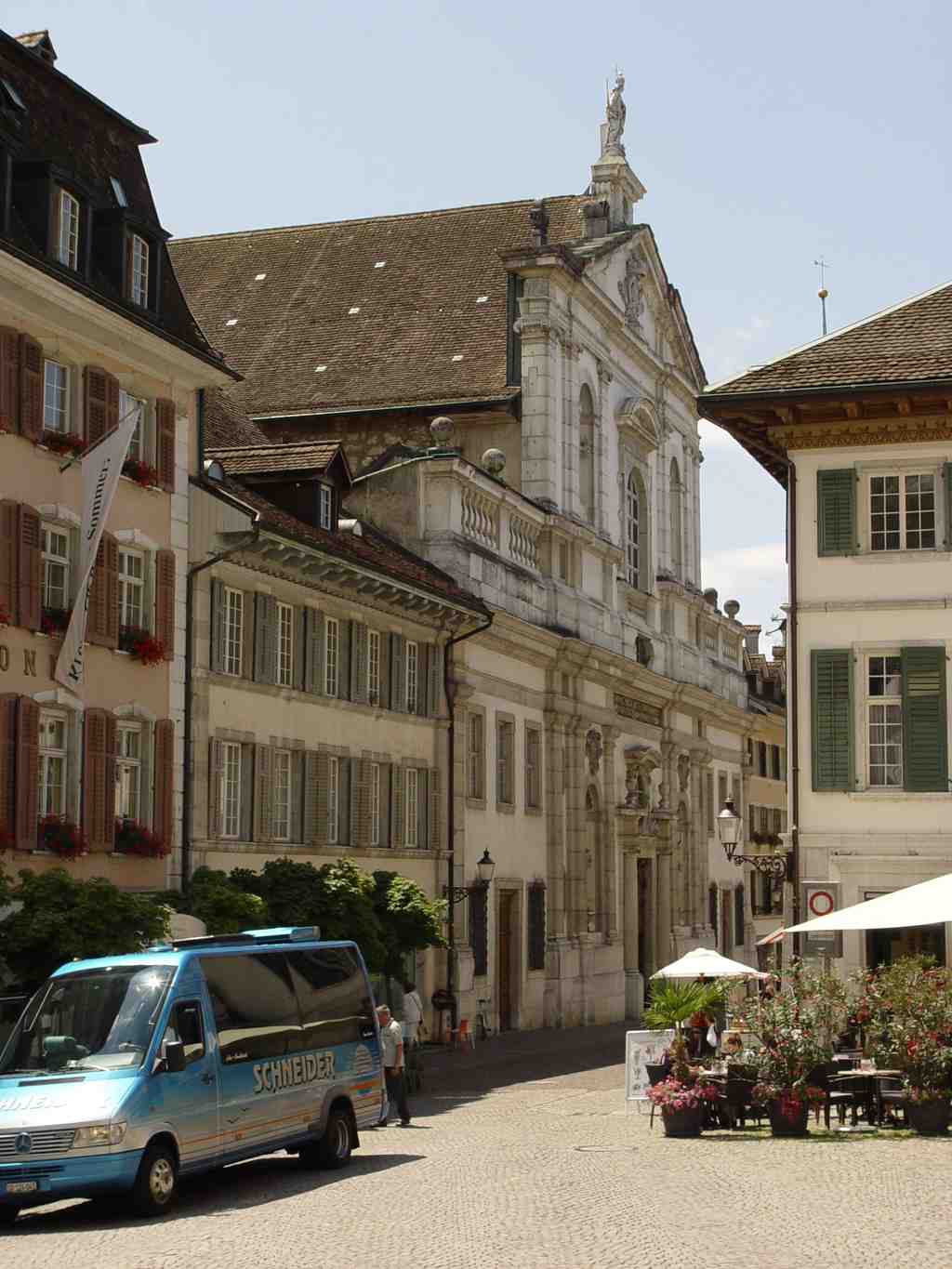
To spot the Jesuit Church, look straight ahead at the majestic two-story white stone façade with a triangular gable and statues, nestled elegantly between historic buildings on a cobbled street.
Welcome, intrepid explorer! You’re standing before the Jesuit Church of Solothurn, a place that has watched over the town’s bustling heart for more than three centuries. Imagine yourself in the late 1600s - the world smells of fresh stone, sawdust, and wet mortar, as workers hustle about, hauling blocks and timber. At that time, news had just swept through the aristocratic halls of Solothurn: the powerful Jesuit order was coming to town on a grand mission to strengthen Catholic resolve! They had the backing of Solothurn’s Grand Council, French nobles, the town’s wealthiest families, and even the illustrious French King Louis XIV, whose ambassador lived right here.
So, the year is 1680, and a man with a vision - Jesuit Heinrich Mayer - begins the plans for this magnificent house of worship. The school and church grow together like twins, with the church opening its doors in 1689 under the shimmering shadow of King Louis’ emblem, still visible on the façade if you look up. The entrance is framed by imposing Tuscan and Ionic pilasters, and nestled in niches you’ll see not just any old stone faces - but key Jesuit saints. On the lower left stands Ignatius of Loyola, the fierce founder, and opposite him the adventurous missionary Francisco de Xavier. Up top, you’ll spot Francisco de Borja and Aloisius von Gonzaga. And crowning it all, the Queen herself: a statue of Mary Immaculate carved from Solothurn limestone.
Step back in time, and you might hear the chatter of students rushing to the Jesuits’ college, ready for lessons that, in those days, replaced the musty old medieval school. For almost a hundred years, the Jesuits guided souls, only for dramatic change to arrive in 1773. Word from Rome! Pope Clement XIV had dissolved the Jesuit order, pressured by skeptical monarchs of Europe. Some say even the angels on the altar paused their singing that day. But Solothurn’s people weren’t about to let the place gather dust - services and learning continued, even without the Jesuit fathers.
As you look at the façade, consider the layers of history behind its clean lines: a facade twice restored after storms of neglect. In the 1800s and early 1900s, the old church was nearly left to crumble. There’s a moment of drama in 1927 - a real nail-biter - when, after years of darkness and closed doors, a company nearly bought the church to tear it down for shops and offices. Can you picture it? Solothurn so nearly lost this beautiful building! Thankfully, tough townsfolk and some federal Swiss money saved the Jesuit Church from the wrecking ball, starting a series of careful restorations.
Inside, it smells today of incense and old wood, but look deeper and picture the candles burning as craftsmen Pietro and Giacomo Neurone shape the splendid stuccowork on the ceilings. High up in the altar, gilded angels glint in flickering candlelight, as if whispering secrets. There’s more: the main altar, perfectly matched to the choir space, crowned with an artwork of Mary’s ascension and guarded by golden cherubs. And when the organ starts to play, you can almost hear the soaring summer sounds of concerts that still echo through the church. Imagine the swell and hush as organist Benjamin Guélat records music there in 2019 - 22 registers of sound, just waiting to lift you up.
This church is no dusty relic - it’s both a survivor and a showstopper, with a main hall ingeniously filled with daylight, thanks to brilliant architects who made sure the galleries and chapels would always be bathed in sunshine. Skilled builders from the region of Vorarlberg honed their craft here, setting a standard that would inspire churches across Switzerland and beyond.
And for a hidden twist: tucked inside, you’ll find the Lapidarium, the stone museum of Solothurn, where history’s weightiest secrets are waiting in the wings. So, pause here, take a breath, and let the spirit of centuries fill your imagination - not just with sounds, but with stories, secrets, and survival. This is the Jesuit Church, and it’s as full of surprises as ever - if these stones could only speak, oh, the tales they’d tell!
Intrigued by the architecture, equipment or the organ? Explore further by joining me in the chat section below.


