
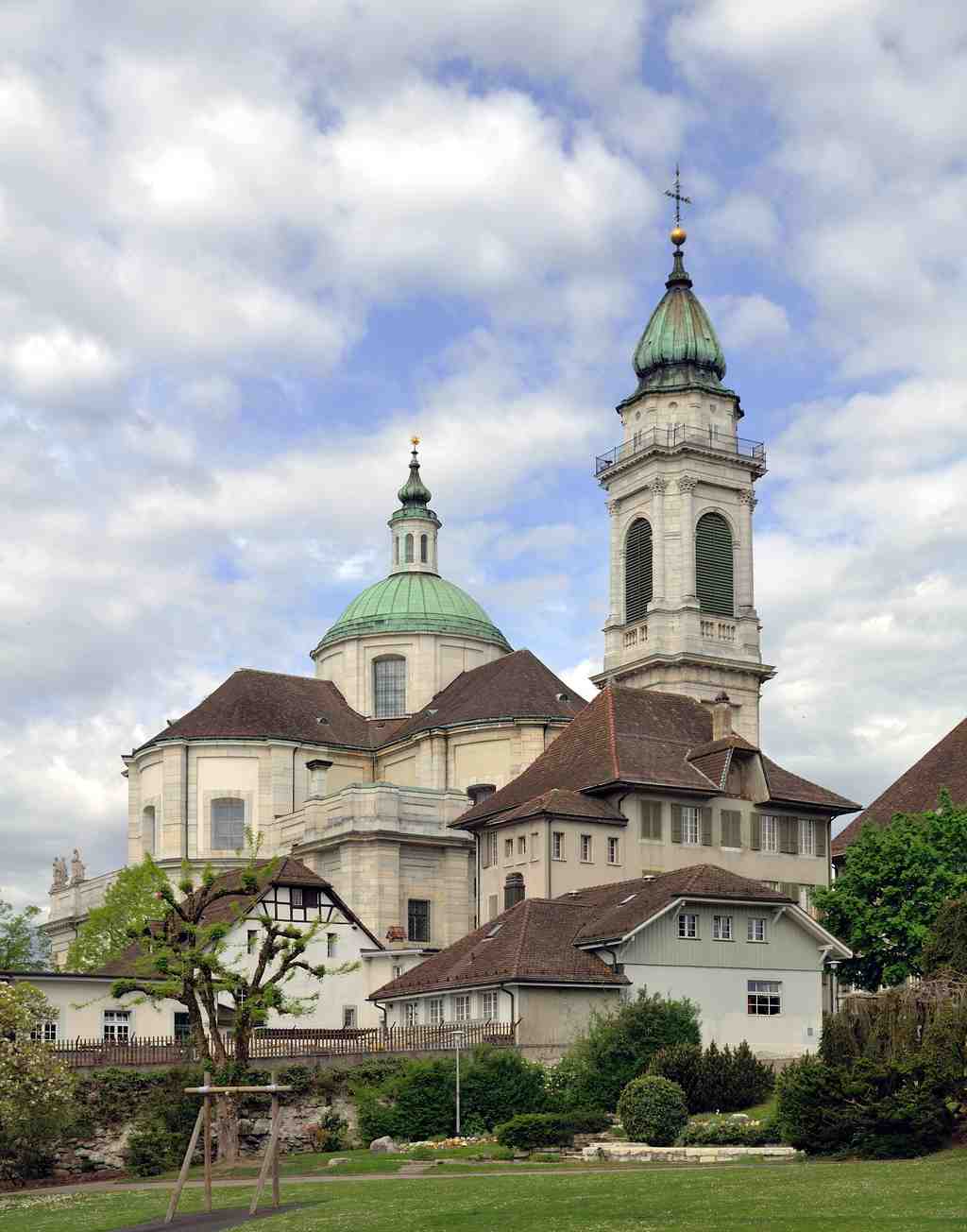
If you look straight ahead, you’ll spot an impressive stone church with a tall, onion-shaped green tower and a grand dome rising above surrounding rooftops-it’s hard to miss among the nearby houses and gardens.
Now, take a deep breath and imagine you’ve just stepped back in time-because standing before you is the legendary St. Ursus Cathedral, the majestic heart of Solothurn! Picture this: for over a thousand years, people have looked up at this very hill, where churches have come and gone like chapters in a very, very long storybook. In fact, two older churches probably stood right here, their secrets buried beneath your feet-and perhaps just a few ancient ghosts comparing architectural notes.
But the grand cathedral you see today took shape in the 18th century. It all started in 1762, when an Italian architect named Gaetano Matteo Pisoni rolled into town. The old church was-let’s just say-looking a bit tired, and local leaders wanted something dazzling. After a few false starts, some passionate debates, and plans that would make any council meeting feel exciting, Pisoni’s fresh vision finally won the day. His nephew, Paolo Antonio, took up the mantle alongside him. Stones were cut from the nearby Jura mountains, so you could say the building is very “locally sourced.” And if you listen closely, you can almost hear the echo of chisels on stone as the cathedral began to rise.
Of course, nothing ever goes as planned. Just as work was getting underway, a key tower called the Wendelstein came crashing down during a church service-don’t worry, the only thing it injured was everyone’s nerves! That changed everything: construction switched to a total rebuild. The new plans gave the cathedral a single, mighty onion-domed tower instead of the original two, mainly because, well, who wants to pay for a second tower when you could spend that money on marble altars and golden knickknacks?
As you stand outside, look up at that soaring 66-meter tower. For years, this was the home of the tower guard, who had perhaps the best-and windiest-view in Solothurn. On sunny days, you can climb all 249 steps to see where he lived, with breathtaking views across the old town and the Aare river, although you’ll get your cardio for the week!
The outside, with its baroque style, is all about drama-curves, statues, that sweeping staircase of 33 steps divided in threes, and fountains on each side. If you’re curious about the numbers, three is a lucky number here in Solothurn. The inside, designed with early classical, or “neoclassical,” style, is a secret world of smooth marble, delicate stucco, and gentle light filtering through arched windows. Here you’ll find 11 altars, all of different marbles, and a treasure trove including a remarkable manuscript from the 10th century and an ancient statue of Mary.
But it wasn’t all peace and prayers. In 2011, a terrible arson fire struck, sending smoke curling through these historic halls. Luckily, the city rallied to restore the cathedral, and today’s altar-shaped from brilliant white Carrara marble-draws inspiration from Leonardo da Vinci’s Last Supper.
As you gaze up at those statues and carvings, notice the reliefs above the doors, telling stories of Solothurn’s patrons, Saints Ursus and Victor, who were legendary Roman soldiers-so you could say bravery runs in these stones. And every summer, the air inside fills with music from the grand organ, whose pipes have rung out for centuries, except when they’re taking a break for a tune-up.
So next time you hear the bells toll through Solothurn, remember the centuries of faith, drama, fire, and even bureaucratic wrangling that shaped the St. Ursus Cathedral. It’s not just a church-it’s the city’s memory, standing strong, one loyal stone at a time.
If you're curious about the building description, equipment or the organs, the chat section below is the perfect place to seek clarification.


