
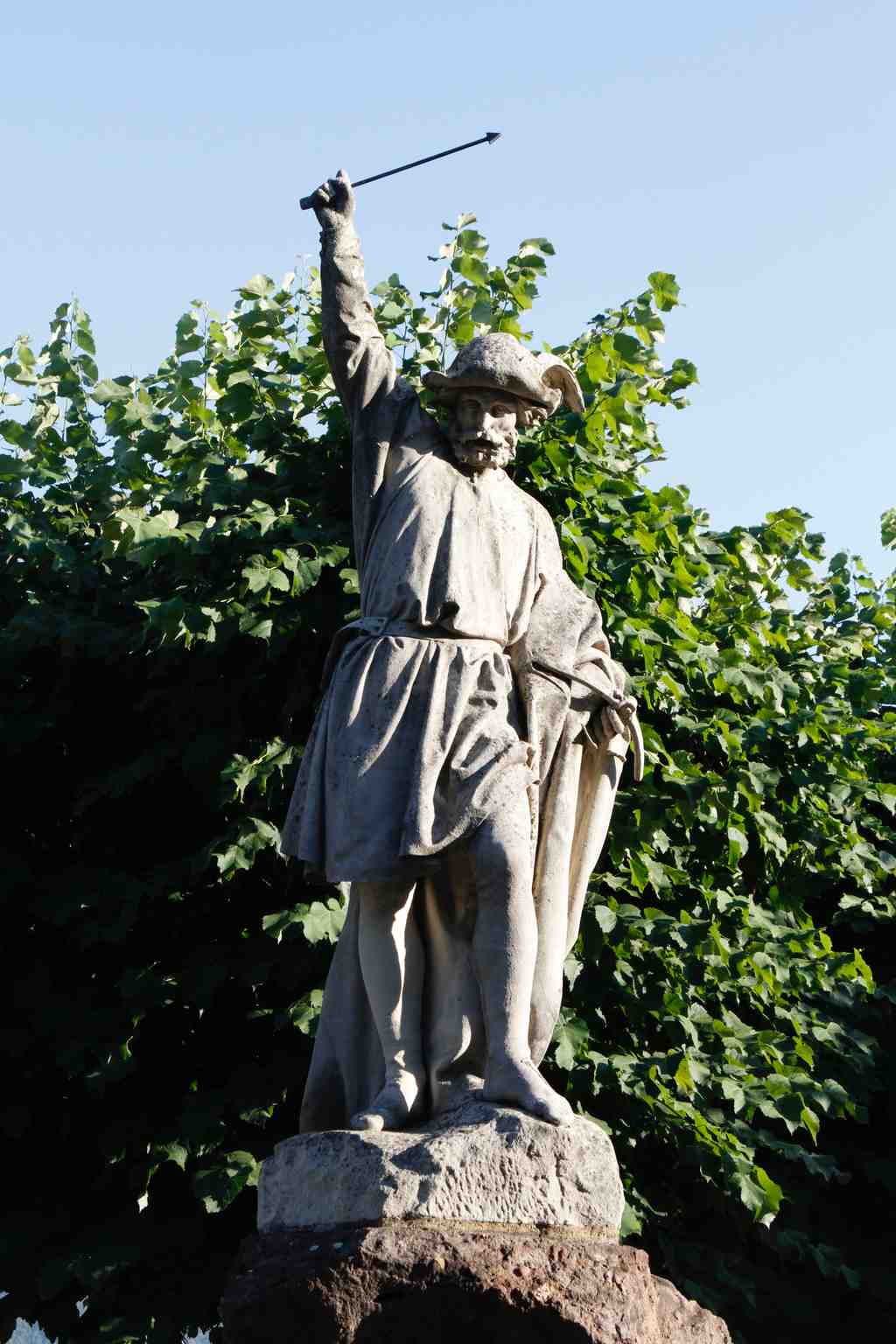
Look for a life-sized stone statue of a bearded man in a floppy feathered hat, tunic, and cloak, boldly raising an arrow in his right hand-he’s easy to spot just ahead, with the leafy trees behind him and standing proudly by the lake.
Now, imagine the early morning sunlight shimmering across Lake Lugano, and there it is before you: Vincenzo Vela’s Tell Monument, a monument with a tale as gripping as one of those old Swiss legends you might hear in the mountains. Close your eyes for a second-almost two centuries ago, the bustling site behind you was nothing like it is today. In 1855, right on this spot, there was the brand-new Hôtel du Parc, replacing an old monastery, and the owners, brothers Filippo and Giacomo Ciani, wanted something dramatic to greet their guests. “Let’s ask my friend Vincenzo,” Giacomo whispered-a young, ambitious sculptor, just 25! What could possibly go wrong?
So, Vincenzo picked up his chisel, dreaming of Swiss freedom and wild heroism. In 1856, his sculpture of Wilhelm Tell, the mythic archer and symbol of independence, was unveiled right here by the water, shocking and inspiring all who passed. Picture it: Tell in mid-action, his right arm flung skyward, arrow in hand, crossbow at his side, and no sign of an apple or his famous son Walter-Vela skipped those so Tell looked even more heroic! Even his clothes speak of the land, a knotted tunic like a Ticinese shepherd, topped off with a feather in his hat and a cloak spilling over his shoulders.
But oh, the drama that followed! In 1887, unknown vandals struck by night, mutilating parts of the statue. The years weren’t kind either: by the turn of the century, Tell was blackened, battered, and lost his crossbow. The city had to rescue him when the promenade was widened, and in 1914, after heated debates-should Tell, Swiss hero, glare at Italy or at Switzerland?-they restored him and placed him here, still facing north, his back to Italy just as the artist wanted.
Standing here, you meet not just a statue but a survivor-scarred, celebrated, sometimes criticized, but always ready, arrow in hand, to shout for Swiss freedom at the edge of the lake. One thing’s for sure: nobody ever accused Wilhelm Tell of lacking direction!
Intrigued by the description, interpretation or the reception? Make your way to the chat section and I'll be happy to provide further details.




