
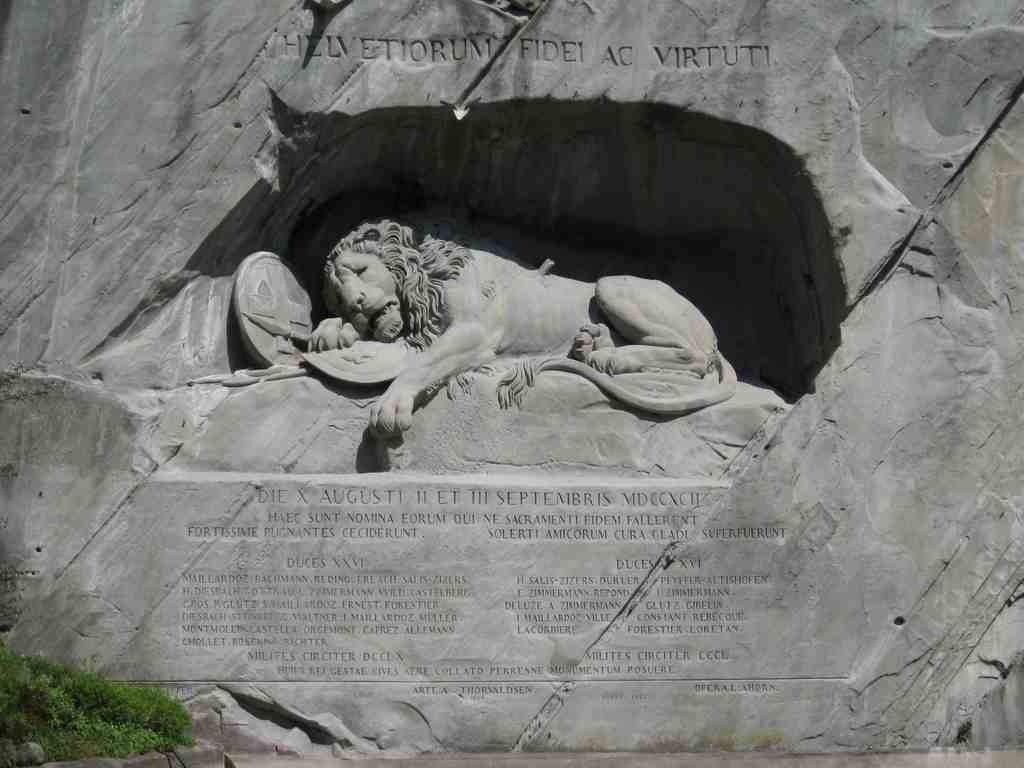
If you look straight ahead into the rock face, you’ll spot a giant lion carved into the cliff, lying mournfully on his side, with a shield under his paw and another resting nearby-it’s almost like he’s guarding them right before your eyes.
Welcome to the Lion Monument, or as the locals say, the Löwendenkmal! Now, you might be thinking, “That’s a seriously sad-looking lion for a city known for chocolate and mountain views.” Well, you’re right. Carved directly into this sandstone cliff by Lukas Ahorn in 1821-but designed by the famous Danish sculptor Bertel Thorvaldsen-this lion tells one of the most heartbreaking stories you’ll find in all of Switzerland.
Let’s flash back to the year 1792. Revolutionary Paris is in chaos-the air thick with shouting and the clang of swords. The Swiss Guards, proud and loyal soldiers hailing from Switzerland, were stationed at the Tuileries Palace, protecting King Louis XVI and his royal family. These men wore bright red uniforms and carried with them centuries of tradition. But on August 10, the revolutionary mobs rushed the palace, and chaos erupted. As bullets flew and smoke choked the corridors, the Guards valiantly stood their ground. Their ammunition dwindled, their numbers thinned. Deep in the melee, King Louis managed to scribble a note, telling his Guards to retreat-talk about sending the memo a little late!
Around 760 Swiss Guards died during that desperate stand or were massacred after surrendering. Those who survived often faced a grim fate, with many dying in prison or in the bloody September Massacres. Only a handful managed to escape the city, and a lucky detachment sent to Normandy before the attack had missed the carnage entirely-proof that sometimes being sent on an errand really can save your life.
But this lion? He isn’t just any cat. Mark Twain, the famous American writer, called him “the most mournful and moving piece of stone in the world.” Can you see why now? His head droops in sorrow, a broken spear piercing his shoulder. His paw rests protectively on a shield with the fleur-de-lis, symbol of France, and beside him lies the Swiss cross-two nations tangled together by fate’s cruel joke. If you listen closely, maybe you can even imagine the drip of the stream that trickles into the tranquil pond at his feet, mirroring that serene exhaustion after great loss.
This monument came about because one Swiss officer-Karl Pfyffer von Altishofen-had survived. Why? He was on leave back in Lucerne. Some people have all the luck! He wrote a book about the Guards’ bravery, stirring hearts all across Switzerland. The public's reaction was so strong that they organized a collection, mostly from noble European pockets, to make a monument worthy of their sacrifice. That’s how Thorvaldsen got the gig, and how Ahorn found himself chiseling this ten-meter-long, six-meter-high lion into a Lucerne quarry.
The inscription above the lion reads: Helvetiorum Fidei ac Virtuti-“To the loyalty and bravery of the Swiss.” And just below, you’ll see the names of the officers who fell and the numbers: 760 died, 350 survived. It wasn’t just a monument; it was a monument with math included.
When it first appeared, not everyone was happy. Some Swiss folks worried it was too much a celebration of old monarchies and not enough about Swiss independence. In fact, the controversy got so intense that rumor had it-someone threatened to saw off one of the lion’s paws in protest! Can you imagine the world’s most mournful lion waking up to find itself with one less paw? Now that would be a real cat-astrophe.
But the lion remained, stoic and dignified, and over the years captured the hearts of writers like Mark Twain and dramatists, school children, and curious tourists who came by the millions to gaze at his sorrowful face. The monument has even inspired copies-one in Atlanta, Georgia, for example, though that one had a much rockier reputation, literally and politically.
So, as you gaze at this noble beast, think of those wild days in revolutionary France. Picture soldiers in striking red, their courage shining amidst chaos, their story now set in silent stone. Maybe, if you listen hard enough, you’ll hear not just the mournful sigh of a dying lion, but the echoes of history-where loyalty, bravery, and a touch of drama are never far behind.
Wondering about the background, memorial or the reception? Feel free to discuss it further in the chat section below.


