
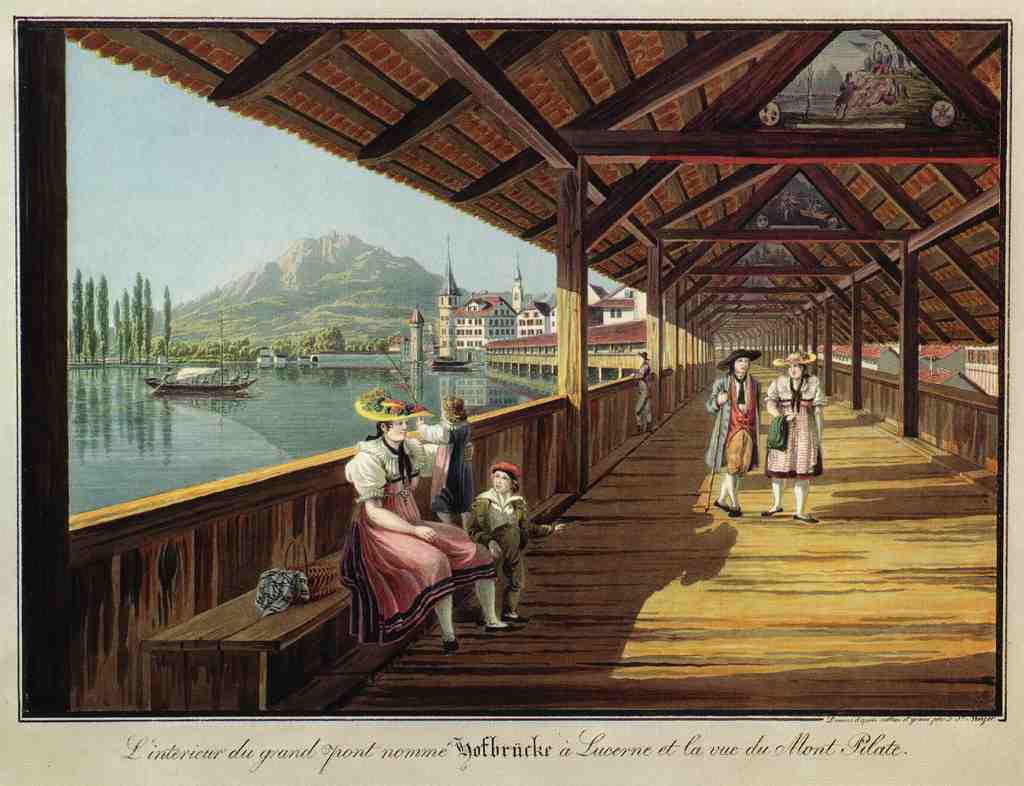
To spot the Hofbrücke, look for a long, roofed wooden bridge stretching over the water, its sturdy beams forming a tunnel, and if you glance above you, you’ll see triangular painted panels tucked into the rafters.
Now, as you stand here, close your eyes for just a moment and imagine the echo of wooden footsteps and the gentle creak of planks beneath heavy boots and clacking heels. Picture yourself in the 13th century: Lucerne looks very different. The lakefront was much wider, and directly in front of you stretched the city’s pride and joy-the Hofbrücke, or, as the locals once called it, the “Lange Brücke,” the Long Bridge. At an impressive 385 meters, it connected the quarter around the Church of St. Leodegar with Lucerne’s bustling Old Town, resting on 121 columns, and no, they didn’t hire any bored beavers for the construction!
But the Hofbrücke was never just another bridge. It was the city’s longest, acting as both a lifeline and a fortress passageway in times of trouble. Imagine, in stormy nights, lantern light flickered inside, casting shadows on the faces of travelers and guards huddled under its shelter. It soared above the water, packed with townsfolk, merchants and, occasionally, some rather nervous geese.
What made the Hofbrücke unique, and frankly the envy of bridges everywhere, was its extraordinary gallery of paintings. Around 1550, with a stroke of genius (and a decent dose of civic pride), the city’s leaders decided not just to cover the bridge, but to tell a story inside it-a story painted in over 460 triangular images, pressed into the wooden gables overhead. Passersby would gaze up, and, in the flickering candlelight or sunlight, see tales from the Bible unfurl, picture by vivid picture, as if the entire bridge had become a magical storybook above their heads. The families of Lucerne weren’t shy either; if you paid for a painting, your family crest, your name, even your hopes and dreams got their spot in the corners. Nearly 239 paintings adorned the bridge at its peak, and the townspeople probably argued about whose painting was the best-just like family photos in the living room.
By 1835, the bridge began its final bow, bit by bit dismantled, though its art endured, tucked away in museums and depots. Today, only 113 of those magical panels remain. The Hofbrücke fundamentally changed how bridges-and maybe even people-told their stories, inspiring Lucerne’s other famous bridges, like the celebrated Chapel Bridge.
So as you stand here, imagine the laughter, the religious pilgrims, the hurried steps over troubled water, and above all, the painted tales that once watched over every soul who crossed, blending Lucerne’s past with each step forward into its future.




