
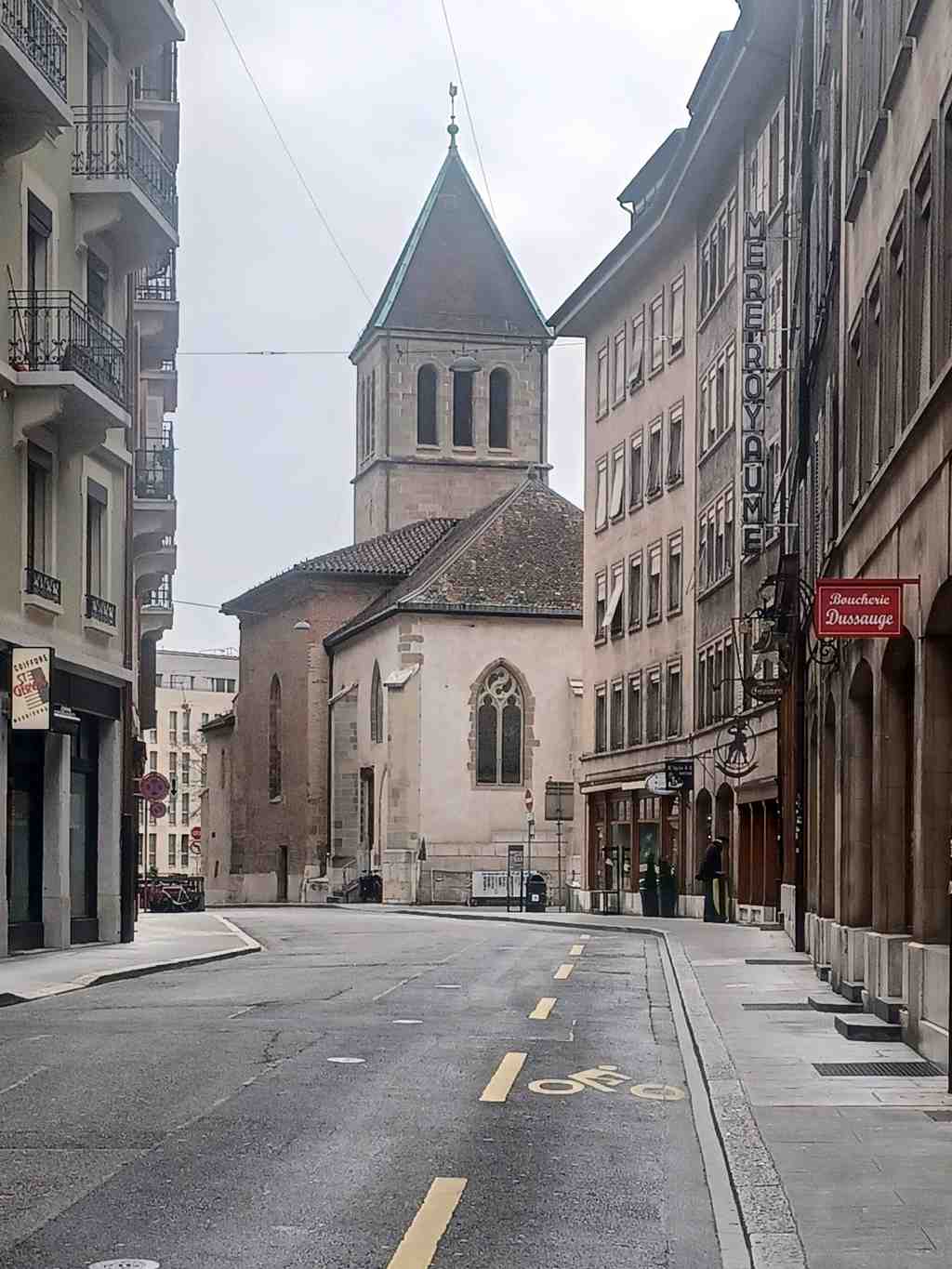
If you look straight ahead, you’ll spot the Temple de Saint-Gervais with its pointed greenish spire rising just past the surrounding old city buildings-look for the tall, narrow tower and the pale pinkish stone walls nestled at the street’s gentle bend.
Ah, welcome to the Temple de Saint-Gervais-standing here, you’re at a crossroads of time, where the Roman legions once marched, medieval stonemasons sweated, and mysterious ancient spirits probably rolled their eyes at the idea of bike lanes! Let’s set the scene: The church you see before you sits on a natural plateau right by the Rhône. Long before these walls existed, this spot was a Celtic burial ground, then a Roman bridge crossing, and the hub for travelers since, well, about 4000 BC! If these stones could talk, they’d probably have the best stories at dinner parties.
As you listen, imagine the year is 58 BC. Julius Caesar is here and-no kidding-orders the Rhône bridge to be destroyed to keep tribes from surprising him. Right under your feet, archaeologists have found traces of Celtic graves, megaliths, and even the phases of a Gallo-Roman sanctuary. It’s fair to say you’re standing somewhere that’s had more makeovers than a reality TV star!
Fast forward to the 5th century: here rose a grand, cross-shaped basilica-Geneva’s original grave church. Some of the first stones came from a nearby ancient mausoleum, so recycling is nothing new! The crypt from that era is still below, a mysterious place that’s hosted generations of ghosts-allegedly. In the 10th century, this spot was part of a Carolingian court complex-basically, think of it as Geneva’s first town hall and courtroom, minus the modern lawyers.
Fire swept through the neighborhood in 1345, but the church stood strong, becoming the parish heart of Saint-Gervais by the 11th century. In the 1400s, huge changes arrived-construction buzzed between 1430 and 1450 as local masons and skilled workers from Piedmont crafted the late-Gothic church you see now, using the soft, pink-tinged sandstone quarried nearby. They built in lively, jagged “sawtooth” patterns, making the sun dance across the façade at just the right angle. It was the 15th-century version of architectural bling!
As you get closer, take in the smooth lines of the stonework and those large, arching windows-most were added in early 1900s renovations. If you’d visited in 1478, you could have peeked inside the Chapel of the Escalade, or “German Chapel,” built for craftspeople from South Germany who settled here and ended up so cozy they named their own guild. Geneva in the Middle Ages: come for the trade, stay for the real estate!
Then came the Reformation in 1535. Suddenly, the church’s lavish altars and saintly images were banished, and the interior was scrubbed down to suit the new Calvinist style. It was probably the biggest clean-up in Geneva since, well, ever. Still, medieval wall paintings survived-hidden under centuries of whitewash until careful restorers peeled it back in the 20th century. Today you can see bold angels at the vault’s base, the painted tabernacle on the wall, and a vivid Madonna-“Notre-Dame de Consolation”-stretching her huge blue cloak over kneeling believers (and even Duke Amadeus VIII, who became an anti-pope, but don’t hold that against him). If you think your family’s got drama, imagine being the only anti-pope in the region!
Let’s talk windows: the originals are long gone, but the modern colorful glass includes one from 2011 and some vibrant pieces from the early 1900s. So, whether you’re into “old as time itself” or “modern with a twist,” there’s a slice of history for you.
And what’s that majestic rumble you sometimes hear from within? It might be the Felsberg organ, installed in the 1990s but built to sound like a 17th-century Normandy masterpiece. This organ brings together the sound of old Europe-with a dash of Swiss mountain air-using wood, metal, and a little magic. Go on, imagine a choir filling the nave while the mighty pipes thunder-you might actually feel the street vibrate beneath you!
And finally, the bells: three in all, each telling a slightly different story. One cast in 1493, another in 1786, and the youngest chiming since 1949, named (quite appropriately for Geneva) “La Paix” or “Peace.” Next time you hear them, remember-they’ve survived wars, reforms, and even renovations by architects with perhaps questionable taste in window shapes.
Today, Saint-Gervais stands as a national treasure, protected and preserved, but above all, a living chapter of Geneva’s story. So give the façade a good look, peer at those ancient stones, and imagine the swirl of centuries passing-one breath, one prayer, one echo at a time.
Interested in knowing more about the description, church window or the organs




