
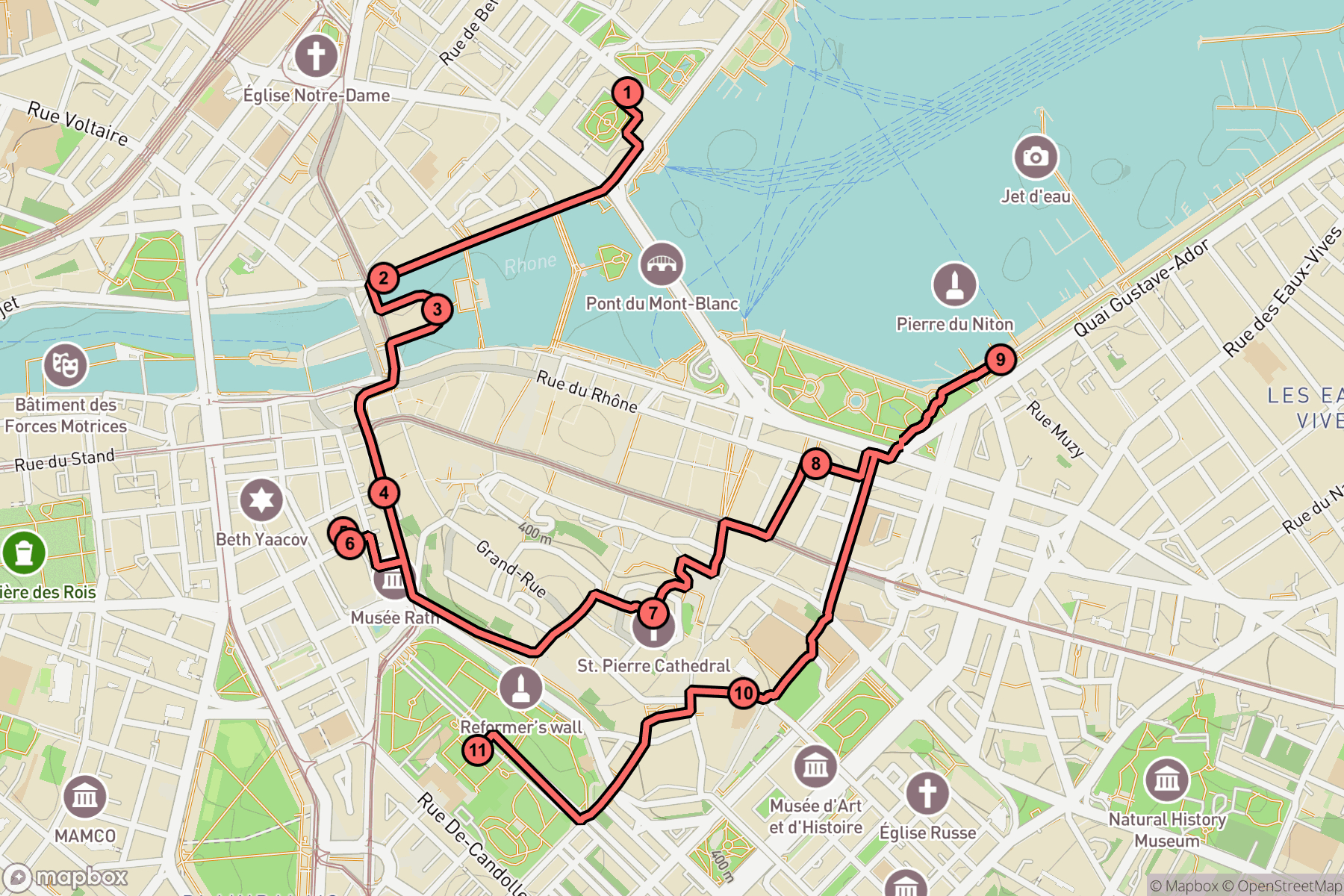
Geneva Audio Tour: Financial Titans and Timeless Stones
Discover the heart of Geneva on this captivating tour visiting iconic landmarks such as Banque Cantonale de Genève, the prestigious University of Geneva, and the historic Bank Lombard Odier & Co. Immerse yourself in the vibrant blend of finance, education, and culture as you explore these remarkable institutions. Experience the elegance and innovation that define Geneva, all while soaking in the city’s rich heritage and picturesque surroundings. Perfect for those fascinated by history, finance, and academic excellence!
Tour preview
About this tour
- scheduleDuration 90–110 minsGo at your own pace
- straighten4.2 km walking routeFollow the guided path
- location_onLocationGeneva, Switzerland
- wifi_offWorks offlineDownload once, use anywhere
- all_inclusiveLifetime accessReplay anytime, forever
- location_onStarts at World Policy Conference
Stops on this tour
lock_open 3 free previews · 8 unlock with purchase
Picture this: The year is 2008. The air’s thick with tension as the planet faces the great financial crisis. World leaders, politicians, journalists, and thinkers are scrambling…Read moreShow less
Picture this: The year is 2008. The air’s thick with tension as the planet faces the great financial crisis. World leaders, politicians, journalists, and thinkers are scrambling to figure out what on earth went wrong. Out steps Thierry de Montbrial, a French professor with more hats than a Geneva fashion show-economist, engineer, columnist, and advisor to presidents. He founds the World Policy Conference with just one wild idea: to gather all the big minds in one room and talk, really talk, about how to keep this world spinning in the right direction. Now, imagine the grand halls filling up-glasses clinking, footsteps shuffling, whispered conversations building in a crescendo of hope and curiosity. Montbrial’s dream was to create a place where leaders would debate not through “my country’s bigger than yours,” but as equals, brainstorming in an atmosphere thick with trust, tolerance and, hopefully, good coffee. The conference isn’t just a political parade; it’s designed to cut through the noise. Whether it’s a passionate plenary session, a no-holds-barred workshop, or a lively dinner debate, everyone gets a fair shot at the microphone. It doesn’t matter if you’re a president, a bank magnate, or the world’s next great political pundit-you’re here to learn, to challenge, and to create change together. But Montbrial knew that the world’s problems couldn’t be solved behind closed doors. So, from the very first edition in Evian, France, the WPC set out to tackle global challenges: financial crises, climate threats, international disputes-you name it. And as each year passed, the guest list became a dazzling roll call of who’s who: UN Secretary Generals like Ban Ki-moon, champions of peace such as Martti Ahtisaari, economic masterminds like Bertrand Badré, and even state presidents, business moguls, and Nobel Prize winners. Every year, the mood here turns electric with the arrival of these movers and shakers. One year, you might spot Mary Robinson-Ireland’s former president-chatting with the likes of Joseph Nye from Harvard. Another year, it might be Prince Albert of Monaco sharing a croissant with a former Korean minister. If you ever wanted to overhear what the world’s top minds really thought about tomorrow, this is your chance-though you’ll need ninja-level eavesdropping skills! Humor me for a moment: Have you ever tried getting passionate politicians, bankers, scientists, and journalists all to agree on lunch? These meetings are designed to get past surface-level chit-chat and down to the real business of changing the world-sometimes with a little heated debate, but always with plenty of mutual respect. Every participant is handpicked for their unique insights, so the conversations stay as fresh as alpine air. And speaking of fresh, the entire show is recorded for the world to see and hear. After each meeting, multicolored conference reports are published-like a yearbook for global leaders, complete with participant profiles, juicy highlights, and enough photographs to fill a family album. These reports travel the world, landing in the offices of decision-makers from Africa to Asia, and yes-you can even download them as PDFs if you’re a fan of heavy reading. Online, the World Policy Conference is everywhere: videos on WPC TV, virtual debates, and lively social media, where you might catch a tweet from a retired president or a behind-the-scenes snap of a Nobel laureate lost in thought. As much as this is a gathering for elite minds, the real spirit is inclusion. Every nation’s perspective matters, no matter its size or influence, which means you can walk these steps today and still feel the echoes of past debates and future dreams. So, as you gaze up at this unassuming building, imagine it filled with the hopes, fears, sound, and fury of people determined to lead us to a world that’s more open, prosperous, and fair. Feel that energy in the air-the urgency to solve problems that are bigger than any one nation and to work together in respectful disagreement. And as you move on, don’t be surprised if you catch the faint hint of a heated policy debate in the breeze. Or maybe that’s just me, getting carried away by all this excitement-after all, in Geneva, even the air seems to be thinking big.
Open dedicated page →To spot Banque SYZ, look for a modern logo with big, bold orange letters spelling "SYZ" in a lively handwritten style, with the words "for the future..." just below-if you see…Read moreShow less
To spot Banque SYZ, look for a modern logo with big, bold orange letters spelling "SYZ" in a lively handwritten style, with the words "for the future..." just below-if you see this bright, energetic sign, you’re in the right place! Now, let me whisk you back to 1996, when three fearless bankers-Eric Syz, Alfredo Piacentini, and Paolo Luban-teamed up here in Geneva with a dream bigger than a Swiss fondue pot! With a dash of ambition and a pinch of innovation, they laid the first bricks of Banque SYZ, determined not just to manage wealth but to shake up the banking scene with fresh ideas. Picture their early days: Geneva’s winter winds whipping past old stone buildings, while inside, ideas buzzed like bees in spring. Rapidly, their ambitions grew. Like explorers setting out from Europe’s cozy heart, the founders ventured into Nassau in the Bahamas-imagine palm trees and ocean breezes instead of the chilly Swiss air. Soon, branches blossomed in Lugano, Locarno, and even cosmopolitan London-each new city another daring leap, each new office abuzz with languages, accents, and the thrill of the unknown. And if you think banking is only about numbers, just picture these pioneers juggling partnerships and launches across continents-now that’s high-pressure multitasking! Of course, every great adventure has its twist. In the world of finance, fortunes can turn as quickly as Lake Geneva’s weather. SYZ joined forces with Italy’s Albertini group, expanding their reach to Milan-imagine late-night espressos powering deal-making under twinkling city lights. New ventures followed in Madrid with the Spanish group N+1, and even in the U.S., where Swiss Advisors took aim at American investors. But there’s a saying in Geneva: “Even the smoothest lake hides restless waters.” In 2014, two founders moved on, leaving Eric Syz at the helm. Under his watchful eye-imagine a captain steering through investment storms-SYZ acquired the Swiss arm of the Royal Bank of Canada, opened offices in Munich and Madrid, sailed through turbulent markets, and faced down tough decisions as regulations tightened. They even let go of some businesses, adapting to keep their ship steady. Yet, their spirit was undeniable. In 2014, SYZ was named the most solid Swiss bank and the “Best Private Banking Boutique”-high praise in a country where banks are as common as chocolate shops! So, as you stand before their glowing orange sign, imagine the quiet current of ambition still flowing within these walls. Banque SYZ continues to dream, plan, and look-for the future… and maybe for a good Swiss joke or two.
Open dedicated page →To spot the Banque Cantonale de Genève, look across the turquoise river for a modern gray stone building with Swiss and Geneva flags waving on its rooftop-its bold “BCGE” logo and…Read moreShow less
To spot the Banque Cantonale de Genève, look across the turquoise river for a modern gray stone building with Swiss and Geneva flags waving on its rooftop-its bold “BCGE” logo and striking silhouette are sure to catch your eye above the trees. Now, as you stand here listening, let’s step into the swirling current of one of Geneva’s oldest and most storied banks. The Banque Cantonale de Genève is no ordinary bank-oh no! If these walls could talk, you’d hear tales of ambition, crisis, and more political drama than your average Swiss chocolate box. The story flows back over two centuries, all the way to 1816. Imagine Geneva still dusting itself off from the Napoleonic era, when Jean Auguste Pyrame de Candolle and Richard Tronchin, names as grand as any Swiss mountain, persuaded the city fathers to found a savings bank. Its purpose: to boost local business and help even humble workers squirrel away their hard-earned francs. In those days, you might have collided with a banker on his way to work-hurrying through the echoing corridors of the Geneva city hall, since that’s where the very first branch was housed. Back then, most Genovese people owned a little savings book from the Caisse d'Épargne, and by the dawn of the 20th century-if you’d listened closely on payday-you’d have heard the satisfying “clink” of coins as lines of customers deposited their wages at Rue de la Corraterie. And yet, the BCGE as you see it now is really the result of a marriage-one in the best Swiss tradition-between rivals. Alongside the Caisse d’Épargne was another bank, born in 1847, catering mostly to the region’s hardworking farmers: the Banque Hypothécaire du Canton de Genève. This institution supported customers through lean harvests and changing times, even moving its home from rue de la Pélisserie to the bustling Place du Molard. Over the years, mergers were considered but never realized-almost like two cautious lovers hesitant to tie the knot. It was only in the 1990s, as economic storms battered Switzerland’s banking sector and competition sharpened like peaks in the Alps, that these two old-money houses finally said, “I do.” In 1994, after some spirited debates and a public vote, the BCGE we know today was born-right here at Quai de l’Île. But don’t let the bank’s solid facade fool you. There was plenty of thunder behind these stone walls. In the late 1990s, BCGE ran into a financial blizzard-so many bad loans piled up, management began to sweat more than a banker in a heatwave. In 2000, for a moment, it looked as though the bank might sink, and the Canton of Geneva had to swoop in for a rescue, sending billions of Swiss francs swirling into an emergency fund. The headlines? Let’s just say they made more noise than a marching band. Rumors of mismanagement and even money laundering swirled like smoke. The drama reached all the way from Geneva to Paris to the Swiss courts, leading to a high-profile trial. Imagine the courthouse packed, papers rustling, tension so thick you could spread it on your morning croissant! In the end, most charges were dropped, but the specter of scandal haunted the city’s high society for years. Today, though, BCGE is the picture of respectability and modern Swiss values. The bank is owned mostly by the canton, city, and communes of Geneva, but a slice trades on the Swiss stock exchange-so, while a touch of old family politics remains, it’s got a modern, global outlook too. The BCGE doesn’t just grant loans or handle savings: it offers asset management, business finance, even private banking that reaches from Lyon to Hong Kong. Walk inside, and you’ll find an atmosphere blending the precision of Swiss watchmaking with the flair of a world city. They take equality seriously, too-so seriously, in fact, they’ve been honored for ensuring the same salary for men and women, and for keeping their board of directors balanced. But perhaps most of all, this bank is tied to Geneva’s heart, helping the city grow, evolve, and outlast every storm. So, as you stare up at the building’s crisp, geometric lines reflected in the green-blue Rhône, think of all the stories-of prosperity, risk, near-misses, and comebacks-still whispered inside these sturdy walls. And maybe, next time you walk by a calm Swiss banker, just wink, and say, “I know the whole story.”
Open dedicated page →
Show 8 more stopsShow fewer stopsexpand_moreexpand_less
Let’s rewind the clock all the way to 1796, when Geneva was a city of cobbled streets, horses trotting by, and candles flickering in bankers’ offices, illuminating ledgers full of…Read moreShow less
Let’s rewind the clock all the way to 1796, when Geneva was a city of cobbled streets, horses trotting by, and candles flickering in bankers’ offices, illuminating ledgers full of dreams. Back then, Henri Hentsch, a local with a knack for finance and a side hustle in silk trading (who says you can’t have two jobs?), founded what would become the foundation of Lombard Odier. Picture him: mustache twirled, sleeves rolled up, dealing in fabric by day and dodging revolutionaries by night. At one point, he was even thrown out of Geneva during the French Revolution, only to return and open his bank at the ripe old age of 35. That’s dedication! Geneva, at that time, was buzzing with uncertainty. Napoleon’s troops were marching by, currencies were as mixed up as a Swiss cheese fondue, and local businessmen desperately needed someone to trust with their gold and hopes. Henri’s bank became that anchor-helping traders with loans, settling debts in turbulent times, and trading in precious metals when nobody knew what tomorrow’s currency would be. But banking dynasties need more than one protagonist. Enter the legendary families: the Lombards, with roots stretching back to 16th-century Italy (after escaping religious persecution and, possibly, bad spaghetti); the Odiers, coming over from France, a family of politicians, doctors, and, perhaps most risky of all, future bankers. When Jean-Gédéon Lombard joined as partner in 1798, it wasn’t always smooth sailing. He and Henri Hentsch actually had some legendary disagreements: one wanted to play it safe, the other to take big international gambles. In the end, they split up-but worry not, that only gave us more banks to visit in Geneva! Through the centuries, the Lombard, Odier, Darier, and Hentsch clans became master collaborators, financing railways in America, canals in France, and even braving the ups and downs of economic crises-sometimes losing small fortunes, sometimes surviving by the skin of their teeth. The faces changed, but the hunger for opportunity never left. When the rest of Europe was trembling from crisis after crisis, Geneva’s bankers were forming alliances, merging companies, and rebuilding stronger than ever. Funny to think that the same bank financing the Wild West’s railroads 150 years ago is managing digital assets on modern computers today. The world wars were a real test. By 1939, the bank had just 75 employees-half of whom had to leave for military service. Money from all over Europe started streaming into Swiss banks, seeking shelter. Lombard Odier didn’t just survive these storms; it became a haven, a safe, neutral island in a sea of chaos, thanks to Geneva’s policy of neutrality. There’s a touch of mystery and romance in that old Swiss saying: “During times of trouble, even gold comes to rest in Geneva.” But it wasn’t just about gold and markets. Lombard Odier has always held a surprisingly altruistic streak. In the 1800s, Alexandre Lombard answered the call of Henry Dunant to help the wounded of the Sardinian War, a move that led to the foundation of the Red Cross. Throughout the years, the families involved themselves in local hospitals and charity projects-an emotional reminder that, behind the polished marble and ticking clocks, real people cared for their city. Fast forward to the 21st century: In 2002, a super merger combined all these family banks into a single powerhouse. Today, Lombard Odier is entrusted with nearly 300 billion Swiss francs, watched over by thousands of sharp minds here in Geneva and beyond. They handle everything from wealth management for private clients to tech-savvy solutions for other banks (yes, even bankers need IT support). And as a final fun fact, despite all these changes, the bank’s official logo still bears the names of all four founding partners-a subtle nod to the past, even as they invest in the future. So, as you stand here in front of this grand institution, you’re not just seeing a building-you’re at the crossroads of centuries, where silk, gold, family feuds, and quiet generosity all meet. Just don’t try to open a vault; they might not appreciate the suspense!
Open dedicated page →Look for an elegant corner building with glowing lights and wrought-iron balconies, highlighted by two large flags waving above the entrance on Rue de Hollande-Bordier & Cie will…Read moreShow less
Look for an elegant corner building with glowing lights and wrought-iron balconies, highlighted by two large flags waving above the entrance on Rue de Hollande-Bordier & Cie will be right in front of you. Ah, you’ve found it! Welcome to Bordier & Cie, an address where history, tradition, and a dash of adventure meet under the whisper of Swiss banking. Imagine the year is 1554: Geneva is a refuge from turmoil, and the air is thick with hope and determination. That’s when Guillaume Bordier arrived here, a French Protestant fleeing religious persecution from Orléans. He brought nothing but faith, maybe a little nervous energy, and a knack for fabric, as his descendants would first become cloth makers, then skilled goldsmiths, and eventually-as fate would have it-key players both in business and the church. Now, fast-forward to a crisp Geneva morning in 1844. Jacques Reverdin, previously working at the well-regarded Bank Pictet, feels a spark of rebellion and dreams of building something extraordinary. He starts a banking house in Geneva, and little does he know, he’s igniting the flame for one of the last true Swiss private banks. In a twist worthy of a romance novel, Ami Bordier joins the story not just as a business partner but after marrying Reverdin’s daughter in 1871. When Jacques passes away, Ami takes the reins. The company is reborn with a new name: Bordier & Cie, and it’s more family affair than corporate machine-just imagine the board meetings back then, a bit less “PowerPoint,” a bit more “pass the fondue.” Now, gaze up and picture the year 1906. The family and their small team-only 13 people-move into this very building, the stronghold of Rue de Hollande 16. The walls you see have witnessed every evolution: from telegrams crackling with news of distant markets to the first IBM computer firing up in the 1970s. What a shock that must have been! “So you’re telling me, I push this button…and my spreadsheets appear?!” As the decades rolled on, the Bordier sons, grandsons, and eventually daughters (because even Swiss banking families must keep up with the times) took over. They shepherded the bank through wars, economic booms, and a few awkward Christmas dinners, growing their staff and presence far beyond Geneva. Today, you’ll find Bordier nameplates not only here, but also sparkling in Zurich, Bern, and Nyon, echoing across London, France, Uruguay, Singapore, even the Turks and Caicos. If you ever find yourself on a sun-kissed Caribbean island and catch a whiff of freshly printed Swiss francs, you’ll know why! But here’s the real drama: those majestic doors mark one of the last strongholds of the old Swiss private banker. Four partners still stand behind every promise Bordier & Cie makes-with their own fortunes on the line, not just the bank’s. It’s a tradition as rare as a quiet day on the Swiss stock market and perhaps a little nerve-wracking for those partners. Imagine signing on for, “unlimited liability.” That’s right, if something goes awry, it’s not just corporate money at stake-it’s personal. That’s both courage and a bit of madness, don’t you think? Through the decades, Bordier & Cie has managed fortunes, guided families, advised on everything from investments to inheritance, and grown to manage over 18 billion Swiss francs. Yet, even as times changed, mergers happened, and computer screens replaced quill pens, the atmosphere inside remained thick with trust, discretion, and the hush-hush air of old Geneva. So as you stand here, with the city’s golden streetlights flickering and those flags above swaying, imagine every generation of the Bordier family gazing out from those balconies-watching a changing world, quietly plotting their next move, and maybe arguing over who gets the corner office. That’s Bordier & Cie: resilient, family-rooted, fearless, and just a little mysterious. Now, onward to our next stop-let's see if any other bankers have as exciting a story!
Open dedicated page →You’ll spot the Grand Théâtre de Genève by its grand limestone façade ahead-lined with tall pillars, marble statues, and a dramatic winged figure crowning the pediment-looking…Read moreShow less
You’ll spot the Grand Théâtre de Genève by its grand limestone façade ahead-lined with tall pillars, marble statues, and a dramatic winged figure crowning the pediment-looking every bit like Geneva’s palace of the arts, right at the heart of Place Neuve. Ah, take a deep breath and imagine it: the Grand Théâtre de Genève standing before you like a slice of Parisian grandeur at the edge of the Swiss Alps! The columns rise as if to say, “you’re about to witness something epic,” and the wide stone steps lead you straight into the heart of centuries-old drama, music, and a generous pinch of operatic intrigue. Let’s rewind a bit, shall we? Imagine Geneva back in the 1700s, when the strict Calvinist spirit frowned on fun-and opera was a definite no-no! But things started to loosen up, thanks to characters like Voltaire (the ultimate party guest for any Enlightenment soirée), and suddenly opera flourished just outside the city walls in quirky little theatres, where perhaps a few upstanding citizens snuck out past curfew for a forbidden aria or sly pas de deux. It wasn’t until the 1870s, though, that the city decided it was time to think big-big enough to match Geneva’s growing reputation and its people’s appetite for culture. Cue Charles II, Duke of Brunswick-a man with style and, more importantly, money. Part of his legacy helped fund the enormous project here. With funds secure, acclaimed architects got to work on this marvellous plot by the old city moat, and by 1879, Geneva’s sparkling new opera palace made its debut to the grand tune of Rossini’s William Tell. Opera had officially moved inside the city walls…and was ready to dazzle. The façade before you is a show in its own right! There’s that sweep of Jura limestone pillars, plinths hewn from mountain stone, red granite accents, and a whole parade of sculptures and busts of legendary composers-Rossini, Beethoven, Mozart, and even hometown hero Jean-Jacques Rousseau. If you look up, you’ll spot the coat of arms and the “Genius of the Arts,” with allegorical figures keeping it company. It’s a feast for the eyes long before the curtain rises inside. Speaking of inside: imagine marble floors catching the glint of glittering chandeliers, mirrors playing tricks with light, and dramatic staircases leading well-dressed crowds to gilded foyers. Each mural and carving whispered the city’s love for music and performance-six grand paintings by Léon Gaud wrapped around the stairs, celebrating every kind of music you could name, from military marches to mythic serenades. But-plot twist!-in 1951, disaster struck during a rehearsal. A fire broke out, devouring the stage, roof, and much of the plush décor. Picture stagehands running, smoke billowing out over Place Neuve, and the great curtain falling not on applause, but on charred remains. For more than a decade, the theatre went dark. Opera singers swapped their satin for fireproof suits as productions moved to the Grand Casino. The story could have ended there-a tragic final act. But Geneva is never short of a comeback. By 1962, after years of debate, negotiation, and a considerable amount of scaffolding, the Grand Théâtre reopened. This time, it sparkled with the latest technology-a stage as large as a football field, ceilings that shimmer like the Milky Way with Murano glass, and backstage gadgets so advanced they change sets at the touch of a button (making stagehands everywhere breathe a sigh of relief, and maybe despair over lost heroic stories). Each renovation-from the computerised stage machinery to the dazzling chandelier and seats fitted for nearly 1,500 music-lovers-makes sure the building honors its heritage but sings with modern flair. And did you know beneath those marbled steps are hidden technical decks deep enough to fit entire stage sets and even raise or lower the whole orchestra? It’s almost like Geneva’s own batcave for the performing arts. So whether you’re here for Verdi or Wagner, ballet or recitals, remember: beneath the stately façade and the echo of a soprano’s high note, this place is a survivor, a chameleon, and, after nearly 150 years, still the stage where Geneva comes to dream, weep, and applaud. And if you feel a tingle in the air, don’t worry-that’s just the spirit of the Genius of the Arts, waving down to welcome you to the show. Fascinated by the the grand théâtre 1879-1951, the great fire - reconstruction 1951-1962 or the the grand théâtre 1962 - to present? Let's chat about it
Open dedicated page →Look ahead for a grand stone building with soaring columns at the entrance, a triangular roof above them, and a mix of round and sharp towers rising behind-if you see a majestic…Read moreShow less
Look ahead for a grand stone building with soaring columns at the entrance, a triangular roof above them, and a mix of round and sharp towers rising behind-if you see a majestic set of steps leading up to bold pillars, you’ve found St. Peter’s Cathedral. Welcome to St. Peter’s Cathedral in Geneva-the city’s spiritual heavyweight and a place packed with enough history and secrets to make Indiana Jones jealous! As you stand before its mighty columns and gaze up at its dignified towers, imagine: you’re not just in front of a church, but at the crossroads of centuries of faith, rebellion, and even a little chaos. Let’s travel back in time. The first stones for this cathedral were laid around 1160, back when knights probably still said “please” to dragons and Geneva was a medieval hub. The original church shimmered in Romanesque style, but you know fashion trends-about a hundred years later, builders finished it up with tall windows and fancy arches in the soaring Gothic style. And just so nobody could call it boring, the 18th century brought a Parthenon-like portico right out front. So, if you’re having trouble identifying the architecture, don’t worry: this building is basically Geneva’s runway model, showing off designs from three different eras! Now, a truly dramatic moment: it’s August 1535. The crowd in the square buzzes nervously. Inside the cathedral, the preacher Guillaume Farel is on fire-he’s announcing the Reformation, new ideas, and boom-Geneva is changing forever. Within days, statues and furniture are smashed, colorful paintings are painted over, and the cathedral transforms from a Catholic temple into the pulsing heart of the new Protestant faith. Enter Jean Calvin, arguably the city’s most famous resident-not bad for a French guy fleeing persecution. For 23 years, Calvin’s powerful sermons thundered within these walls. Picture thousands hanging onto every word, while Geneva’s fate hangs in the balance. But wait-there’s more below the surface, literally! Under your feet are ancient remains: excavations show the site has hosted churches since the 4th century, and archaeologists even uncovered the grave of a Celtic chieftain, who clearly liked prime real estate. Throughout history, the cathedral was more than a place to pray; it was a gathering spot, a classroom, a warehouse, and-thanks to the Maccabees' Chapel-an occasional storage room and schoolhouse (imagine learning geometry beneath soaring Gothic arches). Sound matters here, too. The cathedral boasts mighty bells-eight in two towers, ringing everything from national holidays to midnight on New Year’s Eve. Listen carefully and you might hear “Le Rappel,” the smallest bell tugged by rope, marking special occasions the old-fashioned way. And if organs make your spine tingle, you’re in luck: the 1965 Metzler & Söhne organ inside is a musical giant, blending Swiss engineering with the grandeur of northern Germany and baroque France. If you ever hear a thunderous musical storm inside, remember: that’s just the pipes warming up. This is not just stone and stained glass; it’s a living witness to centuries of dreams, debates, and drama. So as you stand here and soak in the scene, let your imagination wander-the echoes you hear might just be history, whispering its next great story.
Open dedicated page →Here we are, standing before the elegant façade of Union Bancaire Privée, or UBP if you’re short on breath! As you gaze at the sleek lines of this modern private bank, let me…Read moreShow less
Here we are, standing before the elegant façade of Union Bancaire Privée, or UBP if you’re short on breath! As you gaze at the sleek lines of this modern private bank, let me whisk you through a story of ambition, intrigue, and a little touch of Swiss financial magic-without revealing any secret vault codes, of course. Picture Geneva in 1969: bell-bottoms on the street, a whiff of fondue in the air, and a certain Edgar de Picciotto with a twinkle in his eye and big dreams in his heart. Edgar started out with a simple but bold idea: giving people a new kind of private banking experience. On November 11th, he founded the Compagnie de Banque et d’Investissements, or CBI. It was a tiny fish in Geneva’s lake of banking sharks, but Edgar was clearly no ordinary fish. In fact, it’s said he could spot a hidden treasure where others just saw numbers. Fast-forward to 1990, when CBI made a daring move that only a banker with nerves of steel (and maybe a Swiss chocolate bar nearby) would dare: acquiring TDB-American Express Bank. That acquisition was like swapping your tricycle for a sports car, because it set the wheels in motion for today’s Union Bancaire Privée. The UBP quickly became known as a specialist’s specialist, managing fortunes for both private and institutional clients, not just in Geneva, but across the world. The bank expanded like a well-watered alpine Edelweiss: in 2002, it took over the Discount Bank and Trust Company, proving once again that UBP never misses an opportunity. But it wasn’t all smooth sailing. Remember the infamous Bernard Madoff scandal? In 2010, UBP stepped up as the first big international bank to agree to a $500 million compensation deal for victims, showing a willingness to face reality head-on-a rare trait in any industry. But wait, the plot thickens! In 2011, UBP began a new adventure by acquiring the Swiss arm of ABN Amro Bank. That may sound like corporate shuffling, but it’s really about opening doors-literally, in some cases, as UBP’s expansion soon shot eastward with joint ventures in the buzzing cities of Hong Kong and Taiwan. This Geneva bank had developed a real taste for international flavor. By 2012, it acquired Nexar Capital Group in Paris, popping up in world capitals like London, Jersey, and New York. If UBP were a traveler, its passport would need extra pages. Did its appetite slow down? Not in the slightest. In 2013, UBP snapped up the private banking business of Lloyds, and just two years later, the royal seal arrived: an agreement with the Royal Bank of Scotland Group gave it the keys (well, maybe just the electronic codes) to parts of Coutts & Co International. Monaco, the Middle East, even the swanky boulevards of Luxembourg-UBP’s reach stretched ever further. And just in case you were wondering, this isn’t a tiny club: today, UBP has over 1,900 employees and manages a wallet-busting 160.4 billion Swiss francs. That’s more zeros than you’ll find at a Swiss cheese factory. The bank is a heavyweight, but it’s known for rather nimble thinking: pioneering new approaches to wealth management, asset strategies, and a special flair for alternative investments. If traditional bonds and stocks aren’t your thing, UBP can serve up hedge funds like a sommelier recommends wine-with a smirk and a knowing nod. But it’s not just about crunching numbers. UBP’s team of over 300 advisors can practically read your financial horoscope. Whether you’re a family plotting your legacy or an institution seeking smart investments, UBP’s knack for crafting customized solutions-often with global partners-has become legendary. Imagine a private office that helps families from every corner of the world structure their fortunes. There’s probably a lot of coffee and a little bit of James Bond in those meetings. And then, of course, there’s the bank’s conservative approach to risk. No wild gambling here-just a tight ship, carefully sailed through stormy seas. Its core capital ratio is one of Switzerland’s strongest. They’ve even earned an Aa2 Moody’s rating, meaning your hypothetical gold bars are in safe hands. UBP’s story is one of vision, courage, and a relentless quest to make banking both personal and global. So as you stand here, feel the echoes of deals struck, risks managed, and families’ dreams mapped out behind these walls. The only mystery left: will your own fortune someday make its way into these illustrious halls? And if you find an extra Swiss franc around, remember-here, it might just multiply. Or at least get a very good cup of coffee.
Open dedicated page →Just ahead of you in the harbor, look out over the water and spot two big granite boulders jutting out-the closer one is Pierre Dyolin, and the more distant, larger block is the…Read moreShow less
Just ahead of you in the harbor, look out over the water and spot two big granite boulders jutting out-the closer one is Pierre Dyolin, and the more distant, larger block is the famous Repère Pierre du Niton, marked by a bronze disk just below its highest point. Welcome to one of Geneva’s most quietly legendary spots, the Pierre du Niton! If you’re thinking, “What’s the big deal about a couple of stubborn rocks hanging out in the middle of the lake?”-well, welcome to the most important stone in all of Switzerland when it comes to heights and maps. Seriously, if you’ve ever looked at a Swiss mountain in a travel book and marveled at its exact height-thank this stone. But let me take you back… way, way back. Imagine for a moment you’re standing here, not in modern-day Geneva, but nearly 20,000 years ago. The air is cooler, you’d be in the shadow of the towering Rhone glacier. Slowly, over millennia, that glacier crept down from the Mont Blanc massif, clutching in its icy grip two enormous chunks of granite. These rocks rode that frozen river like icebergs on a lazy adventure, eventually being dropped right here in the harbor when the ice finally let go. They sat, enormous, heavy, and patient, long before Geneva was even a sparkle in a Roman’s eye. Fast forward: The city grows up, the Romans come and go, and the lake’s water ebbs and flows. Sometimes these stones were almost completely submerged, sometimes high and dry-the water’s mood swings were legendary, at times up to thirty meters higher than today. In fact, even as recently as the beginning of the 19th century, there were dozens more of these erratic boulders visible at low water, though now our Pierre du Niton and his sidekick Pierre Dyolin are the stars that remain. What sets the Pierre du Niton apart? Well, let’s go on a quick journey to the 17th and 18th centuries, when scientists and surveyors begin to realize these rocks could be... useful. There was a mysterious pull to these granites; was it just that they were so conveniently stubborn and permanent? Possibly. In 1775, a certain George Shuckburgh-Evelyn, an Englishman with a name as long as many Swiss valleys, used them for trigonometric experiments aimed at measuring Mont Blanc’s height. If only Mont Blanc knew its true glory came courtesy of a stone in Geneva’s port! Now, cue some political drama: in the 19th century, the regions of Geneva and Vaud were in a bit of a squabble. The Vaudois accused the Genevans of mischief-claiming Geneva was hoarding lake water and flooding Vaud to get back at them. Amid all their bickering, a clever and determined man named Guillaume Henri Dufour, Geneva’s own engineer extraordinaire, saw an opportunity. In 1820, he fixed a bronze disk (the Repère!) into the Pierre du Niton, effectively declaring, “This is the zero point for height in all of Switzerland and Liechtenstein!” Yes, that rough old boulder is the very spot from which all heights in Swiss territory, from chalet rooftops to alpine summits, are calculated. Picture Dufour at work, eyes squinting, measuring by hand with delicate old instruments as fishermen row by and children toss breadcrumbs to ducks. The story gets even juicier! France had already set up their own height measurements, and in these passionate surveyors’ hands a bit of friendly rivalry brewed: Whose base point would rule the heights? Swiss cartographers soon borrowed, refined, and even debated French methods, producing the famous Dufour maps-where all elevation figures whispered back to our modest friend, the Pierre du Niton. And just to throw in a historic plot twist: in 1902, a new calculation based on not one but four different rivers and seas re-set the Pierre’s official height to exactly 373.6 meters above sea level. Suddenly, all those old maps were “off” by over three meters! You can imagine the sighs and the exclamations in geographer’s offices all over Switzerland. But wait, there’s lore too. Where did this stone get its name? Some say it hints at Neptune, the Roman water god, who was thought to have been worshipped by ancient Celts here-though of course, there’s mystery, skepticism, and even whisperings that the name might refer to local water spirits or trickster devils, since in old Vaud dialect, “Niton” was a word for the devil himself. Add in legends of ancient god statues on this rock, and suddenly it’s not just a point on a map-it’s practically the most dramatic rock star in Switzerland! So, as you stand here listening, the city bustling behind you and the water quietly slapping the granite, imagine you’re in the company of glacier-hauling forces, legendary surveyors, political intrigue, and mythic gods. You might never look at a rock in the harbor quite the same way again! Now, onward-Geneva has plenty more secrets to share.
Open dedicated page →Romandy, or Suisse romande in French, is the soul of French-speaking Switzerland. In 2020, nearly 2 million people-or about 23% of the population-called this region home, and the…Read moreShow less
Romandy, or Suisse romande in French, is the soul of French-speaking Switzerland. In 2020, nearly 2 million people-or about 23% of the population-called this region home, and the majority live right here in the Arc Lémanique, stretching along the beautiful crescent of Lake Geneva from Geneva itself, up through Vaud, all the way to the Lower Valais. If you’ve ever wondered why everyone around you sounds like they’ve just come from a Parisian café, that’s because French is the sole official language in Geneva, Vaud, Neuchâtel, and Jura. But, in true Swiss fashion, things aren’t always so simple-French and German coexist as official languages in Fribourg, Valais, and even parts of Berne. Trust the Swiss to add an extra serving of culture to every canton. Now, let’s talk names. “Romandy” might sound modern and polished, but the adjective romand goes way back, evolving from the Old French “roman,” which itself was a nod to the Gallo-Romance languages spoken after the Romans left their stamp here. There’s a twist though-the final D in ‘romand’ is, much like that sneaky extra square of Swiss chocolate, a little surprise that’s not quite etymologically justified. The term picked up steam in places like Vaud and Fribourg during the 17th and 18th centuries and finally waltzed into Geneva in the 19th, cementing its local status. Before all this, folks talked about “Suisse française,” emphasizing France’s allure on Swiss soil-a reflection of when Napoleon himself helped carve out Vaud, and when Geneva, Valais, and Jura were, briefly, French departments. Imagine that! For a moment, the cheese here might have been closer to brie than to gruyère. But Switzerland, as you know, loves contrasts and borders. Here, the most famous of all is the Röstigraben-literally “the rösti ditch.” No, it’s not a giant dividing line made of hash browns, but a symbolic and playful boundary between French and German-speaking regions. The locals joke that on one side, it’s all red wine and conversation, on the other: beer and, of course, rösti. This divide meanders like a river, carving through plateaus, hills, even the High Alps, and splitting Fribourg into French-speaking West and German-speaking East. In Valais, it marches boldly between the French Lower Valais and the Germanic Upper Valais-an invisible line that has shaped traditions, dialects, and sometimes even dinner menus. Language matters here, and it evolves. The residents of Romandy originally spoke Franco-Provençal or Patois, which you might still catch a snippet of if you wander into a rural festival and listen very, very closely. Now, you’ll hear Standard French everywhere, and the differences between a Genevan and a Parisian are subtle-maybe an odd word here or there, or the melody of an old patois drifting from a church gathering. In fact, some in the Jura flirt with the Franc-Comtou dialect that slips across the border from France. There’s even been a recent spark-since the 1970s-in reviving Franco-Provençal, now often called Arpitan and celebrated as part of a cultural treasure chest. What defines Romandy isn’t just language. Its spirit is reflected in the great universities-from Geneva to Fribourg to Lausanne to Neuchâtel-and in cultural touchstones like the Tour de Romandie, the region’s own high-speed cycling drama. Historically, Romandy tilted Protestant, especially after Calvin put Geneva on the spiritual map, but the story is never straightforward-Catholic communities thrived in Jura, Valais, and Fribourg, and today, thanks in part to newcomers from France and southern Europe, the region’s faiths mingle freely. And if you love a good book, know that the library network of Western Switzerland centers right here, preserving stories older than any of Geneva’s stones. So as you stand in Romandy, imagine centuries of spirited debate, a blend of faiths, and voices singing in every imaginable French accent. The names may have changed, the language too, but this place remains a crossroads-where Swiss precision meets French passion, and even a church bell might ring with just a little extra panache. Interested in knowing more about the name, politics or the geography
Open dedicated page →Alright! You’ve made it to our grand finale: the University of Geneva. Picture this: you’re standing before a cluster of elegant old buildings, their stones practically humming…Read moreShow less
Alright! You’ve made it to our grand finale: the University of Geneva. Picture this: you’re standing before a cluster of elegant old buildings, their stones practically humming with centuries of student chatter, smoky debates, and the occasional urgent footstep of someone who’s just realized their exam starts in three minutes. Imagine a little breeze fluttering through the old chestnut trees, books open on benches, coffee cups clinking in students’ hands. Let’s turn the clock back. The year is 1559. The Reformation is sweeping through Europe, and one man in Geneva - Jean Calvin, or John Calvin if you prefer the English version - has an idea: Let’s make Geneva a beacon of learning! He transforms this town into a “Protestant Rome.” That sounds very dramatic, but given the number of theologians pacing around, it probably felt dramatic, too. The Académie de Genève is born - focusing on theology and humanist subjects. Think professors with wide-brimmed hats and students scrawling furious notes on parchment, maybe with an occasional yawn. Now, don’t let Calvin’s reputation for seriousness fool you: even in the 16th century, university life came with all the usual trappings. Students probably found creative ways to avoid assignments or fall asleep during lectures on, say, Hebrew grammar - some things never change! But it’s not all ancient history: over the centuries, this place evolves. The 18th century brings in new fields. Suddenly, alongside biblical exegesis and a hot debate about predestination, students are dissecting frog legs, poring over ancient languages, and wrestling with the mysteries of science. Ferdinand de Saussure, who practically invents linguistics, rubs shoulders with botanists, mathematicians, and - let’s be honest - a few very tired philosophy majors. Fast-forward to the 19th century. Here’s a twist: in 1871, the university opens its doors to women - making it one of Switzerland’s pioneers in promoting female education. By 1913, 80 percent of students here come from abroad. A melting pot of future leaders, scientists, and - who knows? - that one guy always hogging a sunny spot in the library. Medical science explodes in 1876, as the university establishes its own medical faculty: not only dissecting more frogs, but also saving lives and working closely with Geneva’s massive hospital. The Faculty of Law links students to Geneva’s global web of organizations: you could spot tomorrow’s WTO negotiators shuffling to class, heads full of treaties and civil codes. Membership in the League of European Research Universities, along with partnerships from Cambridge to Milan, makes the University of Geneva a true heavyweight on the academic stage. You’re rubbing shoulders - figuratively, but also literally if you go to the cafeteria at lunchtime - with students and professors from almost every continent, nearly 40 percent hailing from beyond Swiss borders. It’s like the United Nations, but with more term papers. This campus has seen its share of stars. Philosophers like Jean Piaget shaped how the world sees childhood. Astronomers, geneticists, world leaders - Kofi Annan, the former Secretary-General of the UN, once paced these corridors. More intriguingly, Lina Stern became the first female professor here in 1918, making the walls shake just a little with excitement and progress. Geneva’s university has nine faculties: from Economics and Management (where you learn what to do with all the Swiss francs you’re going to earn), to Natural Sciences, to a famous law school with Harvard links. Students come here to crack the codes of DNA, unravel the mysteries of linguistics, or even, in days gone by, study architecture (until 2007, that is - no hard feelings, architects of Lausanne and Zürich). Let’s not forget, this place ranks among the best of the best: 49th in the Academic Ranking of World Universities, and consistently scoring high across global rankings. These walls contain countless secret societies and student clubs - five official student fraternities, some of them mixed-gender. One can only imagine the whispered discussions and the laughter echoing through the night. So take one last look. You’re standing where revolutions in thinking and learning were sparked, where students from all over the world forged friendships, skipped lectures, and maybe even fell in love. Geneva’s university: a living, breathing stage for history, culture, and the infinite drama of curiosity. Maybe next time you pass by, imagine Calvin himself, cloak flapping, hurrying to lecture - and be grateful you don’t have to write your next essay by candlelight. Wondering about the organization, partner universities or the student organizations? Feel free to discuss it further in the chat section below.
Open dedicated page →
Frequently asked questions
How do I start the tour?
After purchase, download the AudaTours app and enter your redemption code. The tour will be ready to start immediately - just tap play and follow the GPS-guided route.
Do I need internet during the tour?
No! Download the tour before you start and enjoy it fully offline. Only the chat feature requires internet. We recommend downloading on WiFi to save mobile data.
Is this a guided group tour?
No - this is a self-guided audio tour. You explore independently at your own pace, with audio narration playing through your phone. No tour guide, no group, no schedule.
How long does the tour take?
Most tours take 60–90 minutes to complete, but you control the pace entirely. Pause, skip stops, or take breaks whenever you want.
What if I can't finish the tour today?
No problem! Tours have lifetime access. Pause and resume whenever you like - tomorrow, next week, or next year. Your progress is saved.
What languages are available?
All tours are available in 50+ languages. Select your preferred language when redeeming your code. Note: language cannot be changed after tour generation.
Where do I access the tour after purchase?
Download the free AudaTours app from the App Store or Google Play. Enter your redemption code (sent via email) and the tour will appear in your library, ready to download and start.
If you don't enjoy the tour, we'll refund your purchase. Contact us at [email protected]
Checkout securely with 




