
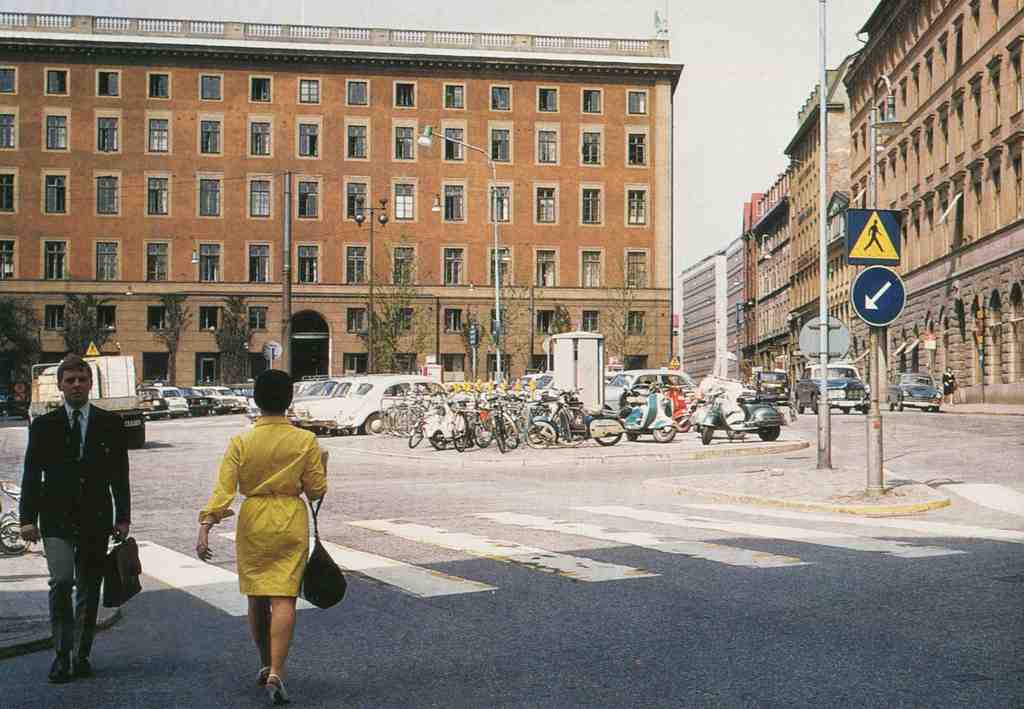
Look to your left for the wide-open square anchored by a massive flat-roofed red brick building featuring a strict repeating grid of rectangular windows.
If you could travel back in time a few hundred years, you would not be standing on solid ground right now. You would be buried inside a hill, because the original ground level here used to be nineteen meters higher. That is over sixty feet straight up in the air. This area was once dominated by a massive esker, which is a giant ridge of gravel and sand left behind by ancient glaciers. It was so huge it literally split this part of Stockholm in two. They even built a watchtower on top of it to look out for fires. But an enormous hill blocking the center of a growing city was not exactly convenient. So, in a massive feat of engineering, Stockholm simply started digging. Over centuries, they carved away the ridge, leveling the earth until they laid out this triangular square in eighteen oh three.
Once the dust settled, this became the absolute peak of high society. Throughout the eighteen hundreds, Brunkebergstorg was lined with luxurious hotels and elegant stone houses designed by the country's top architects. One spectacular building built by a silk merchant even featured Stockholm's very first indoor water line and a glittering, Parisian-style glass-covered shopping arcade where the elite would stroll.
But cities are living, breathing things, and they are always shifting. By the turn of the twentieth century, the artistic and social crowds moved out, and the financial titans moved in. Insurance companies built towering office palaces, soon followed by the banks. Then came the nineteen sixties, bringing a massive urban renewal project that completely wiped the slate clean. The city brought out the wrecking balls and demolished almost all of that nineteenth-century elegance.
They held a grand architectural competition to redesign the space, won by Peter Celsing. His vision gave us the monumental building dominating the square today, the new headquarters for the Riksbank. Since we were just exploring the central bank, you can see how its heavy, blocky, brutalist architecture set a completely new tone for the entire neighborhood.
Out of all those grand palaces from the eighteen hundreds, only a single one survived the wrecking balls. Look around for a red brick building built in eighteen ninety eight called Nordstiernan, the sole survivor of the old square. Recently, the city totally reimagined the space again, laying down elegant stone paving that won a major architectural award in twenty seventeen. It is a true testament to a city constantly reinventing itself. Whenever you are ready, let's keep moving.




