
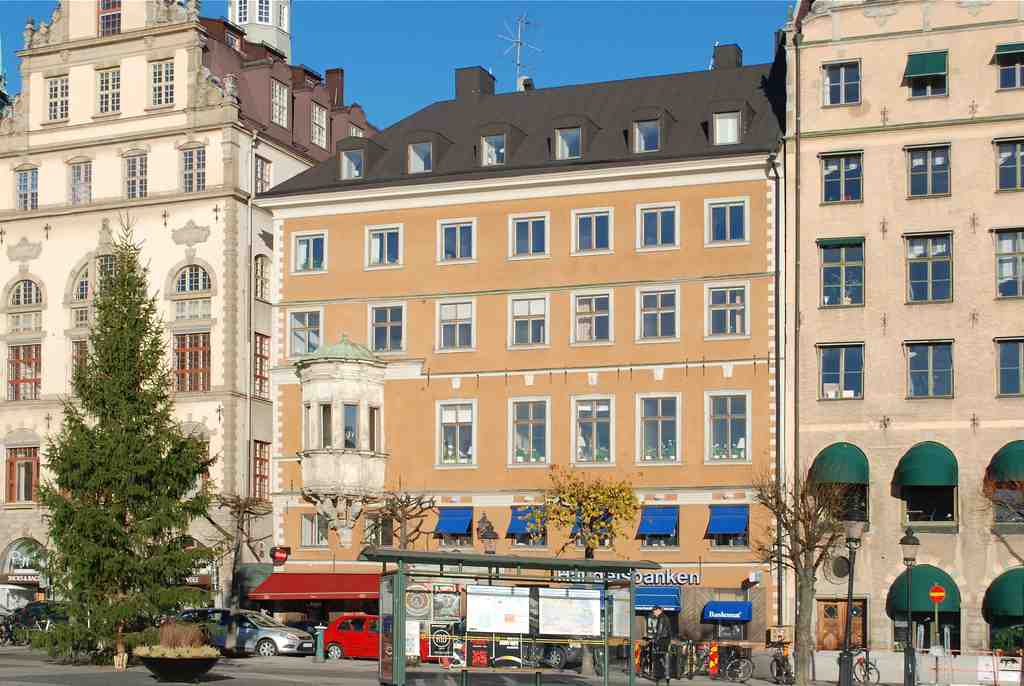
To spot the Von der Lindeska house, look straight ahead for a tan-yellow building on the square with a unique bay window jutting out over the street, supported by striking carved figures underneath.
Now, imagine you are standing in front of a building steeped in drama and more than a hint of mystery. The Von der Lindeska house has watched Stockholm shift and change since 1633. Back then, the walls around you rose for Erik Larsson von der Linde, a man with pockets lined by the king himself, crowned with noble status only two years before this building came to life. Imagine the pride blazing in his chest as he oversaw the construction-a house built to impress, with sturdy medieval bones and a face lifted in the bold, red brick style of Dutch Renaissance, a real showpiece in its day.
But as swiftly as Erik Larsson claimed his piece of Stockholm, his story burned out-he died just three years after the building’s completion. His heirs didn’t linger, and soon, the powerful Gabriel Gustafsson Oxenstierna took possession. Picture the crisp autumn day in 1637 as they signed the deed-shuffling papers in rooms now thick with silence, knowing that this house would see the ambitions and secrets of many families.
Trouble, as it so often does, followed close behind. The house passed into royal hands, then into the hands of Queen Christina, a figure who could add a touch of dramatic flair to any setting. Generously, she gifted it to her half-brother Gustaf Gustafsson af Vasaborg, as if palaces were tokens one could simply give away. The centuries ticked by, and no matter how grand its owners, each seemed destined to lose their grip. Gustav’s own son, Gustaf Adolf, pawned the house to the state bank, and in a twist worthy of a fable, could not repay the debt.
Along came Johan Scharenberg, a merchant with an eye for opportunity. In 1682, under the hammer of an auctioneer, he claimed the house as his own, snapping up this jewel thanks to the failings of a nobleman. Scharenberg’s wealth echoed in the details-he soon added a new stone building next door and connected it with a wing, preserving one of Stockholm’s most fascinating oddities: the five-sided bay window on Kornhamnstorg. Step closer, if you like, and look up. You'll see it supported by four figures-two men and two women-carved in oak, each braced as if bearing the weight of history itself. These guardians once glowed with color, brought back to life in 2019 to their original brilliance, and have a kinship with the ornamentation of the Vasa warship-regal, almost fantastical in their flair.
Walk around to Västerlånggatan and find the grand, sandstone portal. Two gods-Mercury with his sack of secrets and Neptune with the sea-peer out, supporting the heavy form above them. The portal, shaped by the skilled hands of the Dutch sculptor Aris Claeszon, tells you this was a house of power and trade, not just shelter.
And then there are the words-look for the two old German inscriptions, one declaring that everything hangs on God’s grace, the other urging you to trust only in Him. Wander these stones and you can feel the echoes of those who came before: ambitious traders, failed aristocrats, even whispers that the philosopher René Descartes himself once stared out these windows, ill and thoughtful, only for rumor to outlive fact.
So what you see in front of you is not just a house, but a relic-a place of shifting fortunes, creative genius, and secrets sheltered through centuries.




