
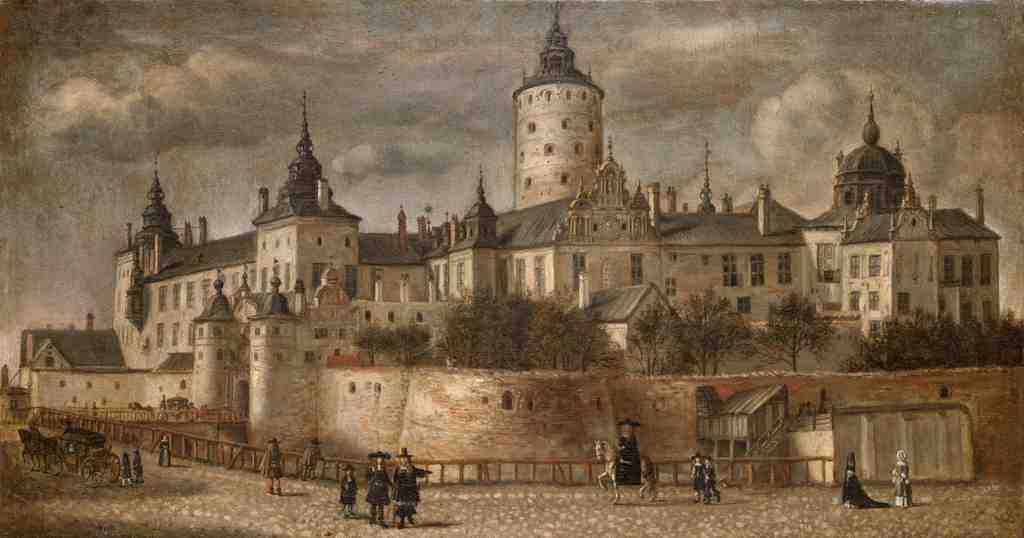
To spot the Three Crowns (Tre Kronor) building, look for a grand old castle with pale stone walls, ornate towers, and a mighty round tower at its center, reaching up high above the other rooftops.
Now, let me carry you back in time to where you’re standing-right here, on the crest of Stockholm’s island, once stood the most legendary and powerful fortress in all of Sweden: Tre Kronor, or the Three Crowns. Imagine the thick scent of damp stone as you stand at the stronghold’s foot. It all began around the middle of the 1200s, when Birger Jarl, the city’s founding lord, built a fortress right here to guard the vital waters between Lake Mälaren and the salty Baltic. If you close your eyes, you might sense the splash of cold waves and distant warning calls, because in those days the city’s survival hung on fortifications like these.
The earliest structure was a massive round stone tower, the heart of all that would follow. Its walls were four meters thick-impenetrable-and it rose boldly, crowned with battlements and a pointed roof, visible for miles around. No ordinary door opened to the enemy: the only way in was by a ladder hoisted to the second floor, and at its base, a dark prison cell could only be reached by lowering a rope through a trapdoor.
Over centuries, the fortress grew into a true royal castle, a place of drama, ambition, and sometimes disaster. Kings and princes called this place home-such as young Magnus Birgersson, born here in 1300. Life in the castle wasn’t always peaceful. In 1419, fire tore through the rooms, destroying archives and precious history, an ominous warning of what would come.
When Gustav Vasa, Sweden’s fearless rebel-king, broke the Kalmar Union in the early 1500s, Tre Kronor became the nation’s crowning seat of power. He was determined to make it impregnable. Old churches provided stone and brick-no material went to waste. Workers laid hundreds of thousands of new bricks to build mighty walls and round bastions, a moat with a drawbridge, and space for new, thundering cannons. At one point, even a section of the neighboring Storkyrkan church had to be torn down, so the castle’s guns could fire freely on any threat.
With each king, the castle became more magnificent. Johan III brought the Renaissance here, topping towers with domes and gilded spires. Three gleaming crowns-Tre Kronor-were placed atop the central tower in 1588, and at last, the whole palace took its name from that glittering symbol. Inside, the grandeur matched the outside: a copper-floored audience chamber (the copper would later pay for peace in wartime!), fancy new wings for the king and queen, secret passages like the “Green Walk,” even a chapel with high windows shining down on Queen Katarina Jagellonica’s private worship.
It was always a hive of activity. By the late 1500s, the castle bustled with around 1,600 people-servants, soldiers, cooks, and courtiers-enough to fill a small town. Wealth, intrigue, and even danger filled these walls, and sometimes disaster struck. In 1642, for instance, four towers collapsed during another great fire. Imagine Queen Christina, not yet grown, fleeing for her life in the chaos.
Yet the greatest tragedy came on a spring morning in 1697. Above the Hall of State, a fire broke out, spreading faster than anyone could fight it. The old castle was lost in roaring flames, centuries of history, the royal library, and even Sweden’s grandest archives turning to ashes. Only the north wing, newly built in a baroque style inspired by Rome, survived the inferno. The blaze drove people into the streets, covering the city in a fine soot, leaving ruins and heartbreak where the nation’s heart had stood.
Standing here now, you are in the shadow of legends. Models and marks in the cobblestones nearby show where the old walls and towers once rose. Today, the present Stockholm Palace stands on these ashes, but beneath it all, the memory of Tre Kronor lives on-a reminder of kings, queens, war and fire, and the unbroken spirit of Stockholm.
Interested in knowing more about the history, the renaissance castle tre kronor or the tre kronor after the fire




