
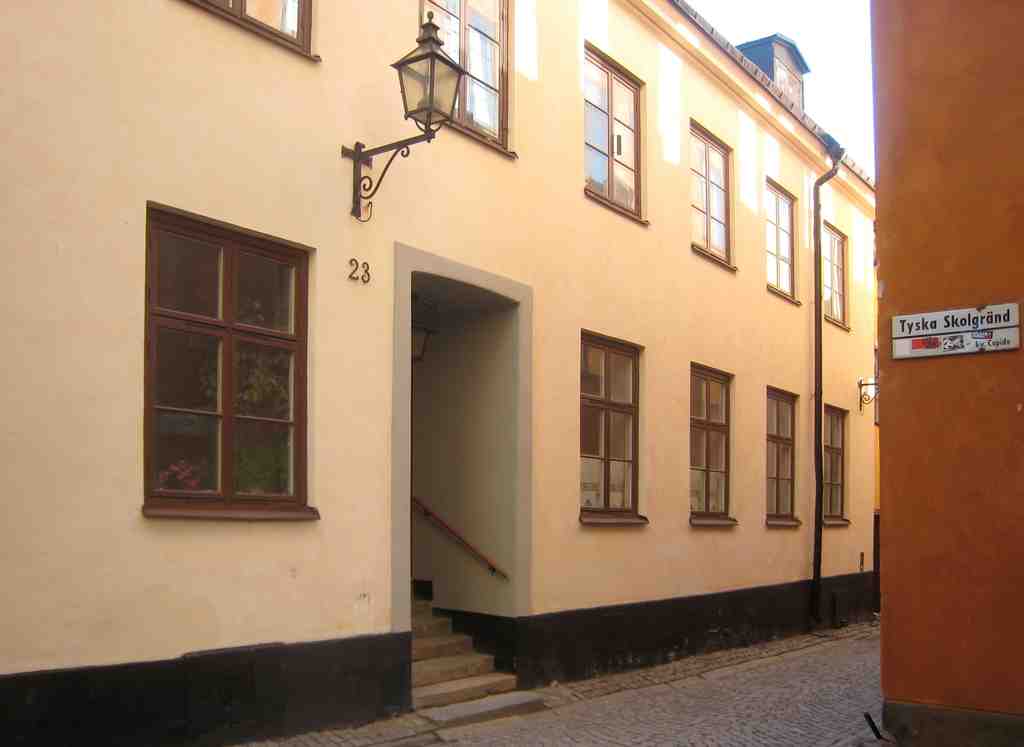
Look to your left for a pale yellow building marked with the number 23 and an old-fashioned street lamp above a simple stone entranceway-this is Ahlström’s maiden cage.
Now that you’re standing in front of these calm windows on this unremarkable, cobbled street, imagine stepping back into a much wilder chapter of Stockholm’s past. This house, with its sturdy facade, once belonged to Magnus Ahlström, a sea captain known as “Ottoman Gate” for his famously foul language. He bought the place in 1762, convinced that somewhere beneath its stones, hidden in the cellar of a former convent, was a stash of glittering silver-a treasure that, sadly for him, never materialized. Not that he didn’t try to get rid of the house: in 1767, Ahlström advertised it in the papers, describing it as sitting atop a mysterious nunnery cellar where riches were just waiting to be found. Yet buyers were unmoved, and Ahlström’s dream of buried fortune never came true.
But Ahlström’s house gained an even stranger kind of fame. During his ownership, it won a scandalous reputation thanks to the lyrics of the iconic Swedish poet and songwriter, Carl Michael Bellman, who sang of it as a notorious brothel-his “Ahlström’s maiden cage.” According to Bellman’s tales, the place was nothing less than a “true temple of Venus,” filled with priestesses-three whole floors of them!-whose occupation was far from holy. It makes for a colorful story, but reality, as ever, was more complicated. While Stockholm’s real brothels didn’t appear until later in the 1800s, the late 1700s city had its own secret systems. Pimps, or “kopplare”, would collect the names of prostitutes, arrange licentious balls, and bring customers and women together in borrowed spaces, sometimes in their own homes. “Maiden cages” like this one were rumored dens of vice, but rarely permanent brothels.
It’s possible-perhaps even likely-that Ahlström himself made good money organizing these clandestine meetings, slipping between being an ordinary landlord and an underground matchmaker. Stories swirled around him: one legend tells that sixty “joy girls” from this very spot were sent off to the parliament in Gävle in 1792-a tale utterly lacking in evidence, but irresistible nonetheless.
In truth, the census of 1765 reveals a far quieter reality: inside, you’d have found widows, tobacco workers, scribes, a caretaker, a maid, and a journeyman going about their more ordinary lives, while two small taverns bustled on the ground floor whenever night fell. Perhaps sometimes a shadowy deal was struck under the flickering candlelight, or a secret lover’s rendezvous arranged behind the closed doors. But the wild three-story brothel of Bellman’s verse was, it seems, mostly gossip, embroidered by later writers hungry for scandal.
Not all the intrigue was so earthy. In 1784, even the king-the flamboyant Gustav III himself, together with Duke Charles-came here on a ghostly treasure hunt, guided by Stockholm’s most famous occultists, to search in vain for the convent’s lost silver.
And just next door, from 1789 to 1795, lived Maria Kristina Kiellström-the real-life inspiration for Bellman’s legendary Ulla Winblad-which only added more fuel to the building’s mysterious fire. So as you gaze at these quiet stones, remember: beneath their surface, the stories of lust, longing, greed, and gossip still linger in the crisp Stockholm air.




