
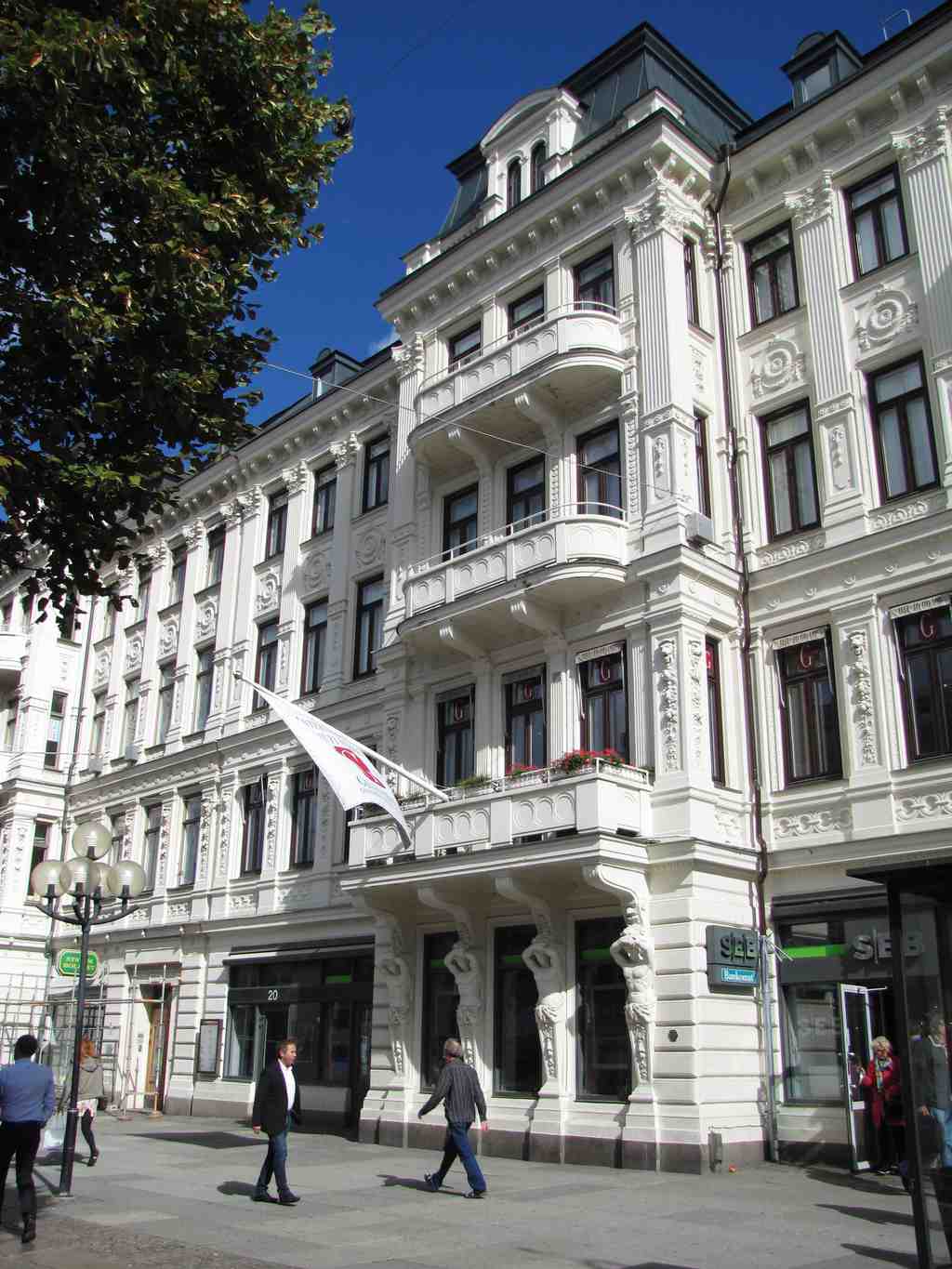
As you walk along, start looking to your right. You should see the impressive white building with intricate architectural details standing tall next to you. The Kvarteret Örup is unmistakable with its ornate façades adorned with stucco decorations and classical columns. You’ll spot beautiful balconies, and statues carved into the building's frontage, giving it an air of grandeur and history.
Kvarteret Örup is a historic block located in the Lorensberg district of Gothenburg. The western part of this block faces the grand avenue of Göteborg, Kungsportsavenyen, with addresses Kungsportsavenyen 16-22. The rest of the block has addresses at Kristinelundsgatan 12-14, Lorensbergsgatan 1-7, and Vasagatan 43A-43B. The buildings along the avenue were designed in 1880-1882 by the renowned architect Adrian C. Peterson for the construction company Nils Andersson & Co.
Most of Kvarteret Örup has been a listed building since April 10, 2001. The block is named after Örup Castle, and the buildings on the avenue now represent one of two preserved sides of the block with unbroken 19th-century character facing Kungsportsavenyen, the other being Kvarteret Kalmarehus. The houses are built of stone and have four stories, with plaster finishes and rich stucco decorations in a neo-Renaissance style, painted in white and yellowish-white. Adrian C. Peterson, a well-known Gothenburg architect, lived in number 18 himself.
Although some modifications have been made, like installing shops on the ground floors and removing the garden plantings, the exteriors are well preserved. In the mid-19th century, Gothenburg was rapidly growing due to flourishing industries and lively international trade. Around 1860, the city's fortifications were replaced with new blocks, public buildings, and parks. The areas outside the park belt with Nya Allén, east of the suburb Haga, were still largely agricultural and pasture lands with scattered, disordered suburban buildings.
The city’s affluent elite viewed the transformations occurring in European metropolises as a model to emulate, particularly the development of Vienna’s Ringstraße in 1857, which symbolized the growing power of the wealthy bourgeoisie. In a grand plan for Gothenburg’s expansion proposed in 1863, "Hagaheden" was highlighted as especially suitable for metropolitan construction. In the 1866 confirmed plan, the broad avenue from Kungsportsbron southwards, alongside Vasagatan, formed the plan's main axes. These streets became the main thoroughfares of elegant Gothenburg in the 1880s, lined with rows of trees and palatial façades.
The build-out along Avenyn went on from 1872-1897, temporarily halting at Engelbrektsgatan until Lorensbergsparken could be breached, allowing the thoroughfare to continue south to Götaplatsen, which was established in time for the city’s grand jubilee exhibition in 1923. The "English" and "French" blocks facing each other were first completed along Avenyn (numbers 3-17 and 4-14 respectively). Designed by Johan August Westerberg between 1872 and 1877 as private palaces in three stories for one or two families each, these buildings showcased contrasting architectural styles: the "English" block in austere, Anglo-Saxon classicism and the "French" block in lively baroque with pronounced façade projections.
In the Kvarteret Örup, the four-story buildings numbered 16-22 harmonized architecturally with lavish embellishments on the façades and roofs, characterized by grand impressions made by the projections and rhythmic subdivision of the façades with pilasters separating the closely spaced windows. The richly decorated façades and garden enclosures used cast cement details, an established method in Gothenburg since the 1860s. The roofs, with towers clad in slate or patterned zinc, were adorned in French style with dormers and wrought iron grills.
Locally, people affectionately nicknamed the block "Adrianopel," cleverly referencing its architect, Adrian C. Peterson, who designed it between 1880 and 1883 for Nils Andersson & Co.




