
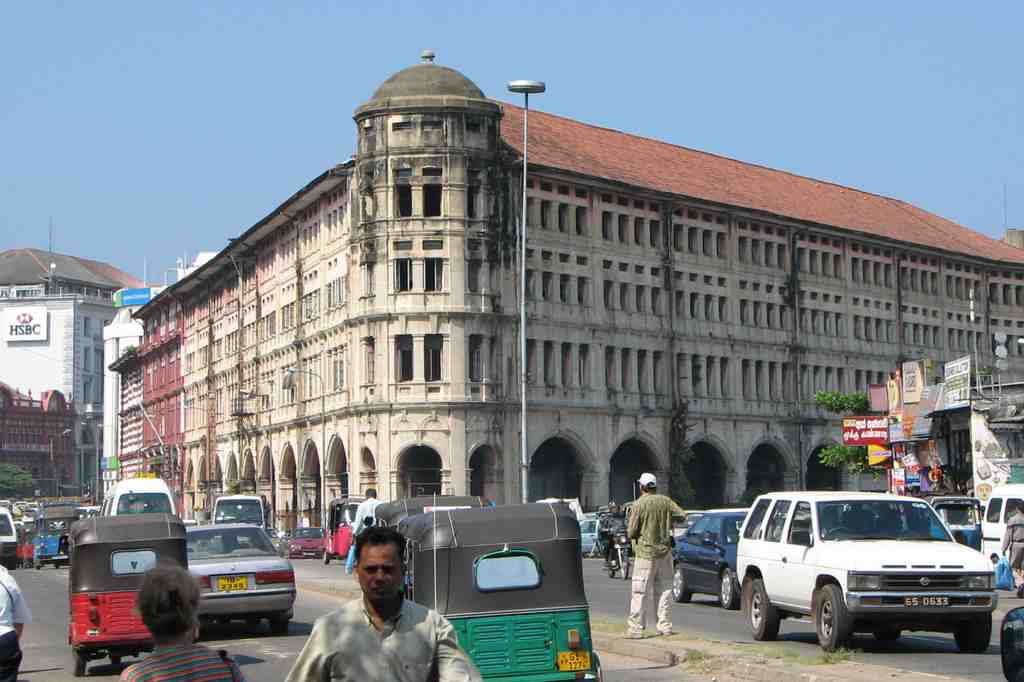
To spot the Gaffoor Building, look ahead for a huge, wedge-shaped corner structure with arched ground floors, pale stone walls darkened by time, and a rounded turret at the end-a landmark that seems to stretch out and hug the junction.
Now, as you stand in front of this magnificent slice of Colombo’s past, let’s imagine the street as it was in 1915. Picture the clip-clop of carriages and the buzz of traders beneath the arches. The air smells faintly of spice and the sea, while the Gaffoor Building itself towers above like a proud ship’s prow, built by a man who certainly knew the value of a good gem. This was home to Noordeen Hajiar Abdul Gaffoor, one of Sri Lanka’s legendary jewel and gemstone traders. Years before, he founded N. D. H. Abdul Gaffoor & Sons at the Bristol Hotel in 1894. Gaffoor was no ordinary merchant-he was one of the rare few allowed to step aboard ships docked in Colombo’s harbor, dazzling travelers and sailors with sparkling sapphires and lustrous pearls. Imagine the gentle clink of gemstones being poured from velvet bags.
Gaffoor’s fame grew so much that in 1901, he got to show his treasure trove to the visiting Prince and Princess of Wales. They no doubt admired his glowing pearls, glittering diamonds, rubies, and exotic artworks. And Gaffoor wasn’t content with just local fame; he took Sri Lanka’s gem story to the world, setting up displays at international expos from St. Louis to Philadelphia and London, each exhibition casting his legend a bit further.
But the Gaffoor Building wasn’t all about jewelry. It quickly became one of Colombo’s most bustling commercial spaces. Inside, wooden floors echoed with footsteps of businessmen, the aroma of freshly printed books wafted from H. W. Cave & Co. upstairs, and rubber traders tapped out deals that would keep the colony running. Even the Australian High Commissioner called it home-at least from 1947 until his fancy for seafront views moved him elsewhere.
Through the decades, the Gaffoor Building wore its history like a crown-and, let’s be honest, a few cobwebs too. In 2000, it was declared a ‘Protected Monument’, so even as the walls crumbled and water seeped under its foundations, the stories held strong. At one point, part of the building was even turned into a car park-imagine Lord Gaffoor himself parking a fancy horse-drawn carriage beside a tuk-tuk!
As the years rolled on, saving the building became an adventure worthy of its own drama. Foreign buyers dreamed of transforming it into a glamorous hotel, but the ownership was muddier than monsoon puddles-claims from business empires, distant descendants, and a few determined squatters slowed everything to a crawl.
Finally, the Sri Lankan Ports Authority and the Urban Development Authority swept in, promising dreams of a boutique hotel and bustling supermarkets, with the Sri Lanka Navy handy to help the renovation. Now, as the building stands-scuffed, elegant, and full of secrets-it waits patiently for its next chapter. If these walls could talk, they’d have plenty of clever tales and maybe a sparkling joke or two about diamonds and politicians!


