
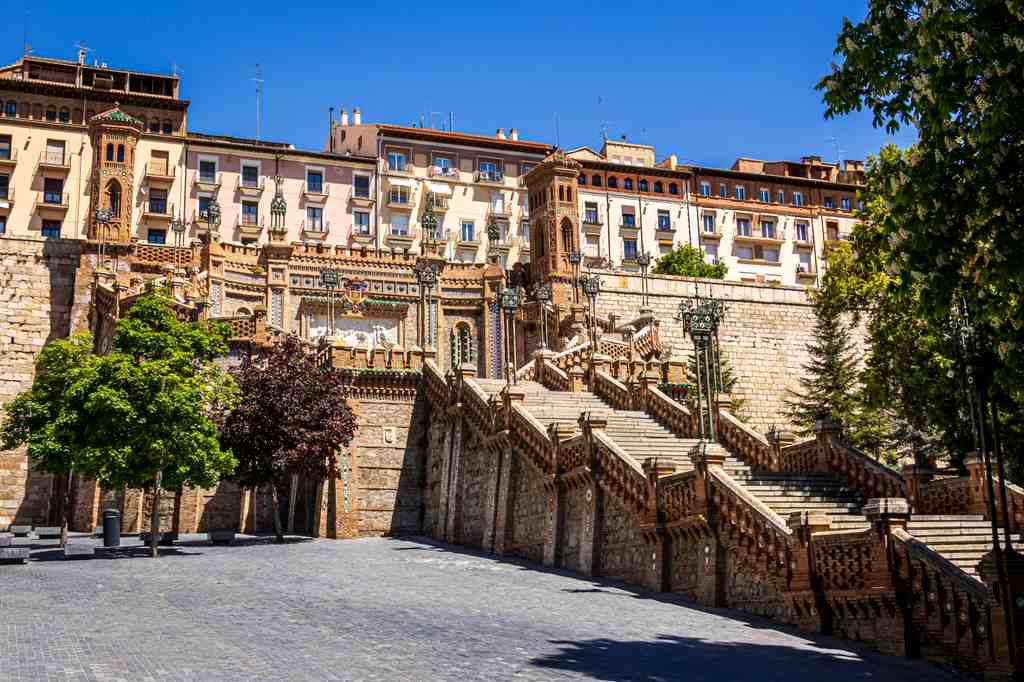
Right in front of you, rising steeply like a brick-red waterfall with splashes of green and white ceramics, is the Teruel Staircase - just look for its grand neo-Mudejar towers and richly decorated steps climbing up from the train station to the city above.
Picture this: It’s the early 1920s in Teruel, a small Spanish city set on hilly ground, and there's a real challenge facing every traveler-getting from the busy train station at the base of the hill up to the heart of the old city. Now, 26 meters doesn’t sound so tough until you try it on a hot summer day with bags in hand and dreams of jamón and local wine! No wonder someone had to step in-pun entirely intended.
Here comes our hero: José Torán de la Rad. Not a caped crusader, but a clever local engineer with a stylish mustache and great taste in architecture. He wanted to do more than build a staircase; he wanted to give Teruel an entrance as grand as its legends. He dreamed up this masterpiece to connect travelers with the Paseo del Óvalo above-a place then called the Paseo de la Infanta Isabel-and, at the same time, to make every climb a feast for the eyes. Why just walk up when you can do it in style?
Construction kicked off in March of 1920. There’s even a tale about the first stone being laid, supposedly by Carlos Castel y Clemente, a well-known statesman. A helpful hint if you’re keen-eyed: check out the ceramic plaque near the top-it says his name! The only problem is, Mr. Clemente had passed away before 1920, so it must have been his son, Carlos Castel y González de Amezúa, who helped launch the project. Proof that even Teruel's staircases are built on a bit of mystery… and maybe a clerical error or two.
But back to our staircase: it only took 15 months to build-faster than some people take to climb it, if you ask the locals. By June of 1921, the people of Teruel were marching up and down these steps with a mix of pride, curiosity, and relief. After all, what used to feel like scaling a cliffside suddenly became a stroll through history and artistry.
Now, take a closer look around. Do you notice the intricate brickwork and those flashing green and white ceramics? That’s neo-Mudejar style, echoing the city’s famous mix of Christian and Islamic art, a distinctive feature of Teruel’s character. The staircase practically glows at sunset, reflecting the colored light like some ancient Arabian tapestry, with towers on top standing like sentinels watching over the city. You can even spot a masterful ironwork on the old farolas-the lamps that line your ascent-flowing with modernist curves inspired by the city’s fondness for art nouveau. Who says a staircase can’t be a catwalk?
If you pause at the main landing in the middle, look up. Set before you, and framed by the city’s coat of arms and a playful fountain, is a large sculpted scene of the Lovers of Teruel-a story so packed with drama and heartbreak it could give Romeo and Juliet a run for their money. The sculptor, Aniceto Marinas, carved their fateful embrace right into the heart of this monument, a reminder that every step up to Teruel holds a story of passion.
Even in the new millennium, this area keeps changing. Thanks to the British architect David Chipperfield and a creative Spanish firm, the Paseo del Óvalo up top has been pedestrianized, complete with modern elevators making the climb a little easier for visitors who’d rather save their legs for dancing… or for more stairs.
There’s one last secret tucked beside the steps. The building next door was once a Carmelite convent, later a headquarters for the Guardia Civil, and now it’s the seat of the Aragon government. History sticks to these bricks as well as the mortar does!
So, whether you’re hiking up to see the sights or just want to stand at the top and pretend you’re royalty entering Teruel, the staircase isn’t just a path-it’s a journey through Teruel’s past, sprinkled with stories, a dash of intrigue, and the odd mistake on a commemorative plaque. Not bad for a set of stairs, right? And if climbing them makes you a little breathless, just tell everyone you were overwhelmed by the history.
Wondering about the description, paseo del óvalo and carmelite convent or the see also? Feel free to discuss it further in the chat section below.




