
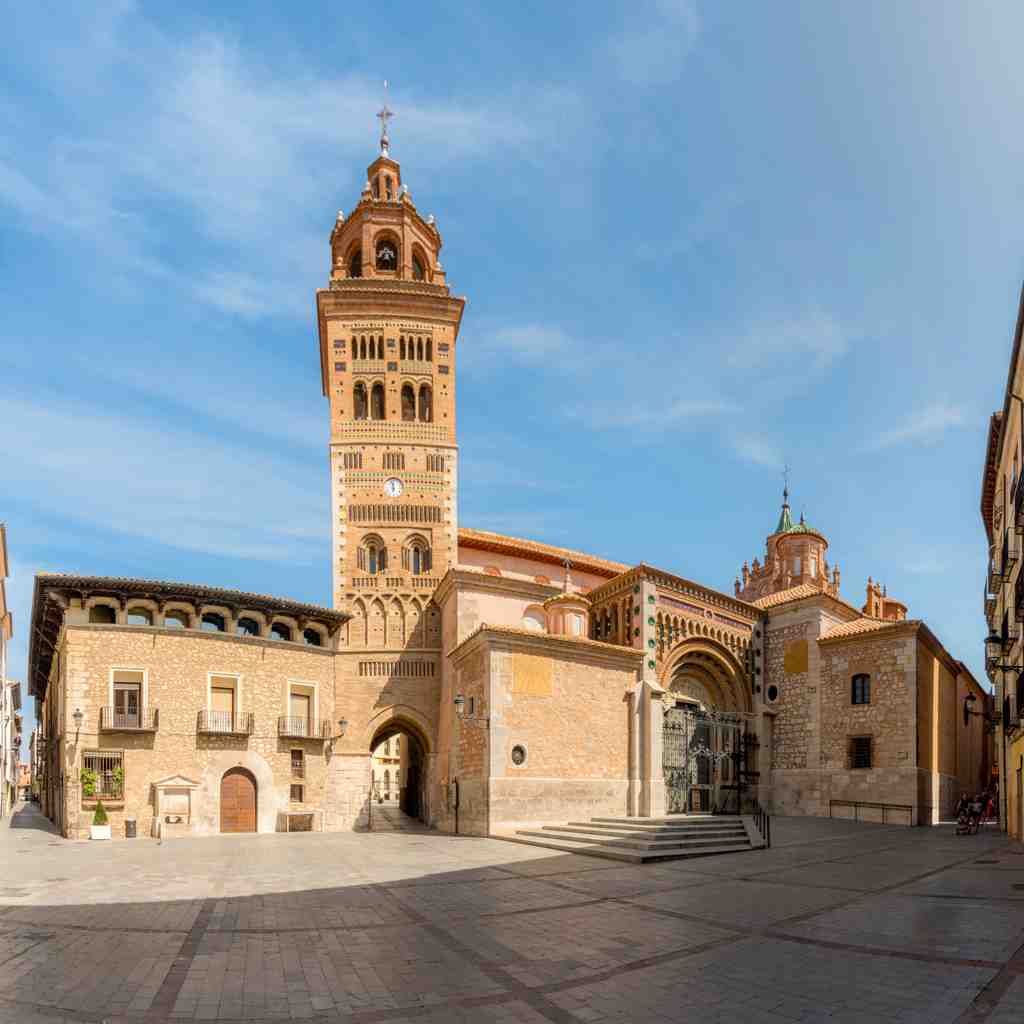
Look for a grand brick tower with detailed arches, colorful tiles, and a decorative iron gate, rising right in front of you at the edge of the plaza-this is the unmistakable Teruel Cathedral.
Welcome to Teruel Cathedral! Take a moment to soak in that dazzling façade. If you tilt your head back, you’ll find yourself staring up at a tall, square tower decorated with glazed tiles that shimmer like a box of spilled jewels when the sunlight hits just right. The iron gate guarding the entrance almost dares you to peek inside and imagine centuries of secrets hidden within these walls.
Let’s travel back in time-way, way back to 1171. Right where you’re standing, the first stones were set for the church of Santa María de Mediavilla. Back then, the air would have been thick with the sound of chisels on stone and the chatter of workers covered in dust. Originally built in the Romanesque style, the place looked sturdy and solid, but not quite as magical as what you see now. Fast forward to 1257, and a Moorish master builder named Juzaff swooped in like a wizard, bringing the tricks of Mudéjar architecture-layers of brick, bursts of color from ceramic tiles, and arches that looked like they belonged in a fairytale. The old Romanesque look was left behind; instead, Juzaff crafted three long, light-filled naves out of masonry and brick, letting sunlight flood into the church in ways that must have astounded the townspeople.
The transformation didn’t stop there. The 14th century saw new Gothic-Mudéjar apses added, and almost like a magician cutting a ribbon, the architect reduced the chunky supports inside and opened up the arches, making the space feel airy and bright. The blend of Christian and Islamic art created a feast for the eyes. By 1423, the cathedral was so grand and important that even the “rebel pope,” Benedict XIII, decided to raise it to collegiate church rank. With all this change, you might wonder: Has anything stayed the same? Well, the authentic Mudéjar spirit remains, untarnished by the centuries.
Now, glance back up at the tower. The lower part forms a vault that you could actually walk through, a tunnel as old as some of the first European kingdoms. It’s one of the oldest Mudéjar towers in Spain, square and solid at the base, then stretching up and topped by a lantern that looks almost like a crown. That lantern, built in the 16th century, flooded the cathedral with light, especially catching the sparkle of the Renaissance altarpiece inside.
Here’s a fun fact: What you see on the outside hides a secret overhead. The ceiling of the central nave has been called the “Sistine Chapel” of Mudéjar art-a hidden wonder covered up during the 18th century by a false ceiling, protected like a treasure map rolled up inside an old pirate’s chest. When the fake ceiling finally came down, the original was revealed, full of paintings-makers, knights, fantastical beasts-almost as if you could hear them whispering stories from the rafters.
The centuries rolled on, leaving their mark. In the early 1700s, bits of Neoclassical taste snuck in, curtain-rod straight and simple, hiding the playful Mudéjar artwork for quite a while. But in 1909, Pau Monguió, a Modernist architect, burst onto the scene with a wild new southern façade-a dramatic mix of Neo-Romanesque and Neo-Mudéjar ornamentation. He finished it off with an iron gate inspired by a 15th-century choir screen inside, closing things off with a clang that echoed through the years.
In 1986, UNESCO finally said, “Enough secrets!” and declared the cathedral, along with its Mudéjar cousins in Teruel and Zaragoza, a World Heritage Site. They admired the inventive use of brick and glazed tiles-as if someone was trying to paint with clay and light all at once. So, as you stand here, maybe you can imagine the sound of history: the sharp snap of tiles being set, the slow ring of hand-forged iron, the footsteps of worshippers beneath the most colorful ceilings in Spain.
So welcome to the crossroads of cultures, colors, and centuries. Keep your ears open; you just might hear a story, or a mysterious echo, from the many lives that have passed through these doors.
For a more comprehensive understanding of the the tower, mudéjar reform or the ceiling of the central nave, engage with me in the chat section below.


