
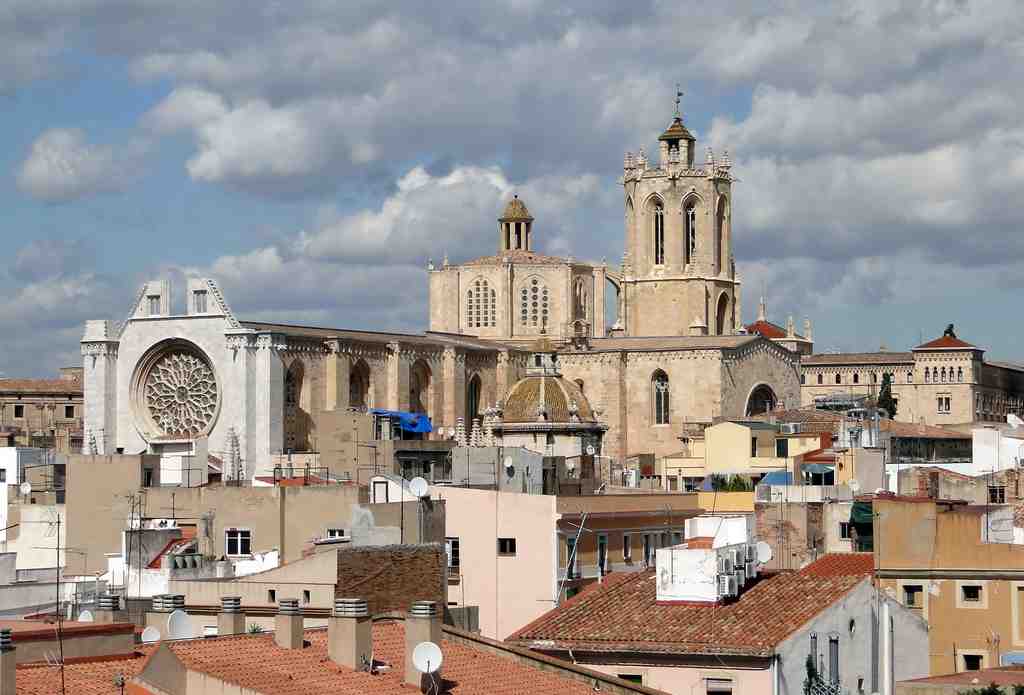
To spot the Roman Catholic Archdiocese of Tarragona, just look up ahead for a grand stone cathedral rising above the rooftops, with an impressive tall bell tower and a huge circular rose window facing the city.
Now, as you stand outside this magnificent cathedral, imagine time swirling around you-and perhaps a few mischievous Roman ghosts peeking from the windows! Welcome to the living heart of spiritual power in Tarragona, where sandstone walls whisper stories stretching back almost two thousand years.
Long before Tarragona had modern snacks or selfie sticks, it was one of the oldest cities in Spain, a place of Iberian coins, enormous cyclopean walls, and, eventually, the marching boots of the mighty Romans. The Romans picked Tarragona as their headquarters for governing all of eastern Spain-a big deal, considering they were the ancient world’s equivalent of a global corporation. Right where you’re standing, the city became the capital of first Hispania Citerior and later the entire province of Tarraconensis.
Of course, with great power comes great paperwork-and spiritual responsibility. The early Church here is said to have even gotten a visit or two from not just anyone, but James and Paul! Imagine the excitement (and probably a mad dash to tidy the altar). The first confirmed bishop’s story is a bit more dramatic: Saint Fructuosus, who bravely faced martyrdom alongside his deacons Augurius and Eulogius, as written in the third-century Acts.
As centuries spun by, Tarragona’s bishops became regulars at church councils, representing their see at Arles in 314, sending letters to popes, and even starring as subjects in papal decrees. But peaceful times didn’t last-if these walls could talk, they’d definitely complain about the Vandals, the Suevi, and the Alani, who trampled through in the 5th century. Then came the Visigoths, who in 475 decided a bit of demolition was the way to go.
Yet, out of the dust, Tarragona’s church rose again-stubborn as a mule and twice as resilient! By 516, the city’s Archbishop John was so organized he convened the province’s bishops for councils tackling everything from stubborn monks to holy matters. The bishops here were definitely multitaskers-one even got a commentary on the Song of Solomon dedicated to him. And talk about traveler miles! Tarragona’s bishops traveled to councils all over Spain, sometimes in person, sometimes by trusty substitute.
Then, in the early 8th century, the city’s echoes were shattered again-this time by the thunder of the Muslim invasion. In 719, Tarragona was destroyed, and for a while, its territory and religious clout passed to other cities. The see’s title played a game of musical chairs between Barcelona, Narbonne, Vich, and back-popes, counts, and bishops all trying to outsmart one another like a medieval episode of “The Apprentice.”
By 1116, you could say Tarragona’s luck changed-at least if you were rooting for the home team. Ramón Berenguer III, who bore the very impressive nickname “the Great,” officially retook the city. Bishop Olegarius, who’d already been a canon, abbot, and bishop (talk about padding a résumé!), became the champion of Tarragona’s renewed spiritual might. He was so devoted, he governed, recolonized, and even showed up to big church councils from Toulouse to Reims, and Lateran to Clermont, all while surviving the sometimes dangerous politics of medieval Spain. One archbishop, Hug de Cervelló, sadly didn’t make it-murdered by the sons of a feuding Norman noble.
But for all its drama, something extraordinary flourished here: A cathedral that became the crowning place for Kings of Aragon, a hub for councils debating issues from Templars to feuds between rival city factions. One archbishop even picked up the future King James I in his arms on the day he swore his oath (imagine the scene-“Don’t drop the future monarch!”). Another, Asparec de la Barca, was so dedicated to Christian expansion he sent money, soldiers, and, if they’d let him, probably sandwiches for the king’s campaign in Majorca.
Through wars, reforms, and even the Inquisition, the Archdiocese of Tarragona endured, growing in strength, population, and architectural splendor. Today, as you gaze up at those intricate rose windows and gothic towers, know you’re looking at the beating heart of centuries-not only of faith, but also of power, drama, and very determined bishops. If walls could talk, these would probably say: “Relax, we’ve survived everything from Visigoths to inquisitions… and the odd enthusiastic tourist!”




