
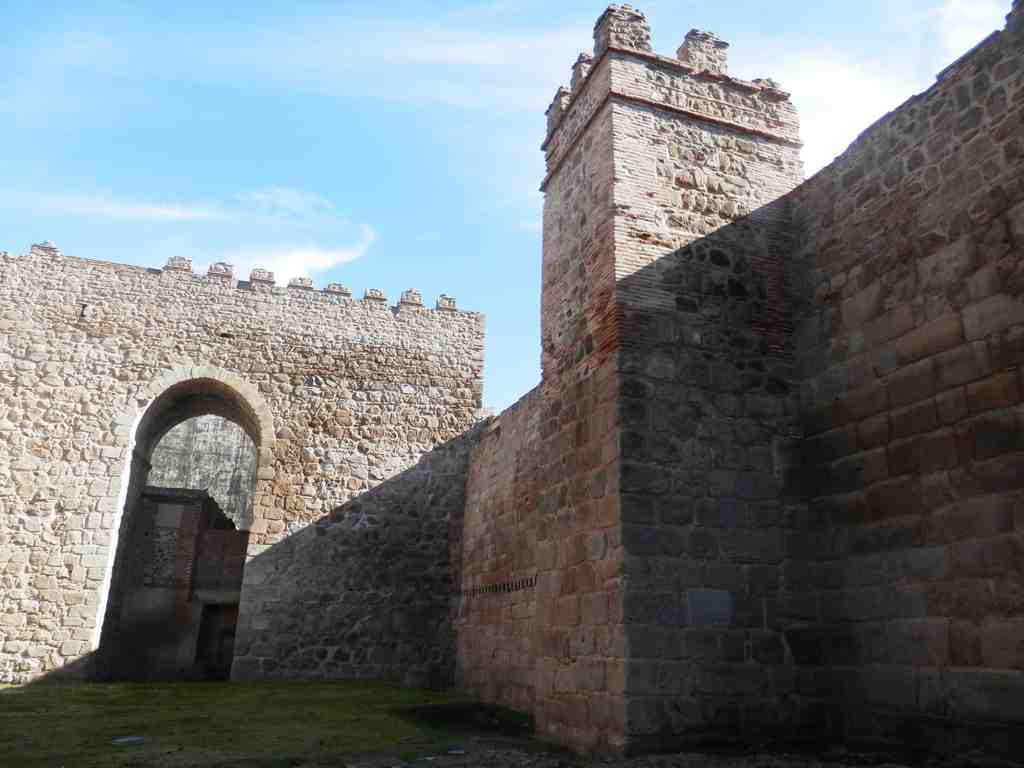
To spot the Walls of Talavera de la Reina, just look ahead for a massive, rugged stone structure rising above you. You’ll see thick, old walls with a square tower on your right and an arched gateway to your left. The stones might look a bit uneven, some with reddish bricks, showing how different periods added their own touch. The walls stretch along the path, so you can’t miss them-just follow the line of ancient rocks and the shadows they cast.
Alright, welcome to one of Talavera’s most impressive survivors: the city walls! Go ahead and imagine yourself as a medieval guard, peeking out from these very stones, squinting at the horizon for a sign of invading armies.
These walls are nearly a thousand years old. They were first built by order of Abderramán III back in the 9th and 10th centuries-so you’re literally standing in the shadow of history! Can you feel the weight of the stone? Some of these rocks were borrowed from the Romans, and if you listen close enough, maybe the walls are trying to whisper their stories. Every time the city changed hands-from Romans to Visigoths to Muslims and then Christians-someone added their own layer. That’s like historical lasagna-just with a lot more stone and a lot less cheese.
Look at the towers, square and semi-circular, gripping the wall like fists bracing for battle. The oldest ones have been here since the 800s! Later on, the Christians built extra towers in the 13th and 14th centuries, making this place almost impossible to sneak into. Unless, of course, you’re a cat on a mission.
Picture the scene centuries ago, crowds of travelers and merchants trying to get through one of the city gates-Puerta de San Pedro, Puerta de Mérida, Puerta del Sol-none of which survived, sadly. Some gates are remembered only in street names, while others disappeared when people fancied having more open streets. Urban planning, medieval style!
What’s left is still impressive: out of 17 towers, 8 are still here, serious and silent. You can still find bits of the older enclosures along nearby streets, and even discover reused Roman tombstones in the stonework. It’s like walking through a jigsaw puzzle where every piece has its own legend.
So as you stand here, let yourself imagine the echo of footsteps on cobblestones, the distant call from a tower, and all the lives this wall has seen go by. Next stop: the Old Bridge, just ahead-let’s cross into the next chapter!
For further insights on the first enclosure, second and third enclosures or the the doors of the enclosures, feel free to navigate to the chat section below and inquire.




