
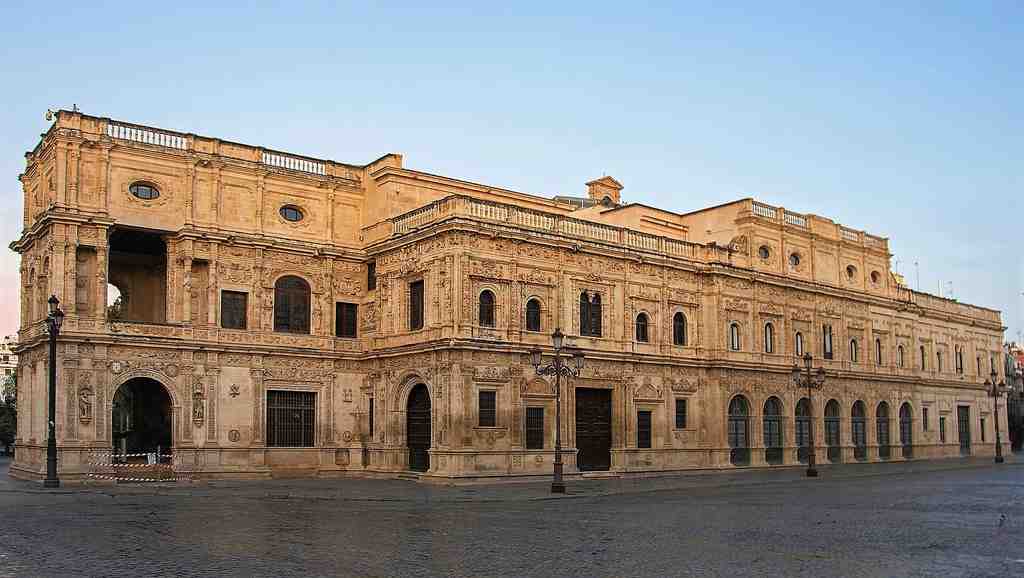
Directly in front of you, the Town Hall of Seville stretches wide across the square, dressed in pale stone with intricate carvings, lots of arched windows, and an elegant arcade-look for a richly decorated facade that seems to glow almost golden in the sunlight.
Alright, get ready for a story that’s got almost as many twists and turns as this building’s decorative carvings! Right where you’re standing, imagine yourself as someone in 16th-century Seville, when this site was just becoming the center of all decisions great and small, from city celebrations to the odd argument about where to keep the best olives. But don’t let these ornate walls fool you-they once stood beside medieval city walls and a patch of land called Corral de los Olmos, crowded with merchants, priests, city leaders, and maybe even a few stray chickens.
When Seville’s fortunes boomed with New World treasure-thanks to the Casa de Contratación arriving in 1503-city leaders thought, “Let’s build an ayuntamiento worthy of all this gold!” And so, in 1526, with the wedding bells for Emperor Charles I and Isabel of Portugal ringing nearby, the old council hall was replaced by this stunner of a building. Imagine the clang of stones arriving from Utrera, the shouts of craftsmen, and the local boys ducking under carts for a look at the action. Master architect Diego de Riaño led a whole team, including stonemasons from as far as France and the Basque Country. They worked, paused (when the money ran out-classic city project, right?), and picked up again, crafting a masterpiece.
See those carved faces and columns? They’re the high-water mark of Plateresque style, like a wedding cake made from stone-busts of mythical and real historic figures, medallions, the coat of arms, and even the twisted Columns of Hercules with the motto “Plus Ultra” (More Beyond) for all those who dreamed of adventure. Over the archway, Hercules and Julius Caesar stand guard, as rumor has it Hercules founded the city and Julius Caesar gave it proper Roman swagger.
By the 19th century, the story gets rowdy. Napoleon’s troops stormed in, turned the neighboring convent into a barracks, and left the city scrambling. Then, fire and politics swept through, reshaping the square and the hall. When Queen Isabel II was due for a visit, the facade wasn’t finished, so the local architect hung up a giant painted “trick” canvas. Yes, Seville invented the pop-up, centuries before Instagram filters!
If you’re scanning the building, see if you can spot spots where new and old crash together-a patchwork of beauty and debates, with bits designed by Balbino Marrón in neoclassical style beside the show-stopping 16th-century work. You might even spot the cross by the corner, marking a plague pit from 1649, quietly reminding us that city life wasn’t always about celebrations.
Inside, the grand halls were council chambers for centuries, the ceiling decorated with Spain’s royal family tree: kings and queens in every square. The meeting rooms are lined with scenes from religion and heroism-Noah and his ark, San Fernando conquering foes, allegories for Justice, Prudence, and a reminder to councilors: don’t let anger (or friendship, or snacks) get in the way of fair judgment.
Over the centuries, the Town Hall became a museum, too-housing everything from a late Gothic painting of the Virgin and Child between saints, to portraits of kings, queens, and even the legendary Martínez Montañés. There’s even a pair of bronze busts memorializing two modern heroes lost to terror, standing as silent witnesses.
Picture the events in this square: shouts of traders, parades crossing the plaza, stonemasons chiseling away, councilors debating Spain’s fate, and Seville’s people celebrating their city through every age-from golden empire to modern marvel. If you feel a bit dizzy standing before all this grandeur, don’t worry, it’s not just the heat-history here comes at you with flair!




