
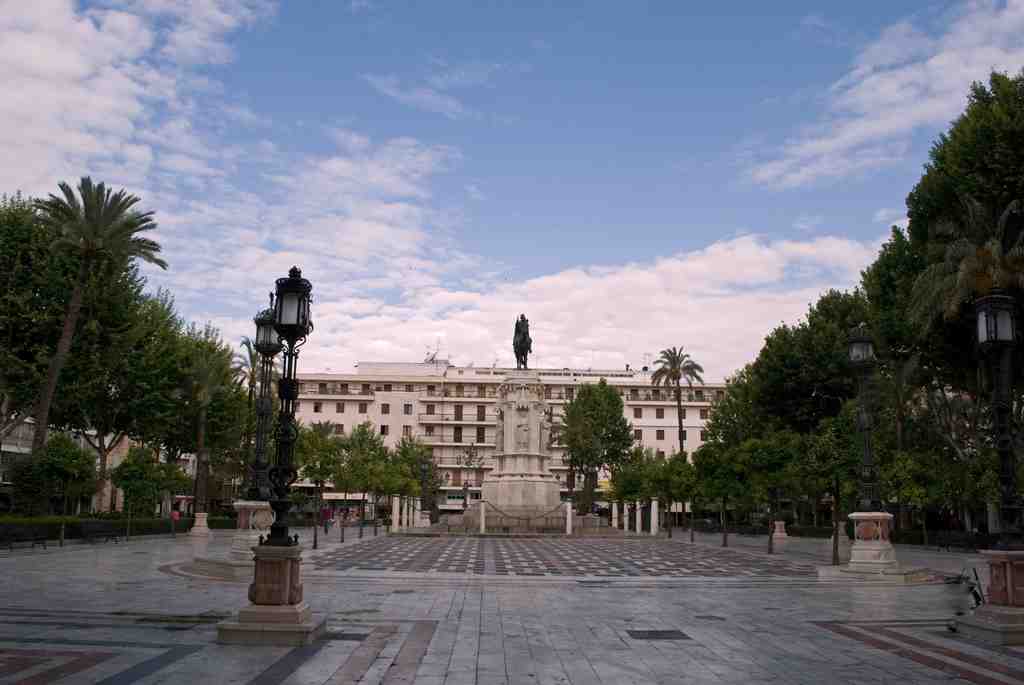
You’re right in front of Plaza Nueva! Take a look ahead-you’ll know you’ve found it when you spot a wide open space paved with pale stones and framed by leafy green trees. Right in the middle stands a tall statue of a man on horseback, up on a chunky marble pedestal. Grand old-fashioned street lamps stand guard like sentinels along the edges, and just behind, you’ll see the elegant symmetrical building front, hinting at Seville’s official power. It’s a plaza that feels both busy and peaceful at the same time-perfect for people watching, or just taking in the history.
Now, imagine this: centuries ago, you’d be standing in the water here, not on stone. That’s right, this very plaza was once under a branch of the Guadalquivir River! It wasn’t until the Visigoth era that it was finally dried out. A thousand years back, merchants, monks, and even Roman sailors would have passed through, and sometimes they left behind anchors or wooden planks from ancient ships, discovered much later during construction.
Fast forward to the 1800s, and this space went through an identity crisis bigger than any soap opera star! It started as Plaza de la Princesa María Isabel-named in honor of a royal born in the Alcázar. Then, thanks to revolutions, republics, and royal comebacks, the square’s name changed more often than the weather. Freedom? Republic? San Fernando? No one could keep up! But the locals stubbornly called it Plaza Nueva, or “New Square”-maybe just to keep things simple.
In the 13th century, King Fernando III handed the land over to Franciscan monks, who built a huge convent. At one point, there were 300 monks here-maybe that’s why things were always so quiet! But then, after wars and revolutions, the convent was torn down, leaving behind only a little chapel and a rennaissance-style arch that you can still find.
Finally, city leaders decided this would be Sevilla’s “main square”-a symbol of civic life. Imagine the hustle and bustle when the town hall’s façade was built in 1852, and architect Balbino Marrón designed the benches and leafy trees you see today. The plaza became the place to meet, stroll, and gossip-because let’s be honest, everyone needs a good plaza to catch up on news.
So, whether you’re here to admire the old stones, picture Seville’s watery past, or just count how many people are feeding pigeons, Plaza Nueva is the spot where history mixes with daily life-one name, many stories, and always something happening.
Interested in knowing more about the toponymy, creation of the square or the the square




