
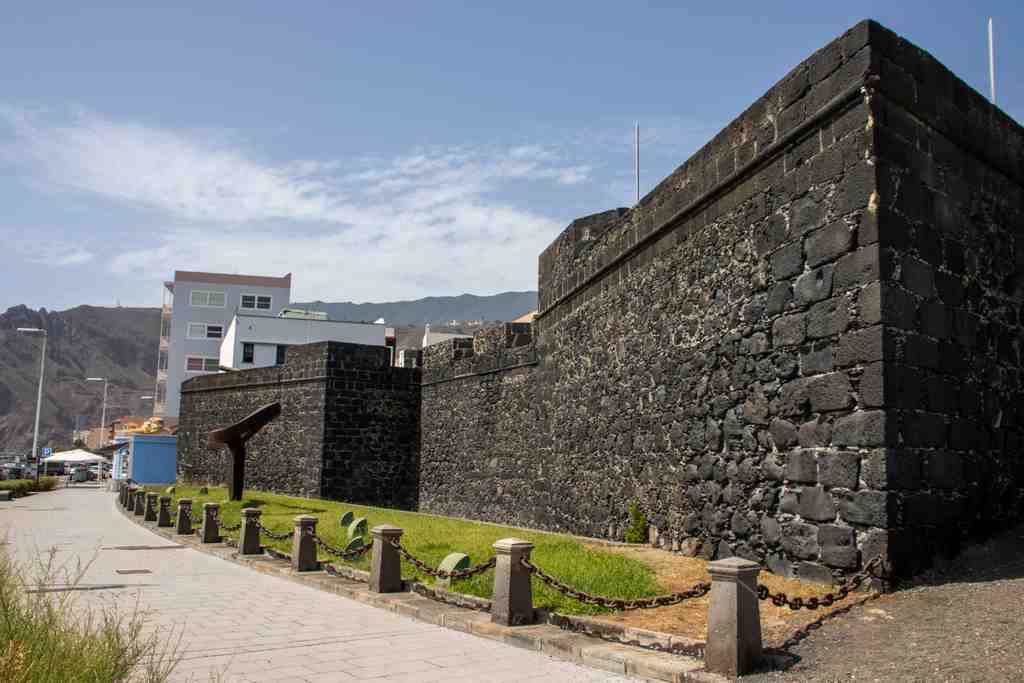
To spot the Castillo de Santa Catalina, look to your left for an impressive stone fortress with thick, dark walls topped by triangular bastions-its sturdy, square shape stands just behind the street, guarding over the coast like a silent sentinel.
Go ahead and take it all in: imagine the salty Atlantic breeze brushing your face as you stand before these enduring stone walls-a place that has witnessed more than its fair share of adventure, drama, and just a little bit of pirate trouble! That’s right, this fortress came to life in the aftermath of a pirate attack. Back on July 21, 1553, French pirates stormed the city. Now, I wasn’t there, but I think we can imagine the chaos-shouts, clanging swords, maybe a few curses in French. The result? The citizens decided to seriously level up their home defense, and between 1554 and 1560, they built the very first Castillo de Santa Catalina, hoping that the next time pirates showed up, they’d be met with more than just a “no soliciting” sign.
The original castle had an elliptical platform with a round tower, and in 1585, an expert named Leonardo Torriani swooped in to redraw its layout-clearly, castle makeovers were all the rage. But despite their best efforts, Mother Nature proved too fierce. By the mid-1660s, constant ocean storms and fierce rains from the Barranco de Las Nieves overflowed, slowly eating away at its foundations until, by the late 1670s, the old castle was nothing but a memory-one big pile of unhappy stones.
Now, here’s where the drama really spices things up! In 1683, the city got new land, and between 1685 and 1692, this current castle rose- funded first with 30,000 silver reales from residents who probably checked their couches for change, and the rest from the island’s government. This version took inspiration from Italian military Renaissance style: picture thick, quadrangular walls, triangular bastions on every corner, a moat that you’d have to cross on a wooden bridge (watch your step!), and even a house for the governor inside! This castle wasn’t just a looker; it was fully kitted out-warehouse, dungeons (for bad guys and maybe the odd grumpy in-law), a weapons room, and a powder magazine.
Oh, and it doubled as the town’s prison. One especially famous guest was a lawyer named Anselmo Pérez de Brito. I bet he wished he could lawyer his way out of this one. The castle became the city’s main defense and looked a lot like the no-longer-standing Castle of San Cristóbal in Tenerife. There was a permanent guard until 1808, after which the castle’s military life came to a slow, creaky halt.
Fast-forward to 1949-this fortress was almost set for demolition! Yes, a group of merchants bought the castle at auction for 300,000 pesetas, hoping to put up modern houses. Just as the wrecking ball was warming up, the Spanish government swooped in with a decree to save Spanish castles-talk about a dramatic rescue! By 1951, it was officially protected as a Historic Monument, and today, it’s the only surviving Habsburg-era fortress in all the Canary Islands.
In front of the castle, you’ll spot ‘El Alisio’, a striking sculpture made by Martín Chirino, installed in 1999 and restored just a few years ago. The trade winds still whistle through here-if you listen closely, you might hear the echoes of guards’ footsteps on the stone, the clatter of the drawbridge, and the waves below.
So, next time someone brings up pirate attacks, you’ll have the perfect story-and the perfect castle-to show them!




