
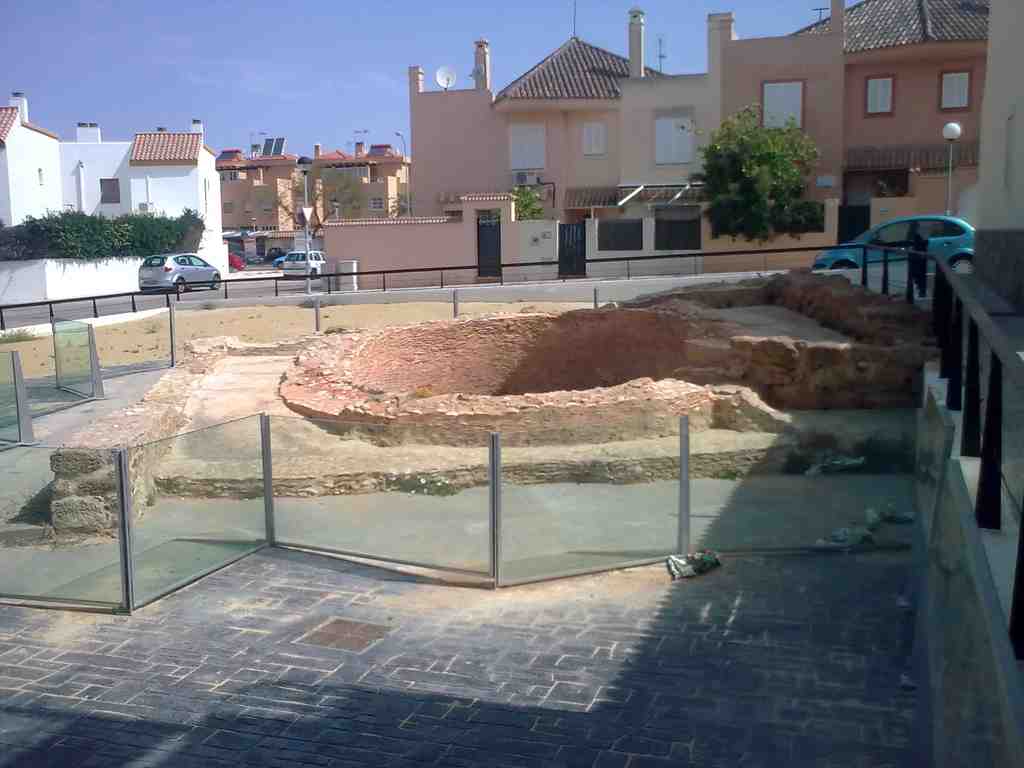
To spot the Horno Romano de El Gallinero, look for the round, brick ruins surrounded by low glass panels just below street level, sitting right in the middle of a modern residential area-it almost looks like an ancient pizza oven had a bit too much fun and decided to settle in the middle of Puerto Real!
Now, as you’re standing here and taking in these ancient remains, let’s imagine the scene nearly two thousand years ago. Forget the parked cars and modern homes for a second-picture yourself swept back to the first century AD. Instead of quiet residential streets, this area would have been alive with the thud of clay, the crackle of fire, and perhaps the occasional shout from a Roman potter who, let’s be honest, was probably complaining about the heat!
This circular structure you’re looking at is the belly of Puerto Real’s ancient industry. The Horno Romano de El Gallinero is a Roman kiln, what you could call the “factory outlet” of its day, churning out essential ceramic pieces-mainly amphorae, those classic big jars you might picture carrying olives or fish pastes across the Roman Empire. With a diameter of four and a half meters, this was no tiny backyard oven; it was big enough to bake pottery for an empire hungry for salted fish and other delicacies from Cádiz!
But the story of this kiln is a little like a detective mystery. It first came to light thanks to the sharp eyes of an archaeologist, M. Ponsich, who noticed something curious while houses were going up in this new part of town. Every new discovery-whether bits of broken pottery, old graffiti scratched onto ancient pots, or evidence of a second, similar kiln (sadly now mostly destroyed)-added another clue about how bustling and important this area was. Pottery sherds scattered across the site told stories of discarded vessels, failed experiments (hey, not even Romans got it right every time!), and the busy business of feeding the empire.
And while the potters were at work, the kiln was the heart of their world: Imagine the searing heat radiating from the praefurnium-basically the oven’s mouth-where wood was fed to stoke the flames. The pottery sat above the fire, supported by a central pillar and a series of stone arches, carefully designed to let the heat rise without letting the flames lick the clay. The potters would have worked quickly, braving the heat to stack their jars and amphorae just so, all while perhaps swapping a few jokes about “firing” their best friend if he cracked another batch.
It wasn’t all smooth sailing for our ancient kiln, though! Over the centuries, storms and stray winds battered it, and it was gradually buried and forgotten by time. When modern buildings sprang up, the kiln was rediscovered, sometimes threatened by new construction, but eventually celebrated for its historic worth. After a few rounds of cleaning, patching, and a well-deserved makeover, it was ready for its close-up, finally presented to the public in 2011-though sometimes the signage still struggles to keep up!
Standing here, you’re peering not just into a hole in the ground, but straight into the heart of ancient industry, invention, and the daily lives of people who might have been more like us than we think. Who would have thought a simple oven could survive so long, only to become a star in the 21st century? Now, that’s what I call being fired up for history!


