
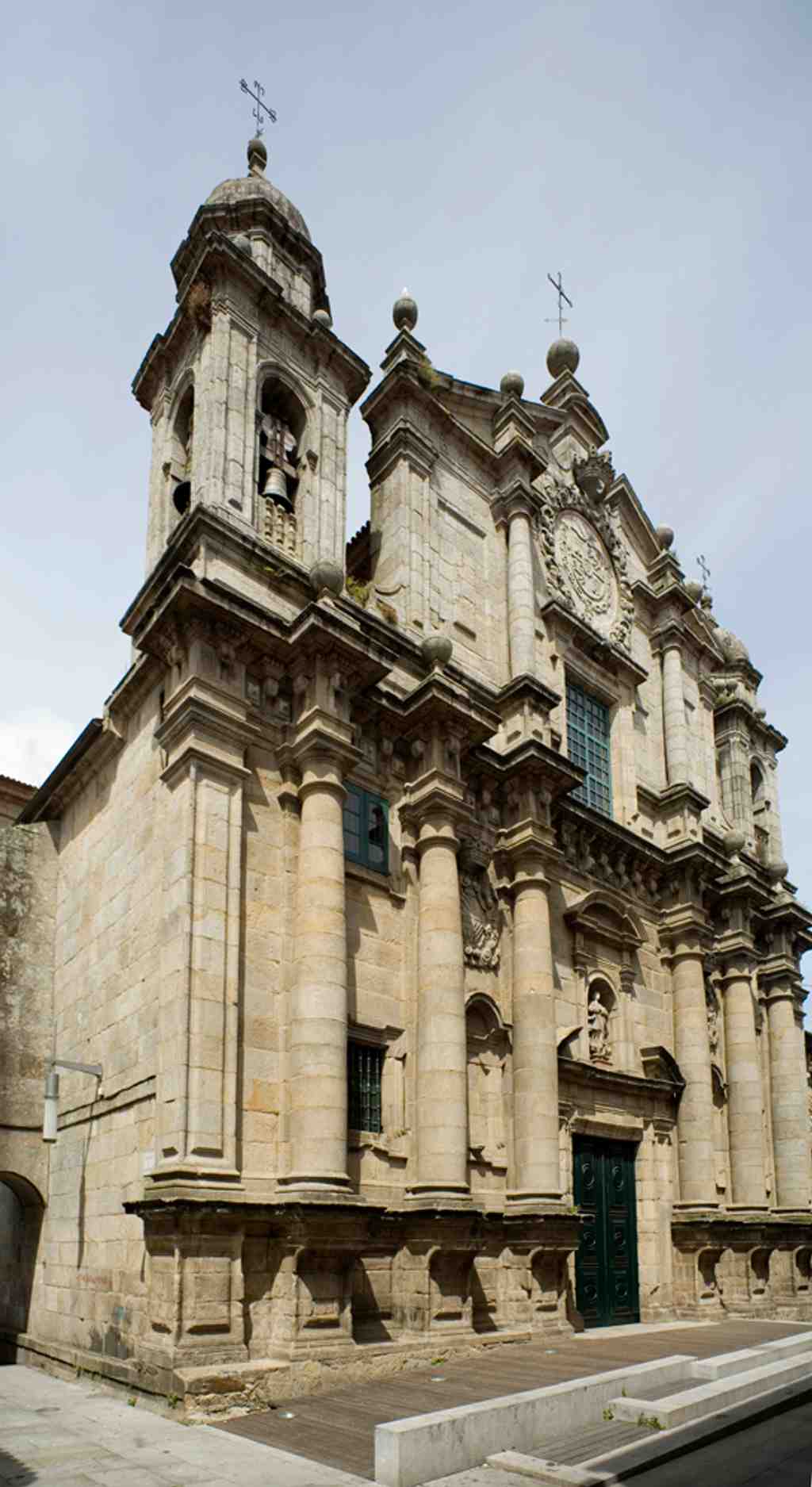
To spot St. Bartholomew's Church, just look ahead for an impressive stone façade with six grand Doric columns and two tall bell towers, rising above Sarmiento Street-the building is bold, symmetrical, and impossible to miss.
Now, take a good look at this majestic church and imagine stepping back through the centuries, when this was the newest, most Italian-looking building in all of Pontevedra-because, guess what, you’re standing before a slice of Italy right here in northwest Spain! Built between 1695 and 1714 for the Jesuits, this church was inspired by the famous Church of the Gesù in Rome. The Jesuits didn’t just bring their books and Bibles-they brought their full architectural flair! The grand design, with its rectangular outline and dramatic Latin cross shape, set a new standard: this was the arrival of International Baroque in Galicia, a true showstopper in a region that favored a different style.
If you listen closely, maybe you can hear the echoes of young Jesuit students bustling into the church from the college next door, which today is part of the Pontevedra Museum. For over one hundred years they prayed, debated, probably sneaked a laugh or two in the pews-until 1767, when the Jesuits were expelled from Spain. After that, the church’s story doesn’t end-it just changes hats. In 1836, it became the parish church, taking over from the older Saint Bartholomew’s, which was replaced by a rather less sacred... theatre. God moved out, and the actors moved in down the street!
Take in the dramatic façade with its twin bell towers and that upper pediment-it’s pure Jesuit Baroque. Look just above the door for the Pimentel family coat of arms, and above the old college entrance you’ll spot a mighty Spanish coat of arms. And in the heart of the church, among the three naves, a barrel vault, and fine sculptures, is perhaps the city’s most precious figure: the Virgen de la O, the beloved “Pregnant Virgin” who’s Pontevedra’s very own patron saint.
St. Bartholomew’s Church survived the Lisbon earthquake of 1755, though it did need a little architectural hug afterwards-extra buttresses were added to keep everything standing tall. So, whether you’re an architecture buff, a history lover, or just enjoy a good miracle or two, this church has something for everyone... and a few stories still echoing off those baroque walls.




