
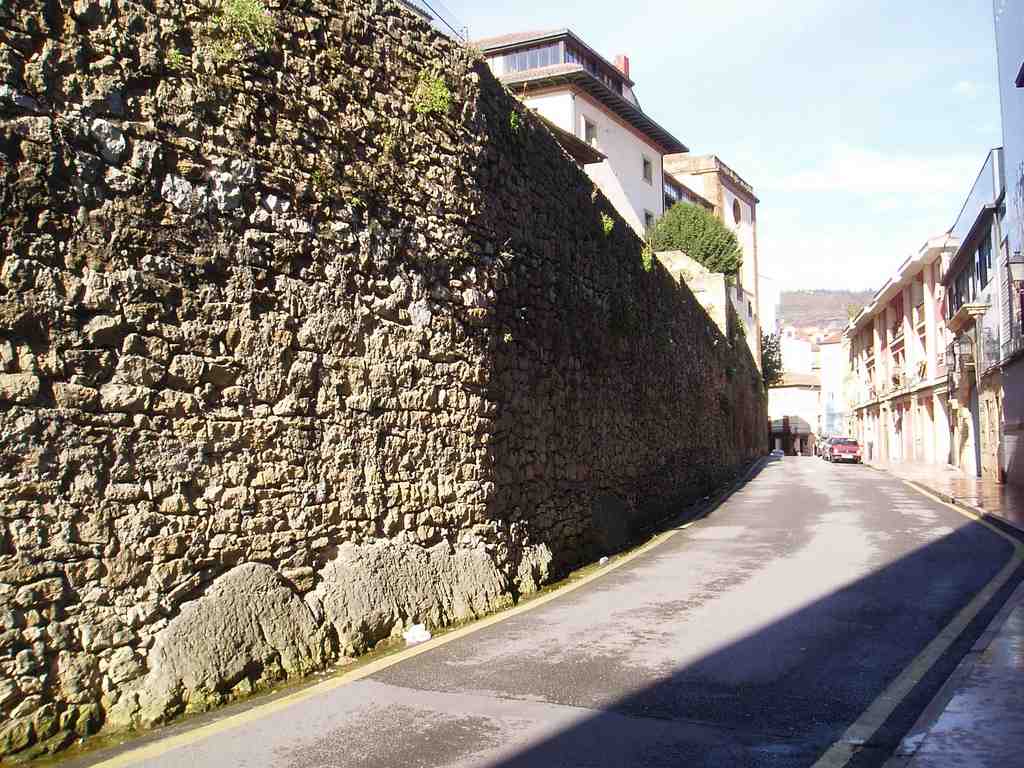
To spot the medieval wall of Oviedo, look for a long, rugged wall of weathered limestone blocks running along the left side of the quiet street-its rough, ancient stones and patches of greenery make it stand out from the modern buildings nearby.
Now, as you stand by this timeworn guardian of Oviedo, close your eyes for just a moment and imagine you’re back in the days of kings and monks. It’s the 9th century. King Alfonso II, nicknamed “the Chaste”-for reasons we shall not ask about-decides to move the kingdom’s capital to this very city. And what does every good king need, besides a crown and a scepter? A wall, of course! The air fills with the clanking of chisels and shouts of busy builders, as the very wall before you rises stone by stone, stretching in a great ring to protect the city’s precious monasteries and palaces, including the Monastery of San Vicente, the seed from which Oviedo would grow.
Not only was this wall tough-it was famous enough to appear in royal documents like the will of King Alfonso II, stored away in the Cathedral of San Salvador. Over the centuries, it saw drama fit for a soap opera: mighty kings made donations, queens handed over palaces, and knights surely strutted around talking about how impenetrable it was. But even walls can have their… ups and downs.
Flash-forward to 1258. Now it’s Alfonso X, known as “the Wise,” sitting on his throne. He looks at Oviedo and says, “Hmm, time for an upgrade!” And so, using Council funds for two-thirds and Church money for the last third, the city gets a brand new wall. This was no garden fence-imagine a wall 1,400 meters around, 4 meters high, and about two meters thick, built with two parallel layers of stone and a chunky center of rubble. It must have looked as if nothing short of a dragon could break through!
But time marches on quicker than a medieval tax collector. Even by the late 1400s, kings and queens were still collecting taxes to add new towers and gates. Soon, though, the city outgrew its old stone skin. By the 17th and 18th centuries, the wall was less about blocking invaders and more about blocking traffic. Houses, shops-even the new City Hall-were built right up against it, like kids clinging to their mother’s skirt! At the Monastery of San Pelayo, the monks were so practical, they just used bits of the old wall as part of their new buildings. Recycling, medieval style.
By the 1800s and 1900s, parts of the wall began to vanish. “Progress!” they shouted. “Room for new houses!” they cried. People were so busy growing the city that few cared when pieces disappeared-except, it seems, for the poor Tower of Gascona, which was demolished in 1963. For decades, the medieval wall was left to weeds and weather. It wasn’t until 1977 that folks said, “Hang on! We’re losing history!” and began preserving what was left, like this very stretch in front of you.
Today, some sections still cling to the city like memories to a storyteller: here at Calle Paraíso, at Plaza de Riego, and in scattered spots across streets and squares. Yes, the wall has seen better days, and sometimes the city squabbles over who should take care of it, but it remains protected as a National Monument-reminding us that even the sturdiest stones need a bit of love now and then.
So as you stand here, imagine centuries of footsteps, royal processions, and neighborhood gossip echoing through these ancient stones. And don’t forget: if these walls could talk, they’d probably ask for a little less moss and a little more admiration!




