
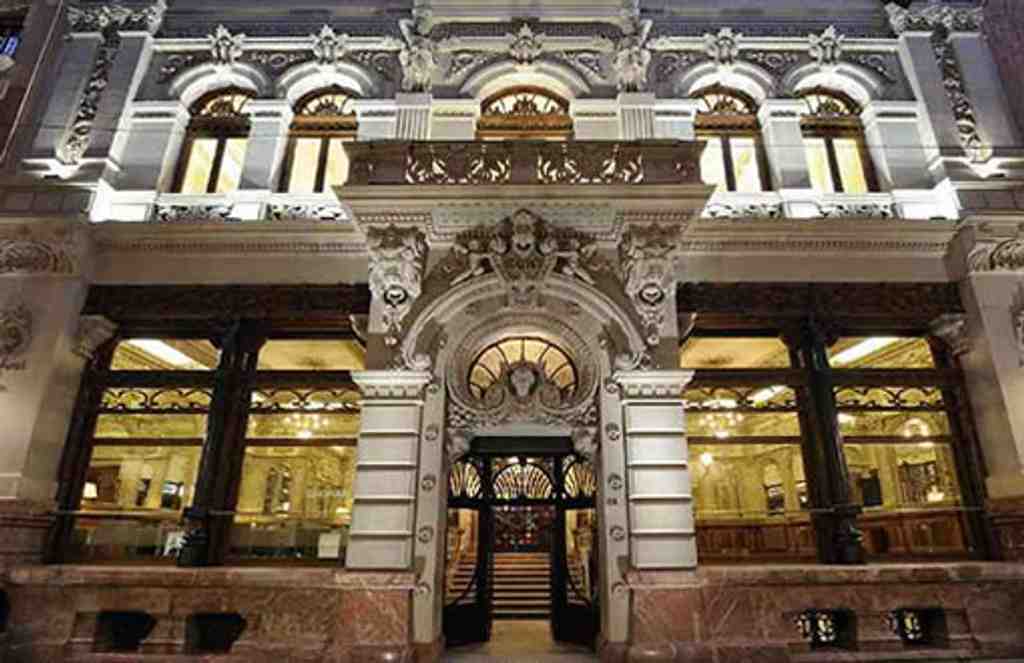
Look to your right for a striking facade of pale stone and stucco, featuring a deeply carved arched entrance flanked by wide glass windows and an intricately sculpted upper balcony. Welcome to the Real Casino de Murcia. And no, despite the name, no one is losing their life savings at a roulette wheel in there. In nineteenth-century Spain, a casino was a private social club for a city's wealthy bourgeoisie. Basically, it was a place to see, be seen, and aggressively show off how much money you had.
The original club started in eighteen forty-seven, but they moved to this spot in eighteen fifty-three and just kept adding to it for the next fifty years. What you are looking at is the nineteen hundred and two facade designed by Pedro Cerdán. It is a masterpiece of eclectic architecture, combining elements from multiple historical periods into one grand, unapologetic statement.
Notice those two large glass rooms flanking the main door. The locals affectionately call them the fishbowls. They were designed specifically so the elite could sit comfortably inside and watch the commoners walk by, while the commoners watched the elite sitting comfortably inside. A perfect ecosystem of judgment.
If you step through that door, the architectural flexing only intensifies. You immediately enter the Moorish Patio. It features a spectacular glass vault, the highest in the entire building, and the walls are covered in over twenty thousand sheets of gold leaf. An Arabic inscription wrapping around the room reads, Nothing greater than Allah. A bold decorative choice for a nineteenth-century Catholic Spanish gentlemen's club, but they clearly appreciated good design.
Beyond that, the building is a labyrinth of elaborate set pieces. There is a Pompeian courtyard from eighteen ninety-three, ringed by fourteen columns topped with Ionic capitals, the classic Greek architectural style with scroll-like designs at the top. In the center stands a sculpture of Venus. There is an English library completed in nineteen thirteen where the upper wooden gallery is held up by cast-iron brackets shaped like flamingos. Why flamingos? Because when you are incredibly wealthy in the early twentieth century, you do not have to explain your interior design choices to anyone.
But the absolute peak of this place is the neo-baroque ballroom from eighteen seventy-five. It is a massive, double-height space dripping in excess. Hanging from the ceiling are five chandeliers imported from Paris in eighteen eighty-six. They are made of gold-plated bronze and adorned with precisely one thousand eight hundred pieces of crystal. The engineering required just to keep those ceilings from collapsing under the weight of all that French glass is impressive in its own right.
After falling into disrepair, the building underwent a massive restoration completed in two thousand and nine, earning the title of Royal Casino from King Juan Carlos the First. Today, it is the most visited civil building in the region, drawing over one hundred and fifty thousand people in organized groups alone every year. If you want to check out the fishbowls and chandeliers for yourself, the building is open to visitors every day from ten thirty A-M to seven P-M.
Take your time admiring the sheer architectural confidence of this historic facade. Whenever you are ready to move on, our next stop is waiting.




