
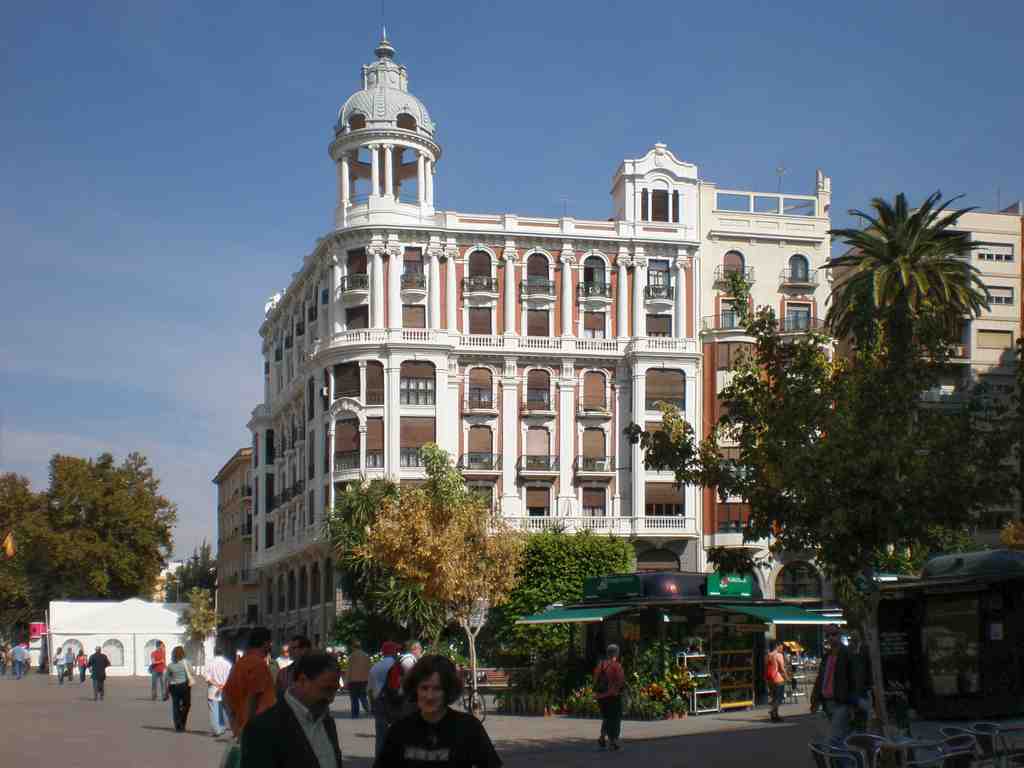
Look to your left for a towering building with a striking red brick and white stone facade, anchored by a prominent cylindrical corner tower topped with a rounded dome.
That eye-catching structure is Casa Cerdá, completed in nineteen thirty-six, and it serves as the perfect introduction to Plaza de Santo Domingo. For centuries, this space was simply called the Market Square, sitting just outside the old city walls.
It was the commercial heart of Murcia. Back in twelve seventy-two, King Alfonso the Tenth of Castile officially designated this exact spot for the Thursday market. Two hundred years later, in fourteen seventy-six, Queen Isabella the First of Castile granted this market the exclusive right to sell salt. Controlling the salt trade in the fifteenth century was essentially a license to print money, as it was the primary way to preserve food before refrigeration.
Because it was the busiest spot in town, it naturally became the place for public spectacle. In fourteen eleven, Saint Vicente Ferrer visited Murcia to preach to the masses. To ensure absolutely everyone could see him, a special stone balcony was built onto the side of the nearby Church of Santo Domingo. It is a completely fake balcony. It connects to nothing inside the church and is accessible only from the outside, designed solely as an architectural prop for a very loud saint.
Of course, not all public spectacles here were quite so holy. The square also served as the city's premier venue for public executions. In eighteen twenty-four, a notorious local bandit named Jaime el Barbudo, or James the Bearded, met his end right where you are standing. He was hanged for his extensive career in robbery and murder, providing a grim afternoon of entertainment for the local shoppers.
Eventually, the city decided to clean up the square's bloody image. Take a look at the enormous, sprawling tree anchoring the plaza. That is a giant ficus, planted in eighteen ninety-three. It has survived over a century of urban chaos, including the Spanish Civil War, when the ground directly beneath its massive roots was hollowed out to build an underground air raid shelter.
Speaking of trees, somewhere in the flowerbeds nearby is a bronze bust of a man named Ricardo Codorníu, placed there in nineteen twenty-six. He was an engineer, affectionately known as the Apostle of the Tree. At the end of the nineteenth century, Murcia suffered from catastrophic flash floods because the surrounding mountains had been entirely stripped of vegetation. Codorníu figured out that the best flood defense system was not a concrete dam, but a massive reforestation project. He successfully replanted the mountains, using complex root systems to stabilize the soil and absorb the torrential rains. It was an incredibly elegant piece of environmental engineering that saved the city from washing away.
In nineteen ninety-eight, the city completely remodeled this space, filling in the old military bunker and turning the whole plaza into a pedestrian haven. Today, it is a much quieter place. No bandits, no fake balconies in use, just clever engineering and some very old shade.




